A historical comparison of copyright and industrial-property offences, with distinct treatment of statutory conduct, quantitative criteria and commercial legal entities.
Intellectual property offences changed significantly between Vietnam’s 1999 Criminal Code and the 2015 Criminal Code as amended. The comparison requires more than matching article numbers: the protected subject, prohibited conduct, criminal thresholds and potential offender must be considered separately. This article explains the principal differences while distinguishing a historical comparison from the legal assessment required for conduct occurring at a particular time.
The 1999 Code was itself amended. Law 37/2009/QH12, effective from 1 January 2010, introduced Article 170a on copyright and related rights, amended Article 171 on industrial property rights, and repealed the earlier Article 131. A comparison that calls Article 170a part of the unchanged original 1999 text misses that legislative development.
The 2015 Code, amended in 2017, took effect on 1 January 2018. Its principal provisions for this comparison are Articles 225 and 226, together with the rules on commercial legal entities. Later amendments also need to be checked for a present-day assessment; the 2025 consolidated Code is a useful official reference rather than relying on the original 2015 wording alone.
The date of conduct matters. An offence label in an old article is not enough to decide which provision applies to a later incident. Criminal-law rules on time and the application of more favourable provisions require their own assessment. The publication date of a legal commentary does not determine the applicable law.
| Question | 1999 framework as amended in 2009 | 2015 framework as amended |
|---|---|---|
| Copyright and related rights | Article 170a addressed the specified copying and public-distribution conduct at commercial scale. | Article 225 retains specified conduct and includes commercial scale and defined quantitative alternatives. |
| Industrial property | Amended Article 171 concerned intentional infringement of protected trademarks or geographical indications at commercial scale. | Article 226 specifies counterfeit trademark or geographical-indication goods and its criminal criteria. |
| Commercial legal entities | The earlier framework did not provide the later corporate criminal-liability regime. | Articles 75 and 76 operate with the specific corporate provisions in Articles 225 and 226. |
| Assessment | The wording applicable at the relevant historical time must be identified. | Individual and corporate conditions and penalty provisions must be assessed separately. |
These differences in intellectual property offences should not be read as a statement that every infringement became criminal after 2018. The statutory conduct, fault and other required elements still have to be established. A dispute about ownership or a licence is not automatically proof of an offence.
Article 170a introduced by the 2009 amendment referred to copying works, phonograms or video recordings and distributing copies to the public without permission, infringing rights protected in Vietnam at commercial scale. Article 225 of the later Code addresses the specified copying and distribution conduct with its own requirements, including intent.
The important distinction is between an infringement under intellectual-property law and the particular criminal provision. Copyright includes several rights, but it does not follow that every breach of any one of them falls within Article 225. Identify the material copied or distributed, the protected rights, the relevant authorization and the person responsible for the conduct.
For example, a disagreement over the price payable under a valid licence raises different questions from deliberate unauthorized reproduction. The evidence must explain what permission existed and whether the conduct exceeded or lacked that permission. The existence of an unpaid invoice alone should not be used to shortcut the criminal analysis.
Amended Article 171 of the earlier Code referred to intentional infringement involving protected trademarks or geographical indications at commercial scale. Article 226 of the later Code expressly describes the relevant subject as goods bearing counterfeit trademarks or geographical indications, alongside its other requirements.
This does not make Article 226 a general criminal provision for all patents, designs, trade secrets and other industrial-property interests. Nor is every dispute involving a similar sign automatically a counterfeit-goods case. The sign, goods, protected right and applicable legal definition need to be examined.
The earlier Code also contained Article 170 concerning violations of rules on granting industrial-property protection titles. The later Code does not retain that separate offence under the same structure. Its absence should not be interpreted as permission for wrongdoing in public administration; any conduct must be assessed against the provisions actually applicable to it.
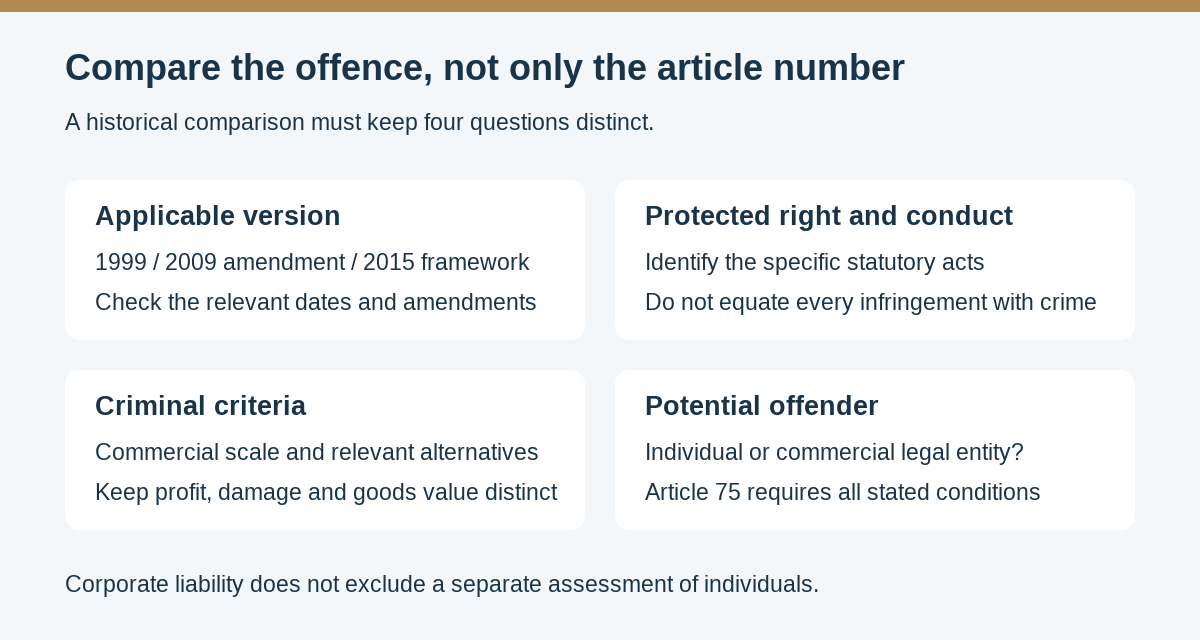
The later provisions add express alternatives based on unlawful profit, harm to the rights holder or the value of infringing goods, alongside commercial scale. The concepts are different. Sales revenue is not automatically unlawful profit, and an owner’s estimate of lost sales is not automatically the legally established damage figure.
For an individual under the basic form of Article 225, the current consolidated wording includes unlawful profit from VND 50 million to below VND 300 million, or the specified damage or goods-value ranges starting at VND 100 million. Article 226 uses different starting figures for its basic individual provision: VND 100 million for unlawful profit and VND 200 million for the specified damage or goods-value ranges.
These examples do not replace the full provisions. Higher values and other circumstances can engage a different paragraph, while commercial scale is an alternative requiring its own assessment. The corporate paragraphs contain their own criteria, including specified situations involving earlier sanctions or convictions. Do not apply an individual threshold mechanically to a company.
When reviewing intellectual property offences, preserve the source records behind every financial figure. Relevant evidence may include transaction records, quantities, costs, valuation material and information about the rights actually exploited. A spreadsheet should show how a figure was calculated, not merely attach a criminal label to a large total.
A major change is the availability of criminal liability for commercial legal entities in the specified offences. Article 76 includes Articles 225 and 226. However, Article 75 requires all of its stated conditions, not any one condition chosen from a list.
Replacing “all” with “or” materially changes the rule. An employee’s involvement does not by itself establish every condition for corporate criminal liability. Conversely, a company cannot assume that a formal instruction was unnecessary evidence merely because several people were involved. The actual decision-making and authorization records matter.
Consider a fictional business where unauthorized copies are distributed through a commercial operation. The review should identify who decided on the copying, in whose name it occurred, who benefited and whether the required corporate direction or approval is established. Those questions are separate from whether the copied material is protected and whether the offence’s other elements are met.
Article 75 also states that corporate criminal liability does not exclude an individual’s criminal liability. This is not automatic liability for every director or employee; each person’s conduct and the applicable requirements need assessment. Corporate status and job title should not substitute for evidence.
The later provisions distinguish sanctions for individuals from those for commercial legal entities. Depending on the relevant paragraph, individual penalties can include fines, non-custodial reform or imprisonment, with possible additional restrictions. Corporate provisions include their own fines and, in specified aggravated cases, temporary suspension, as well as additional measures.
A comparison should therefore identify the offender category and the exact paragraph before quoting a penalty range. The highest figure in an article is not the standard penalty for every infringement. Likewise, the availability of a financial penalty does not mean every case can be resolved simply by paying an amount proposed privately.
The historical and later sanction structures differ, but the appropriate result in an actual case depends on the proven facts and applicable law. This article does not treat numerical thresholds as a substitute for proving the remaining elements or the relevant procedural requirements.
An intellectual-property dispute can require examination of civil remedies, administrative action or other lawful measures even where criminal liability has not been established. Equally, the fact that the parties are discussing compensation does not automatically dispose of every criminal-law issue. The available route depends on the conduct, evidence and applicable procedure.
Preserve the protected work or registration records, relevant licences, transaction evidence and a reliable chronology. Avoid altering files, destroying stock records or pressuring witnesses. If ownership or authorization is disputed, identify that dispute clearly rather than presenting it as already resolved.
A company assessing intellectual property offences should distinguish a factual investigation from a conclusion about guilt. Record what is established, what is alleged and which evidence is missing. A responsible review can identify a serious issue without promising a prosecution or asserting that an accusation proves the offence.
Before a discussion with Jurion & Partners, organize the relevant dates, rights documents, alleged conduct and financial records. State whether the concern is historical interpretation, a current allegation or a corporate compliance review. Those distinctions help identify the legal questions that actually need answering.
The guide to legal due diligence in Vietnam helps organize ownership, licensing and authority records for a business review. Comparing intellectual property offences across the two Codes is useful when it leads to the correct legal version, a precise account of the conduct and a separate assessment of each required element.






Subscribe today to get more breaking news from Jurion Partners - Solicitors & Litigators

108 Tran Dinh Xu St., Cau Ong Lanh Ward, Ho Chi Minh City, Vietnam
(+8428) 66.701.709 - (+84) 903.419.479
contact@jurionpartners.com
Follow us
Accept payment





 English
 Tiếng Việt