Legal due diligence is the process of collecting, understanding and assessing all the legal risks associated during a M&A process. During due diligence, the acquirer reviews all the documents pertaining to a target company
Legal due diligence in Vietnam helps an investor understand the rights, obligations and unresolved issues attached to a proposed transaction. The review should support a decision: whether to proceed, what must change before completion and which risks require contractual protection. It is not simply a collection of corporate certificates, nor a promise that every future problem can be discovered. A useful assignment connects the proposed acquisition with the target's actual operations and records the evidence supporting each material finding.
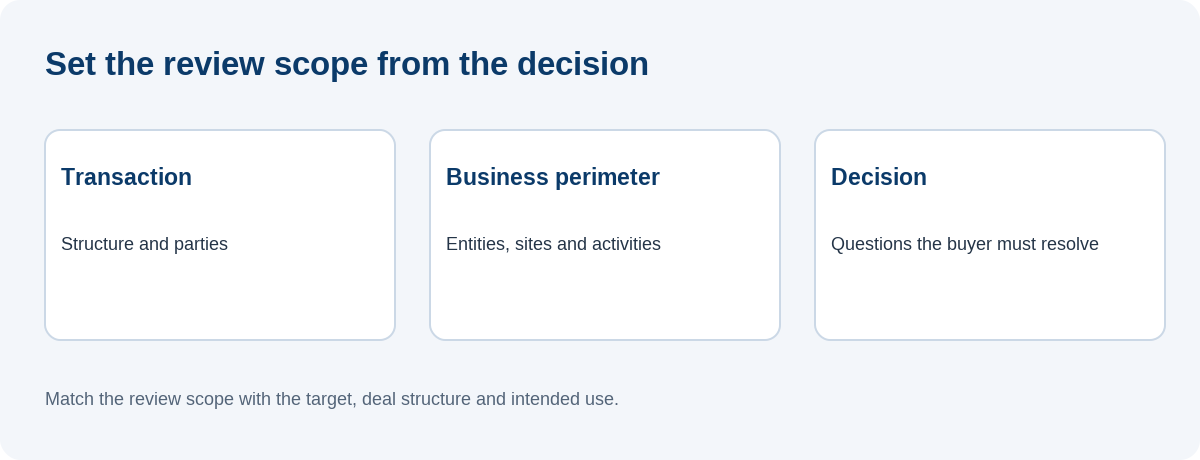
Start with the transaction structure. Buying shares, subscribing for newly issued capital and acquiring selected assets expose the buyer to different issues. Identify the purchaser, the target, the business being acquired and the expected timetable. A minority investor concerned with governance may need a different emphasis from a buyer taking operational control. The document request should follow those priorities rather than reproduce every item from an unrelated deal.
The wider guide to investment in Vietnam provides the market-entry context. Due diligence then examines the particular company and transaction. Agree which entities, periods, sites and legal topics are covered, how materiality is assessed and what information will be excluded. Financial, tax, technical and environmental specialists may need separate instructions. Legal advisers should explain how their work interacts with those reviews without claiming to replace them.
Review the enterprise registration records, charter, ownership registers and relevant changes. Reconcile the stated capital with contribution evidence and the rights being sold or issued. Identify restrictions, approvals and competing claims that may affect the transaction. A current certificate does not necessarily explain the history of an earlier capital change, the authority behind a transfer or an unresolved obligation to contribute capital.
Vietnam's beneficial-ownership rules have developed through the 2025 enterprise-law changes and subsequent implementing amendments, including Decree 296/2026. Assess the applicable criteria and filing position for the target, rather than relying on a shareholder chart alone. The Ministry of Finance's September 2026 explanation also distinguishes the amended criteria from an assumed universal ten-day refiling obligation. A missing record should be analysed against the actual requirement and transition rules.
Identify who can approve and sign the transaction, which internal resolutions are needed and whether existing owners have relevant rights. Review the charter and shareholder arrangements together. If the seller is a holding company, obtain evidence showing its right to dispose of the interest. Avoid treating a management assurance that “all shareholders agree” as a substitute for the required approval record and signatures.
Legal due diligence in Vietnam should compare the target's activities, locations and operating model with its registrations, licences and applicable conditions. Ask the operating team how services are delivered and where revenue arises. The registered business description may not capture a new product, an additional site or work performed by an affiliate. A licence list is useful only when it can be reconciled with the business the buyer expects to receive.
Check the law in force at the relevant date. Enacted changes are not always immediately effective: the Government's September 2026 explanation states that Law 24/2026 amending the investment framework takes effect on 1 March 2027. Do not present a future change as a current exemption. The review should separate current compliance, transitional treatment and changes that may affect operations after completion.
Foreign-investment review, enterprise registration, sector permissions and competition notification address different questions. Passing one does not establish that the others are unnecessary. Determine which requirements are triggered by the actual parties, business and transaction. Competition thresholds and criteria should be checked against current rules, including the relevant treatment of financial-sector businesses, instead of being copied from an old transaction checklist.
For a site-dependent business, assess the legal basis for using the premises and the relationship between the lease, land records and project documents. Identify expiry, renewal, assignment and change-of-control issues. If the target has constructed or altered facilities, coordinate review of the relevant permissions and records. A photograph of an operating factory does not establish that its entire footprint can lawfully be used as planned.
Distinguish assets owned by the target from assets leased, financed, licensed or supplied by a group company. Check security interests and contractual restrictions relevant to the proposed structure. An asset schedule should identify the actual rights that will remain with the business after completion. Where a technical inspection or valuation is needed, record that dependency instead of treating the legal document review as proof of condition or market value.
Prioritise agreements essential to revenue, supply and operation. Examine duration, termination, assignment, change of control, exclusivity, payment obligations and unresolved defaults. The question is not merely whether the contracts were signed correctly: the buyer needs to know whether the expected business can continue after the transaction. Obtain schedules of variations and side arrangements so that the review does not stop at an outdated original agreement.
A customer contract may look profitable while invoices remain disputed or services have expanded without an agreed price. Ask for the correspondence that explains those differences. Compare management's account with acceptance records, claims and relevant payment information. If only selected extracts are available, identify that limitation. A review based on a favourable summary should not be described as verification of the full contractual relationship.
For employees, examine contracts, workplace rules, key benefits and identified disputes in the agreed scope. Consider whether the transaction changes the employing entity or creates a restructuring question. Review the status of foreign personnel where relevant. A senior employee's willingness to stay is a commercial fact to confirm separately from the legal rights and obligations governing the employment relationship.
Identify intellectual property that the business depends on and the evidence of ownership or licensed use. Software created by a contractor, a brand registered by a founder and a platform account held by an affiliate can raise different continuity problems. Assess confidentiality and personal-data handling in the context of the actual systems and processing. Access to the data room itself should be controlled so that diligence does not become an uncontrolled disclosure of sensitive information.
Legal due diligence in Vietnam should consider notified claims, litigation, arbitration, administrative matters and other potential obligations within the agreed scope. Request supporting documents rather than a single statement that there are no material disputes. Compare the claim, procedural stage and available response. A case summary prepared before a significant hearing may no longer support the assessment management is presenting today.
Coordinate with financial and tax advisers where legal issues affect provisions, guarantees or the proposed price. Legal review can identify the basis of a liability or a missing approval, but it does not automatically calculate the economic consequence. Record where an amount depends on specialist analysis or incomplete evidence. The buyer can then decide whether to request further work, negotiate protection or change the transaction.
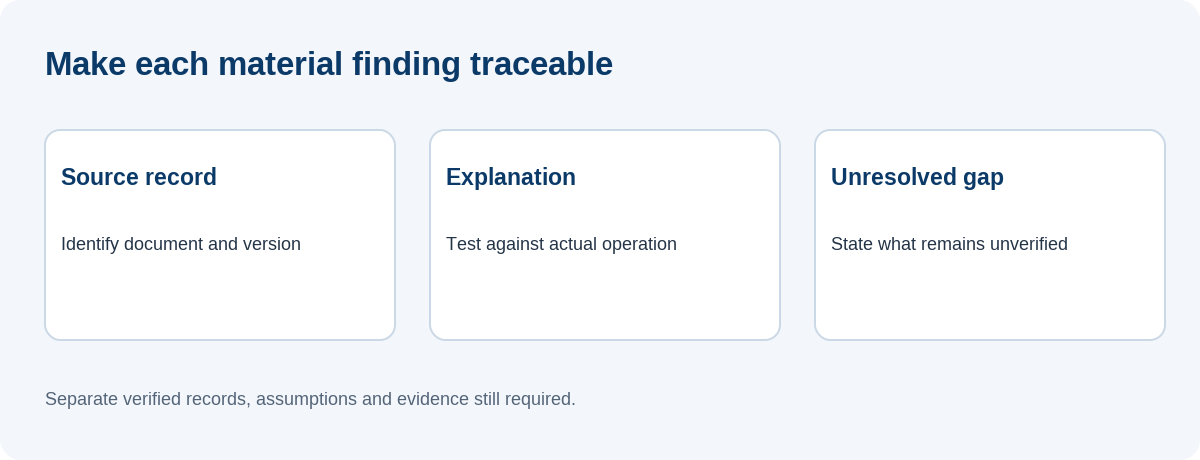
Use a document index, version dates and a question log. Separate documents received from questions answered and issues actually resolved. A management response may explain a gap without proving it has been corrected. Track follow-up evidence and identify the person responsible for providing it. If the seller replaces a document, retain the version history where appropriate so that findings can be understood against the material available at the time.
Interviews help explain how the business operates and where documents may be missing. Prepare questions around specific inconsistencies and confirm important answers in the agreed manner. An informal statement from an employee may not represent the company's authorised position. If a material fact cannot be verified, the report should say so and explain its significance for the decision instead of silently assuming the most favourable answer.
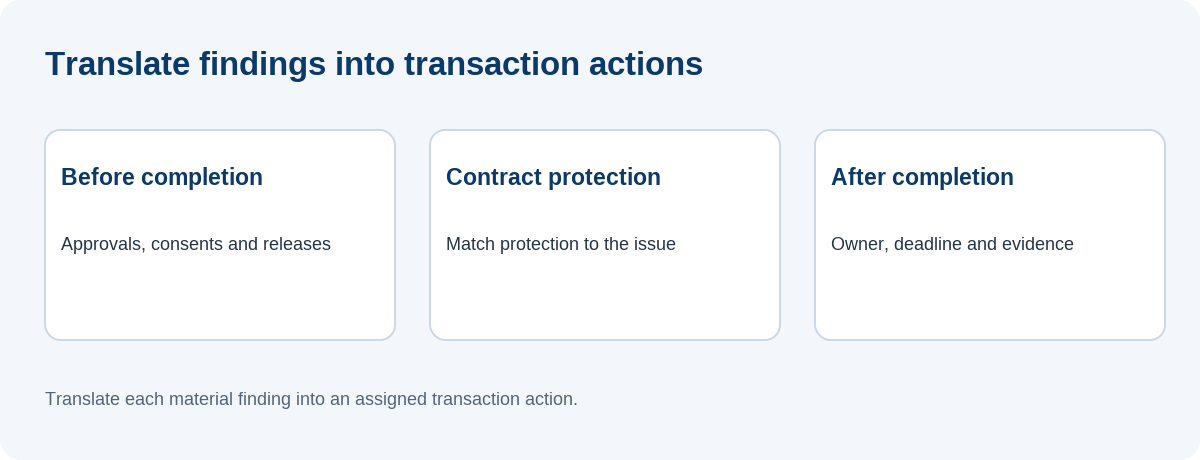
A practical report identifies the issue, evidence, significance and proposed response. Distinguish an obstacle to the proposed structure from a remediable document gap or a risk the buyer may choose to accept. Priority should reflect the transaction, not simply the number of pages devoted to an issue. Missing operating rights may matter more than several minor defects in routine records.
These responses need negotiation and enforceable drafting; their inclusion in a report does not mean the seller has agreed to them. A warranty is also not a substitute for a permission that the business must actually hold. Check that the proposed protection addresses the finding and that its practical value has been considered, including the identity and capacity of the party responsible for it.
The engagement should explain whether the output is a red-flag report, a fuller review or another defined deliverable, together with scope, assumptions and reliance arrangements. Legal opinions are not universally required from both parties' advisers in every acquisition. If an opinion is required by the transaction documents or another applicable requirement, its subject, qualifications and timing need separate agreement.
Before completion, update material findings for changes occurring after the review cut-off. Confirm whether required actions have actually been completed and preserve evidence for the handover team. To discuss an assignment with Jurion & Partners, prepare the proposed structure, business description and decisions the review must support. Those inputs allow the parties to agree a proportionate scope and identify specialist work early.
Legal due diligence in Vietnam is most valuable when it links reliable evidence to the investor's actual decision and the steps needed to implement it. Define the scope, investigate material gaps and translate findings into clear transaction actions. A well-managed review helps the buyer understand both the opportunities and limitations of the available information, rather than presenting document collection as a guarantee against every future risk.






Subscribe today to get more breaking news from Jurion Partners - Solicitors & Litigators

108 Tran Dinh Xu St., Cau Ong Lanh Ward, Ho Chi Minh City, Vietnam
(+8428) 66.701.709 - (+84) 903.419.479
contact@jurionpartners.com
Follow us
Accept payment





 English
 Tiếng Việt