Understand the practical value and limits of an acquisition legal review, including transaction scope, valuation assumptions, negotiations and completion dependencies.
The importance of legal due diligence in an M&A transaction lies in testing whether the business being offered can deliver the value the buyer expects. Accounts and presentations may describe attractive revenue, assets and growth opportunities, but the underlying legal rights and obligations can change their significance. A focused review helps the investor understand what it is acquiring, which assumptions need revision and what must be resolved before it commits to the deal.
A useful review does more than assemble a list of missing documents. It explains how the target's ownership, contracts, permissions, workforce and disputes affect the proposed investment. The result should help decision makers distinguish an acceptable administrative issue from a problem that threatens the commercial reason for buying the business.
This distinction matters because acquisitions rarely offer perfect information. A buyer has to decide which uncertainty can be reduced through further evidence, which exposure can be accepted with an appropriate response, and which matter makes the transaction unsuitable. The legal investigation provides a disciplined basis for that judgment rather than a guarantee that nothing will go wrong.
The business described in negotiations may be wider than the legal entities or assets being sold. A group presentation can include operations owned by affiliates, premises used under a founder's arrangement or intellectual property licensed from another entity. Unless the transaction perimeter is clear, the buyer may value benefits it will not acquire.
Legal review traces the material interests and rights to their holders. It asks whether the seller owns the interest it proposes to transfer and whether the relevant business assets sit within the target. Where a valuable right is outside the transaction, the parties can identify the additional arrangement needed instead of discovering the omission after payment.
It also clarifies the rights attached to the proposed investment. Buying a minority interest, acquiring all existing shares and purchasing selected assets have different consequences. Understanding those differences helps the buyer align its expectations about control, participation and business continuity with the structure actually available.
Valuation depends on assumptions about future income, costs and the continued availability of important resources. A legal finding can change those assumptions without appearing as an obvious liability in the accounts. For example, a valuable contract may be terminable sooner than expected, or a right used by the business may require renewal on uncertain terms.
The legal team should explain the factual issue and its implications, while financial and other specialists assess the appropriate adjustment to the model. This cooperation is more useful than asking counsel to assign a speculative monetary amount to every legal concern. Some exposures have a reasonably identifiable corrective cost; others affect whether the business model works at all.
A lower price is not always the right answer. If a problem prevents the target from carrying on its essential activity lawfully, a discount does not restore that ability. Conversely, a documented and manageable correction may not justify abandoning an otherwise sound investment. The review supports a proportionate response.
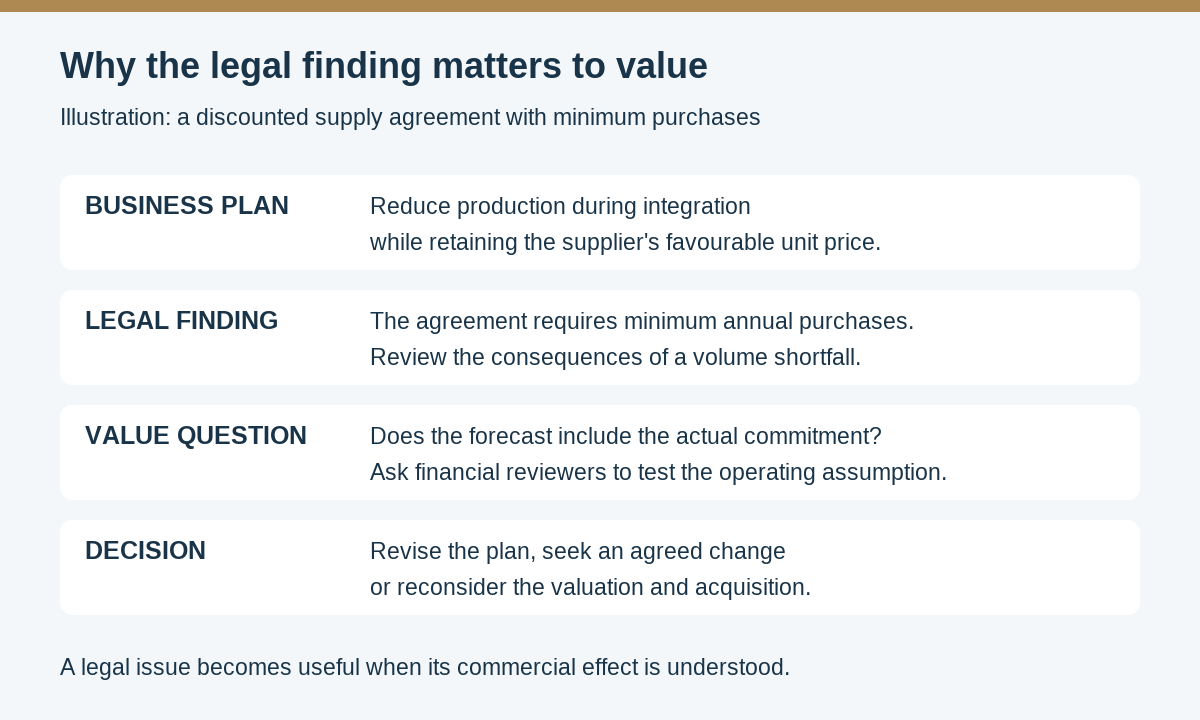
Consider a manufacturer valued partly on a long-term supply agreement offering favourable unit prices. The management presentation highlights the discount, but the contract also requires minimum annual purchases and restricts cancellation. The buyer's business plan assumes that production can be reduced during integration.
Reading the contract may show that the expected saving depends on volumes the buyer does not intend to maintain. The legal finding should identify the minimum commitment, the consequences of a shortfall and any available adjustment or exit route. Financial reviewers can then test the actual cost of the planned operating model.
The importance of legal due diligence in this example is its ability to connect an overlooked obligation with a specific investment assumption. The finding does not automatically make the deal bad. It gives the team a concrete question to resolve through a revised plan, an agreed contractual change or a different valuation.
Negotiations are more productive when the parties can discuss a defined problem supported by evidence. A general request for “full protection” may lead to competing standard clauses. Identifying the particular consent, ownership gap or historical exposure allows the parties to consider a response that addresses the actual risk.
Possible responses include corrective action before completion, a change in structure, a price adjustment, a specific contractual allocation or a decision not to proceed. Their suitability depends on the issue, applicable law and the seller's ability to perform. A contractual promise cannot itself waive a mandatory legal requirement or bind an outside creditor who has not accepted the arrangement.
Clarity also benefits the seller. An issue raised precisely can be answered with the relevant document or explanation, rather than becoming an indefinite negotiating concern. Where the parties disagree about its significance, the evidence and commercial effect provide a basis for resolving that disagreement.
A signed agreement is only one part of the transaction. The parties may still need approvals, contractual consents, releases, payment arrangements and registration steps. A review that identifies these dependencies early helps the team build a credible timetable and allocate responsibility.
It can also expose operational dependencies that survive completion. Access to essential records, a transition service, renewal of a permission or continued support from a key counterparty may be necessary for the buyer's plan. These matters should be understood before the transaction team treats integration as ready to begin.
The resulting action list should distinguish requirements before signing, requirements before completion and tasks that may lawfully follow afterwards. That timing matters: something essential to lawful implementation cannot simply be placed on a later housekeeping list because the parties want to close quickly.
A seller can review its own position before inviting buyers to investigate. This may reveal inconsistent ownership records, incomplete amendments, unclear rights or documentation that takes time to retrieve. Addressing these matters early can make the sale process more orderly and reduce avoidable interruptions.
Preparation should improve the reliability of disclosure, not conceal inconvenient information. Article 387 of the Civil Code addresses information affecting the other party's acceptance of a contract and confidentiality during formation, with compensation where breach causes damage. The statutory duties and the negotiated disclosure process need to be considered together.
A seller's review does not automatically replace the buyer's investigation. Its scope, assumptions, date and intended recipients may differ. The buyer should establish what it may rely on and what further work is necessary for its own structure and objectives.
Understanding the importance of legal due diligence includes understanding what it cannot prove. A report reflects the agreed scope, documents reviewed, enquiries made and information available at a stated date. It cannot certify the absence of every undisclosed fact or predict every later legal development.
Separate confirmed issues from information gaps. If the target has not supplied a particular record, the report should explain that limitation and its significance. It should neither assume compliance nor present an unverified suspicion as a proven violation. Public searches can supplement the investigation, but their scope and currency must also be understood.
Legal review does not replace accounting, tax, technical, environmental or commercial expertise. Nor does a lengthy report necessarily mean that the decisive questions have been answered. The buyer should ask how each material finding affects the investment and which unresolved assumptions remain in the decision.
Begin early enough for important findings to influence the deal. If the buyer commissions review only after fixing the structure and promising an immediate completion, opportunities to investigate or remedy a problem may be limited. Early screening can identify areas requiring deeper work before resources are committed to less material detail.
Proportionate review still requires an explicit scope. A small investment may justify a focused assignment, while a heavily regulated or complex business may require specialist work across several areas. Agree the entities, materiality approach, reporting format and exclusions, and make clear who will evaluate findings that sit outside the legal team's expertise.
The buyer should also plan how the results will be used. Identify the person authorised to accept material risks, the commercial team responsible for valuation assumptions and the advisers responsible for drafting the response. A report left unread in a data room does not provide the same practical benefit as a finding discussed and acted upon.
Read more: Signing M&A Contract, what are the noteworthy points?
Read more: What is the difference between Mergers and Acquisitions?
Prepare a short explanation of why the business is attractive, the proposed transaction and the assumptions that matter most. Jurion & Partners can assist with translating those objectives into a legal review brief and identifying the questions that require supporting evidence.
The broader legal due diligence guide explains how to organise the investigation. The importance of legal due diligence ultimately lies in improving the quality of the acquisition decision: understanding what is being bought, testing the expected value and making the conditions for a workable transaction explicit.






Subscribe today to get more breaking news from Jurion Partners - Solicitors & Litigators

108 Tran Dinh Xu St., Cau Ong Lanh Ward, Ho Chi Minh City, Vietnam
(+8428) 66.701.709 - (+84) 903.419.479
contact@jurionpartners.com
Follow us
Accept payment





 English
 Tiếng Việt