In an era of globalization and digital disruption, companies are under constant pressure to innovate and remain competitive.
The strategic advantages and disadvantages of mergers and acquisitions concern how a company changes its competitive position, rather than simply how much revenue it adds. An acquisition may secure a critical capability, improve supply resilience or reshape a product offering. It can also tie the buyer to an unsuitable operating model, create new dependencies and consume resources needed for the existing business. The decision should therefore begin with the strategic problem and the choices available to solve it.
For modern companies, technology, customer expectations and supplier relationships may change before an integration programme is complete. A sound acquisition strategy needs a clear purpose and enough flexibility to respond. This article examines how to assess strategic fit, choose the degree of control and integration required, and identify assumptions that need legal verification in a Vietnamese transaction.
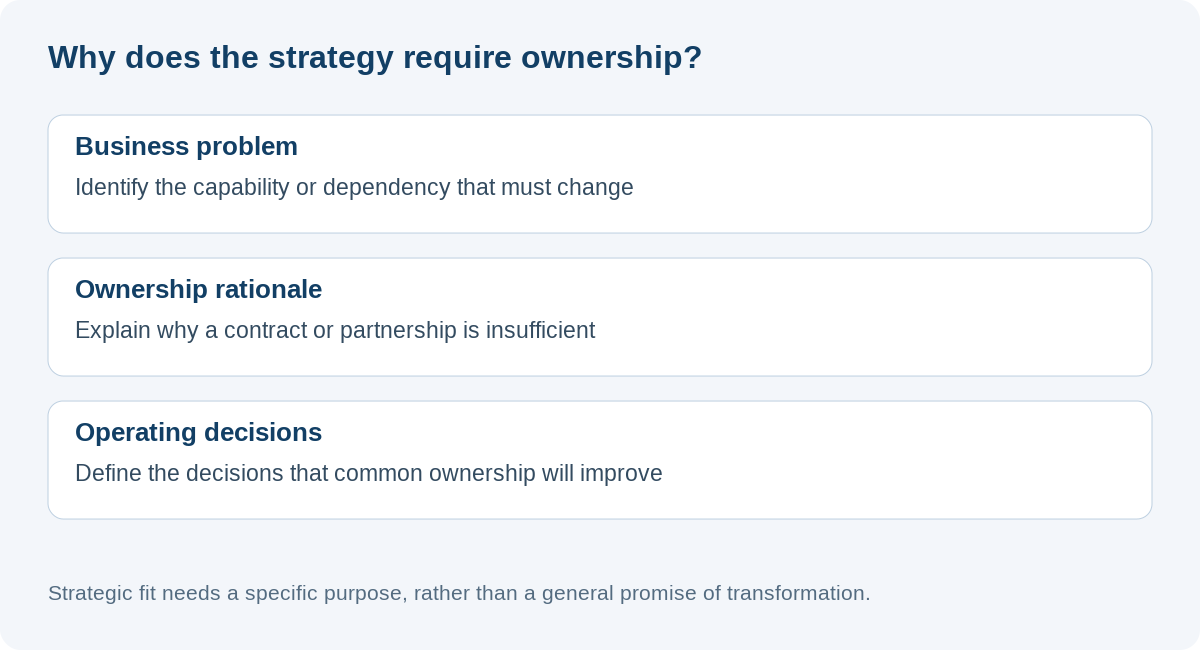
Strategic fit means more than operating in the same industry or using compatible marketing language. The buyer should explain what it can do after the transaction that it cannot reasonably do today, and why ownership is necessary to achieve it. That explanation should identify the customers, capabilities and decisions affected.
A manufacturer seeking a digital service platform, for example, needs to determine whether it wants proprietary technology, a development team or access to an existing customer base. These objectives require different evidence and potentially different structures. Buying the entire company may be appropriate, but it should not be the default answer before the actual need is understood.
Ask where the current business is vulnerable or constrained. It might depend on one component supplier, lack specialist product knowledge or struggle to serve a customer segment. Then examine whether the target genuinely resolves that issue or merely shifts the dependency elsewhere.
Acquiring a supplier can bring closer coordination, yet the supplier may itself depend on an exclusive technology licence or one experienced manager. The buyer should investigate the complete dependency chain. Ownership of one link does not necessarily provide control over the resources that make it valuable.
A licence, development agreement, supply arrangement or minority investment may sometimes achieve the desired access with a different level of commitment. Each alternative has limitations: access may be temporary, decision rights may be restricted or the parties' priorities may diverge. Compare those limitations with the obligations and integration work of an acquisition.
The strategic case should explain why the proposed level of ownership is preferable under realistic conditions. If a short-term commercial agreement would answer the immediate problem while preserving flexibility, the board should understand what additional benefit justifies the larger acquisition commitment.
Bringing complementary activities under common ownership may help align investment decisions, product development and service standards. A business can plan capacity with better knowledge of downstream demand or coordinate product design with after-sales support. These benefits require workable decision processes, not merely a shared shareholder.
Before counting coordination as a benefit, specify which decisions will change. Who approves technical priorities? How will internal transfer terms be set? What information will the operating teams share? Without answers, common ownership can add meetings while leaving the original coordination problem unresolved.
Complementary products or services may allow a company to offer a more complete solution. An industrial equipment business might combine installation, monitoring and maintenance so that customers have a clearer service arrangement. The strategy must account for whether customers want that package and whether the combined business can deliver it consistently.
Brand choice matters here. The target's name may carry trust in a specialist market that the buyer does not yet understand. Retaining that identity could support the strategy better than immediate rebranding. Examine the relationships and rights supporting the brand before deciding how it should appear within the group.
A target may contribute knowledge that helps the buyer adapt its products or processes. The advantage is not simply possession of a new technology. It is the ability to understand, maintain and develop that technology within an organisation capable of using it.
Investigate the technical team's working methods, access to tools and relationship with customers. A capability can be damaged by imposing approval routines that delay experimentation or separate developers from the users they serve. Integration should preserve the practices that make the capability effective while providing appropriate oversight.
The strategic advantages and disadvantages of mergers and acquisitions should be considered over the period in which the business expects to use the acquired capability. A transaction can solve today's problem while making tomorrow's choices more difficult. Examine what would happen if customer needs, technology or the target's key relationships changed.
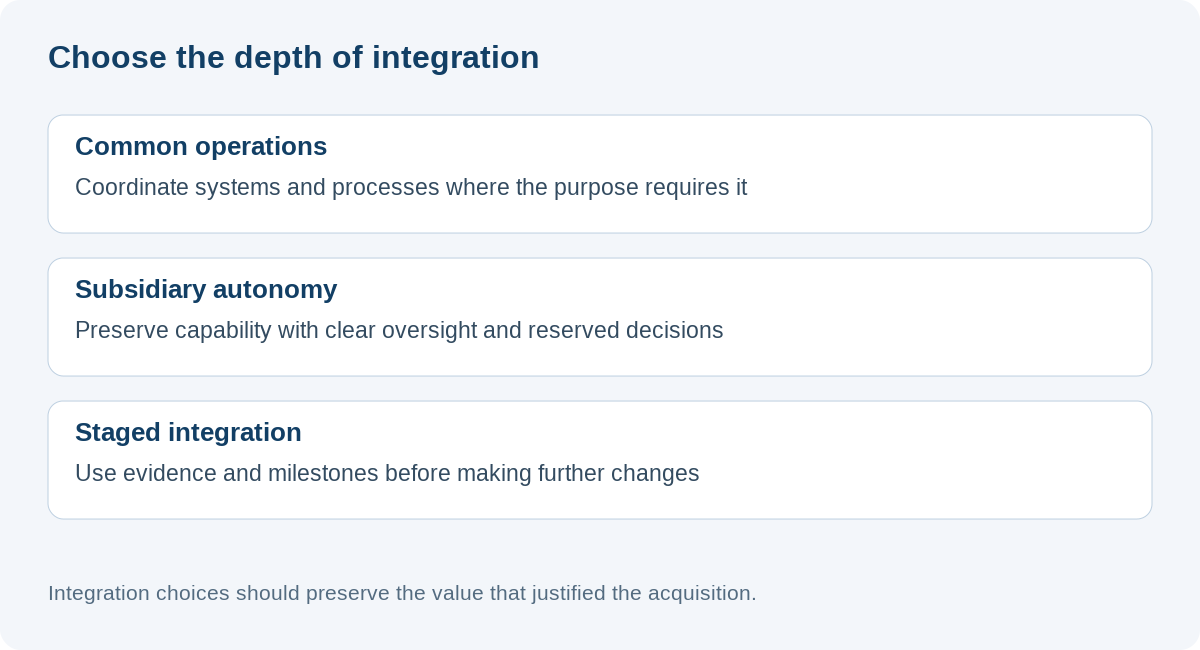
A company may invest heavily in combining systems and processes that later prove unsuitable. Reversing those changes can involve further disruption. Before integration, identify which activities need common standards and which can remain separate without undermining the strategic objective.
For instance, group financial reporting may need consistent definitions and controls, while a specialist product team may benefit from a distinct development process. The appropriate boundary should follow the business purpose and relevant legal requirements. Uniformity is not a sufficient reason to replace an effective process.
A target may have served customers who compete with the buyer. After acquisition, those customers could question whether their commercial information remains protected or whether service will receive equal attention. The group should assess those concerns before relying on continued revenue from them.
There may also be conflicts over budgets, product priorities and the use of shared staff. A governance plan should identify which decisions belong locally, which require group approval and how disagreements will be resolved. Leaving those boundaries unclear can turn an intended strategic advantage into recurring internal friction.
Capital and management attention devoted to an acquisition cannot simultaneously support every other initiative. Consider what the buyer would postpone and whether the transaction leaves enough capacity to respond to unexpected developments in its existing business.
A plan that requires every integration milestone to succeed on the original schedule deserves further examination. Identify the decisions that can be staged, the commitments that are difficult to reverse and the evidence needed before moving to the next stage. This makes flexibility a deliberate part of the strategy.
Acquiring an established company does not provide a general route around regulatory barriers. Article 21 of Vietnam's Law on Investment 143/2025/QH15 requires foreign equity participation to meet applicable market-access, national security and relevant land conditions, with registration before changes to members or shareholders in specified cases. The review must use the target's actual activities, ownership proposal and property interests.
A strategic forecast should therefore distinguish existing operations from proposed expansion. A permission held for the target's current business may not establish the right to launch a new regulated service, operate elsewhere or use a different structure. Identify the specific permissions and conditions supporting each intended activity.
A technology-led transaction needs evidence of rights to the relevant software, designs, documentation and supporting tools. Review ownership and contractual permissions rather than assuming that everything used by the target belongs to it. Where a third-party licence is involved, examine the actual terms and intended post-acquisition use.
Supply-chain strategies require similar attention to exclusivity, duration, termination and change-of-control provisions. The commercial team may describe a relationship as stable, while the contract permits termination on short notice or restricts service to other group companies. Such findings should change the strategy or its implementation assumptions.
The broader guide to legal due diligence in M&A explains how to organise the investigation. For a strategic acquisition, the priority is to connect each important right and restriction to the capability the buyer intends to obtain.
Evaluating the strategic advantages and disadvantages of mergers and acquisitions should lead to an operating model, not just approval of the transaction. The buyer may seek close operational integration, a largely autonomous subsidiary or a staged combination. Each choice needs a clear explanation of how value will be created and controlled.
Discuss the model with the people expected to operate it. A management presentation may assume that technical staff can support two product lines immediately, while the team knows that training and tooling are required. Resolving that difference before completion produces a more credible plan.
Consider a manufacturer planning to acquire a software company to offer monitoring services with its equipment. The initial strategy assumes that the software can be incorporated into every product and that the acquired team will immediately support the manufacturer's customers.
The review reveals two important dependencies. Part of the software uses a third-party component with contractual restrictions, and the target's developers rely on direct feedback from its existing customers. These findings do not automatically defeat the transaction, but they challenge both the product plan and the proposed integration timetable.
The buyer should establish what permissions are required, how existing customer commitments will be served and which development processes should remain intact. It may choose a staged product rollout and retain a distinct technical team while introducing common financial oversight. The strategy becomes more specific and testable than a general promise of digital transformation.
A board assessing the strategic advantages and disadvantages of mergers and acquisitions needs a concise record of the intended benefit, supporting evidence and remaining uncertainties. Separate established facts from assumptions. Record which findings would require a revised price, different structure or decision to stop.
After completion, review the original strategic measures alongside financial results. These might include improved service coverage, reduced dependence on an external resource or successful delivery of a new product capability. If the assumptions change, reconsider the operating model rather than preserving it solely because the transaction has already closed.
Jurion & Partners can help examine the legal conditions behind a proposed strategic acquisition and translate material findings into transaction requirements. A useful initial brief identifies the intended capability, the target's key dependencies and the decisions the buyer expects to control after completion.
>>> See more: Signing M&A Contract, what are the noteworthy points?
>>>Read more: Legal due diligence in M&A transaction
The strategic advantages and disadvantages of mergers and acquisitions depend on whether ownership provides a useful, lawful and adaptable response to the company's actual needs. Define the capability sought, verify the rights that support it and choose an integration model that preserves its value. That discipline helps a modern company pursue transformation without losing sight of the decisions and dependencies that determine whether the strategy works.






Subscribe today to get more breaking news from Jurion Partners - Solicitors & Litigators

108 Tran Dinh Xu St., Cau Ong Lanh Ward, Ho Chi Minh City, Vietnam
(+8428) 66.701.709 - (+84) 903.419.479
contact@jurionpartners.com
Follow us
Accept payment





 English
 Tiếng Việt