Mergers and acquisitions (M&A) are powerful tools for business growth, but they also involve complex legal, financial, and regulatory challenges.
Lawyers in M&A transactions help the client connect its commercial objective with the legal rights, obligations and implementation steps of a deal. Their work is not limited to producing a purchase agreement. It can include defining the structure, investigating material issues, advising on negotiated choices and organising the documents and actions needed at completion.
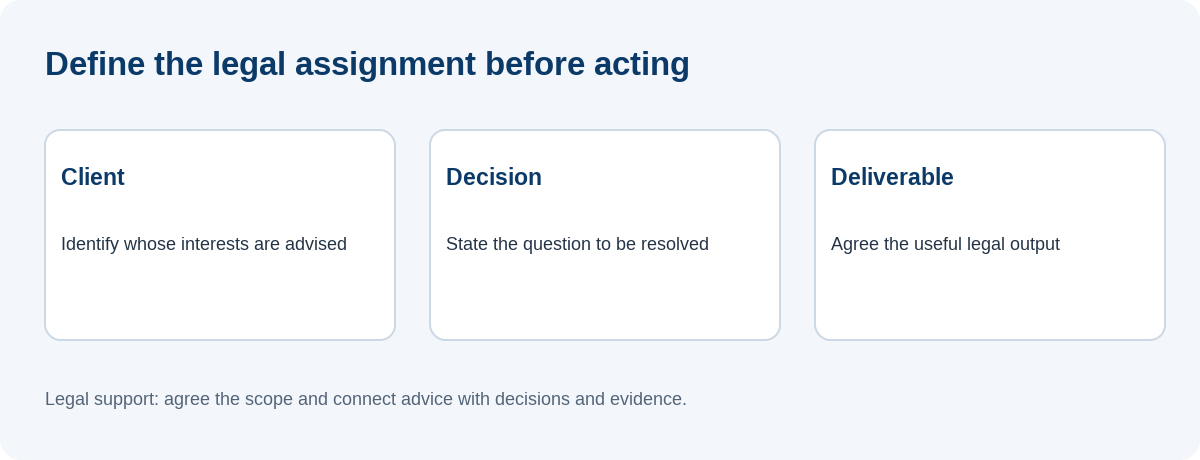
The appropriate scope depends on the transaction and the client's instructions. A small share purchase, a regulated business acquisition and a transfer of selected assets do not require an identical work programme. This article explains how legal support can be organised into useful decisions and deliverables, while keeping responsibility for business choices and other specialist work clear.
Establish who instructs counsel and whose interests the engagement covers. A buyer, seller, target company and individual shareholder may have different concerns. An adviser attending a meeting should not be assumed to represent every participant. Clarify the engagement, authorised contacts and any relevant conflicts before sharing a complete file or requesting joint instructions.
Describe the decisions the client faces: whether to proceed, which structure to use, what protection to negotiate or whether completion conditions have been met. A request to “handle the M&A” is too broad to establish a workable assignment. Agree the questions, documents and expected output so the legal work can support the actual timetable.
Financial, tax, valuation, technical and legal specialists may review overlapping information for different purposes. Identify who is responsible for each conclusion and where one team depends on another. A lawyer's review of title does not confirm an asset's technical condition, and a financial model does not establish that every assumed right can be transferred.
For example, if the acquisition case relies on a licence or a property arrangement, the legal team can examine the relevant rights and restrictions. The financial team can then assess the effect of a verified limitation on its model. Neither should silently treat the other's report as resolving a question outside that report's scope.
An early task for lawyers in M&A transactions is to identify what the parties intend to acquire and the steps that would achieve it. A share acquisition, asset transfer and corporate reorganisation have different consequences. The legal structure should reflect the business objective rather than simply reuse the form of an earlier transaction.
Counsel can explain the rights being obtained, the entities involved and the approvals or documents that need further assessment. The client should understand which elements are already established and which depend on investigation or a third party's action. A proposed structure is not a completed legal outcome.
Keep connected steps visible. An acquisition may depend on financing, a separate licence arrangement or a release of security. The transaction team needs a sequence that explains those relationships. Otherwise, one workstream may assume a result that another has not agreed or cannot deliver on the proposed date.
Legal review should be directed by the business and transaction risks. Identify the material records to examine and the questions they should answer. The scope may cover corporate ownership and authority, important contracts, licences, assets, employment matters and disputes, depending on the target and the proposed deal.
A legal due diligence review helps organise that investigation and its limitations. The report should distinguish verified information from assumptions and missing evidence. Finding a document in a data room does not itself show that it is current, complete or consistent with the transaction plan.
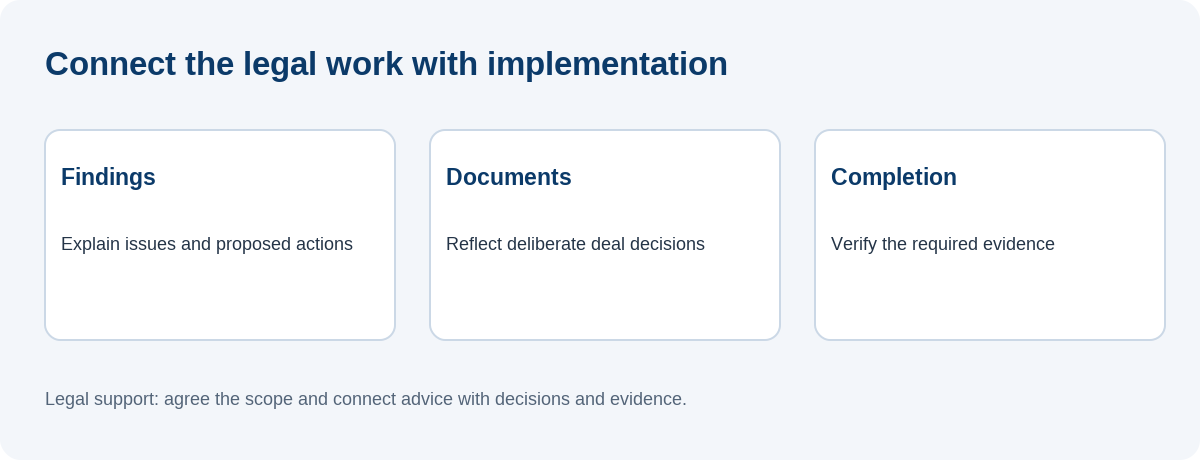
Lawyers in M&A transactions should explain the significance of findings. A useful issue note identifies the fact, its consequence and the response to consider. That response might be further investigation, a condition, a negotiated protection or a change in structure. A list of risks without a decision path leaves the client to interpret their importance alone.
Suppose the shareholder register and transfer records supplied for review do not support the same ownership account. Counsel should identify the discrepancy, request the relevant history and explain why it matters to the proposed purchase. Simply selecting the more convenient document would not resolve the issue. The client needs to know what evidence is missing and whether that gap affects a decision to sign, complete or change the proposed protection.
Negotiation involves choosing how risk and responsibility will be allocated. Counsel can explain proposed clauses, alternatives and the limits of a contractual protection. The client decides which commercial compromise it is prepared to accept, informed by the evidence and the legal consequences.
For example, a buyer may discover that an important contract needs attention before the planned transaction can be implemented. The team can consider what evidence or action is required, who must obtain it and what happens if it is unavailable. A general warranty may serve a different purpose from a condition requiring the issue to be resolved before completion.
Keep instructions and open points recorded. Where the client accepts a known issue, make clear what was decided and what the documents need to reflect. A negotiating draft should not be mistaken for approval to proceed, particularly where material points remain subject to internal review.
The drafting role of lawyers in M&A transactions is to give coherent expression to the agreed structure and decisions. The purchase agreement may need to work with disclosure materials, shareholder arrangements, financing documents and completion deliverables. Definitions, dates and obligations should be consistent across the set.
Review how a provision operates in practice. If the agreement requires a consent, identify the relevant document and the standard for confirming it. If a payment depends on a calculation, connect the definition with the available records and specialist input. Clear drafting should reduce uncertainty about the promised action rather than merely add length.
Maintain version control and a record of changes still requiring agreement. The signed set should reflect the final negotiated position, including schedules and attachments. A correct main agreement can still be undermined by an outdated annex or a document that describes a different transaction.
Before signing, identify the required approvals, signatories and execution arrangements for each document. Do not infer authority solely from a participant's seniority or presence in negotiations. The relevant entity and authorisation need to be checked in the context of the document and transaction.
For completion, prepare a checklist showing conditions, documents, responsible parties and evidence. Distinguish a party's statement that a task is done from the material needed to verify the result. If a condition remains outstanding, identify the decision required instead of treating silence as agreement to overlook it.
Payment and document exchanges should follow an agreed process. Lawyers can help connect the legal requirements with the completion sequence, while the responsible finance teams verify and perform their assigned steps. No participant should have to improvise the meaning of a missing release or unresolved payment instruction while completion is underway.
Completion does not necessarily end every legal task. The transaction may leave registration work, outstanding undertakings, governance actions or continuing contract obligations. Give the operating team a clear account of those matters, including who is responsible and which records must be retained.
Review the post-completion scope rather than assume the original engagement covers all integration work. A company may need separate assistance with appointments, policy changes or a newly emerging dispute. Identify the decision and relevant documents before extending an earlier conclusion to a changed situation.
Where a claim arises, counsel can help assess the agreement, evidence and applicable process. Precise drafting may assist that assessment but cannot guarantee that no disagreement will occur. Representation in negotiations or proceedings should be agreed and established as appropriate; an advisory engagement should not be treated as an automatic mandate for every later action.
Expect advice that explains assumptions, material issues and practical options. A lawyer should not promise regulatory approval, a particular court result or commercial success simply because the documents have been reviewed. The quality of the advice also depends on the completeness and accuracy of the information provided.
The client should disclose relevant facts, provide reliable records and identify who may make decisions. If the structure, timetable or commercial objective changes, tell the legal team promptly. A recommendation based on one set of instructions may need reassessment when another workstream changes the deal.
When discussing assistance with Jurion & Partners, provide the intended transaction, current stage and decisions requiring support. Bring the available structure chart and draft documents, and identify which other advisers are involved. That makes it possible to define legal deliverables and dependencies before the work begins.
>>> Read more: Competence of Vietnam courts over civil cases with foreign elements
The role of lawyers in M&A transactions is to help the client make informed choices and implement them through appropriate legal steps and records. Agree the scope, connect findings with decisions and keep responsibilities clear through completion and handover. That gives the transaction team a more reliable basis for acting.





Subscribe today to get more breaking news from Jurion Partners - Solicitors & Litigators

108 Tran Dinh Xu St., Cau Ong Lanh Ward, Ho Chi Minh City, Vietnam
(+8428) 66.701.709 - (+84) 903.419.479
contact@jurionpartners.com
Follow us
Accept payment





 English
 Tiếng Việt