A practical framework for assessing Vietnam’s international jurisdiction, forum restrictions and the current domestic court before preparing a foreign-related civil filing.
Vietnam court jurisdiction over foreign-related civil cases must be assessed before choosing a court or translating a filing package. A foreign party, an overseas contract or an asset abroad can raise several different questions: whether Vietnamese courts may hear the matter, whether another forum affects that competence, and which Vietnamese court is the correct recipient. Treating these questions as one test can lead to a filing in the wrong place.
Article 464 of the Civil Procedure Code describes cases with foreign elements by reference to the parties, events in the legal relationship and its subject matter. A foreign individual or organization is one possibility. A matter between Vietnamese parties can also have a foreign element because the relevant relationship was established, performed, changed or terminated abroad, or because its subject matter is overseas.
The foreign element does not by itself identify the procedure. Classify whether the matter is a contractual dispute, family case, employment dispute, property claim or another type of application. Different procedural conditions and territorial rules may follow from that classification. The broad civil-procedure framework should not be mistaken for a single form suitable for every international disagreement.
Prepare a factual map showing the parties' legal status, residence or registered office, locations of relevant events, location of property and the relief sought. Keep facts separate from assumptions. A foreign trading name on an invoice, for example, needs to be connected to the actual person or entity alleged to owe the obligation.
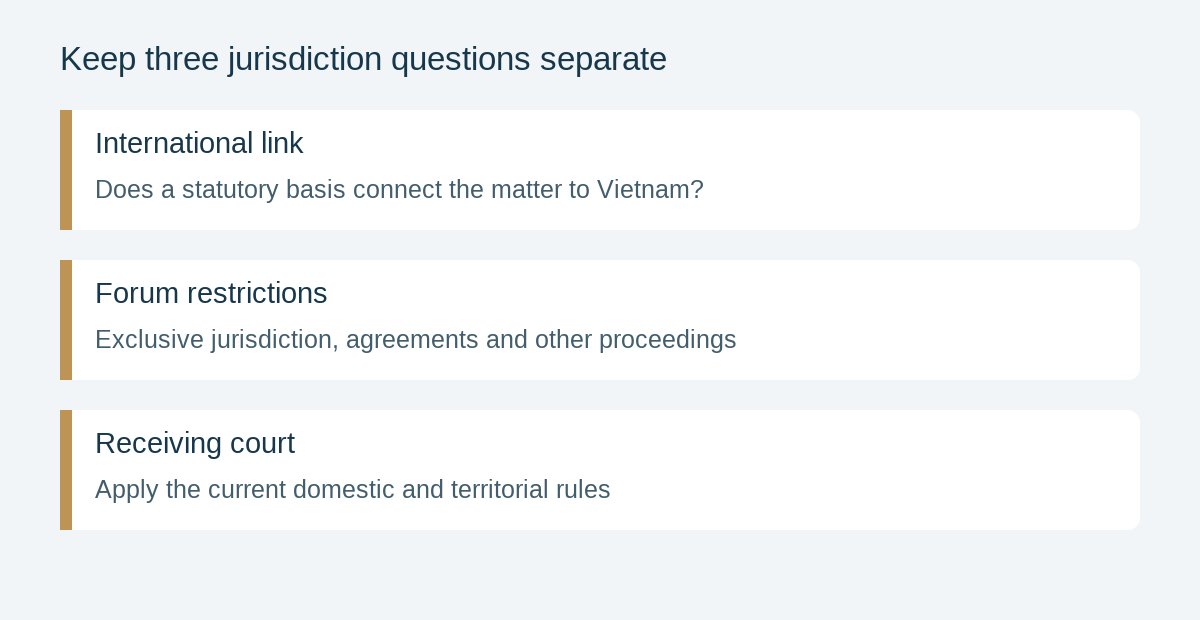
Article 469 sets out the general jurisdictional connections. They include specified links concerning a defendant in Vietnam, an organization's relevant presence here, assets in Vietnam, certain divorce situations and civil relationships connected with events, property, work or rights and obligations identified in the provision. The precise statutory branch must match the actual facts.
For an organization with a branch or representative office in Vietnam, do not omit the requirement concerning the relationship between the case and that office's activities under the relevant branch. A local contact point is not automatically proof that every dispute involving the overseas organization can be brought here on that basis.
Similarly, if reliance is placed on assets in Vietnam, identify the evidence supporting that connection and the proposed claim. A statement that “the group has assets here” may leave unresolved which entity owns them and why that entity is the relevant defendant. An initial jurisdiction assessment should identify the supporting documents, not simply repeat the statutory wording.
Assume a fictional overseas supplier seeks payment from a company registered in Vietnam. The buyer's identity and registered office are relevant starting facts. The analysis should then examine the contract, the dispute clause, any other proceedings and the requested relief before selecting a particular court. The international connection is a starting point, not a promise that the petition will be accepted.
Article 470 identifies matters within Vietnamese courts' exclusive jurisdiction. Examples include cases concerning rights over immovable property located in Vietnam and the specified divorce situation in which both spouses reside and live long-term in Vietnam. The Article also addresses a permitted agreement selecting Vietnamese courts and certain non-contentious matters.
Do not assume that every dispute with a foreign spouse falls within the same exclusive category, or that every claim mentioning land is legally identical. Identify the particular rights and request. Likewise, a clause selecting a Vietnamese court needs examination of whether that choice is permitted under the governing legal framework.
The distinction matters when considering a foreign forum and the later recognition of an overseas judgment. A general connection with Vietnam and exclusive Vietnamese jurisdiction are not interchangeable labels. They can produce different results when another court has already been asked to deal with the dispute.
Article 472 addresses situations in which a Vietnamese court must return a petition or discontinue a matter otherwise within general jurisdiction. A permitted selection of arbitration or a foreign court can be relevant. The Article also contains qualifications, including circumstances involving an invalid or unworkable agreement, a refusal to accept the matter, or a changed choice.
An arbitration clause should therefore be read as a separate issue rather than ignored because the defendant has a Vietnamese address. Conversely, the mere appearance of the word “arbitration” does not establish that every request falls within a valid, operative agreement. Review the text, parties, scope and relevant procedural history.
Distinguish a governing-law clause from a dispute-forum clause. Choosing a law for the contractual relationship is not necessarily the same act as choosing the court or tribunal that will resolve a dispute. Keep both provisions in the assessment file and explain how each affects the proposed route.
Vietnam court jurisdiction over foreign-related civil cases also requires a check of proceedings elsewhere. Article 472 deals with specified situations involving exclusive foreign jurisdiction, prior acceptance by a foreign court or arbitration, an existing foreign judgment or award, and judicial immunity. The qualifications in the provision must be read with the facts and any applicable treaty.
A client's statement that another case “has been filed abroad” is not enough detail. Obtain the initiating document, proof of acceptance where available, the parties and claims involved, and any decision already made. A demand letter, a lodged petition and a case accepted by a foreign court are different procedural events.
If an overseas judgment already exists, consider whether the task is recognition and enforcement, a fresh claim, or another application. These routes should not be mixed into a petition that simply asks the Vietnamese court to decide everything again. Jurisdiction to hear a dispute and permission to enforce a foreign judgment are distinct questions.
Article 469 directs the next step to the domestic jurisdiction rules once Vietnamese international jurisdiction is established. Under the amended Article 35, regional People's Courts have first-instance competence for the categories of disputes and requests listed there, with specified exceptions. The former blanket explanation that a foreign party, overseas assets or foreign judicial assistance automatically sends an ordinary first-instance dispute to a provincial court should not be reused.
The current division of work, specialized court rules, territorial jurisdiction and special provisions still need checking. Identify the dispute category and the precise relief before entering the receiving court's name. Merely replacing “district” with “regional” in an old template may leave an incorrect territorial choice or an overlooked special rule.
Foreign-related status also does not mean every party may select any convenient city. Where a statutory choice is available, identify its conditions and supporting facts. Where it is not, use the applicable territorial rule rather than a preferred meeting location or the lawyer's office address.
Article 471 addresses continuity of jurisdiction after a Vietnamese court has properly accepted a foreign-related matter. The provision covers changes in nationality, residence or address and new circumstances of the kind specified there. A party should not assume that moving abroad automatically removes the accepted case from that court.
This does not excuse failing to update contact or service information through the appropriate procedure. The continuing court needs usable details, and the parties must still attend to notices. If the original acceptance itself is disputed, that is a different question from a later change in residence.
A jurisdiction assessment should identify where each person can be served and what evidence supports the address. Article 473 addresses identifying information for parties abroad. An incomplete overseas address can create practical and procedural difficulties even where a jurisdictional basis has been identified.
Foreign-issued records may require translation, certification, legalization or an applicable exemption. Check the source and type of each document rather than assume one treatment fits every item. These formalities help make a file usable; they do not themselves prove the underlying claim or create jurisdiction.
The language of proceedings and any interpreter arrangements should be planned early. An English summary can help a client understand the strategy, but it should correspond with the Vietnamese submission and supporting record. Names, dates and requested amounts must remain consistent across versions.
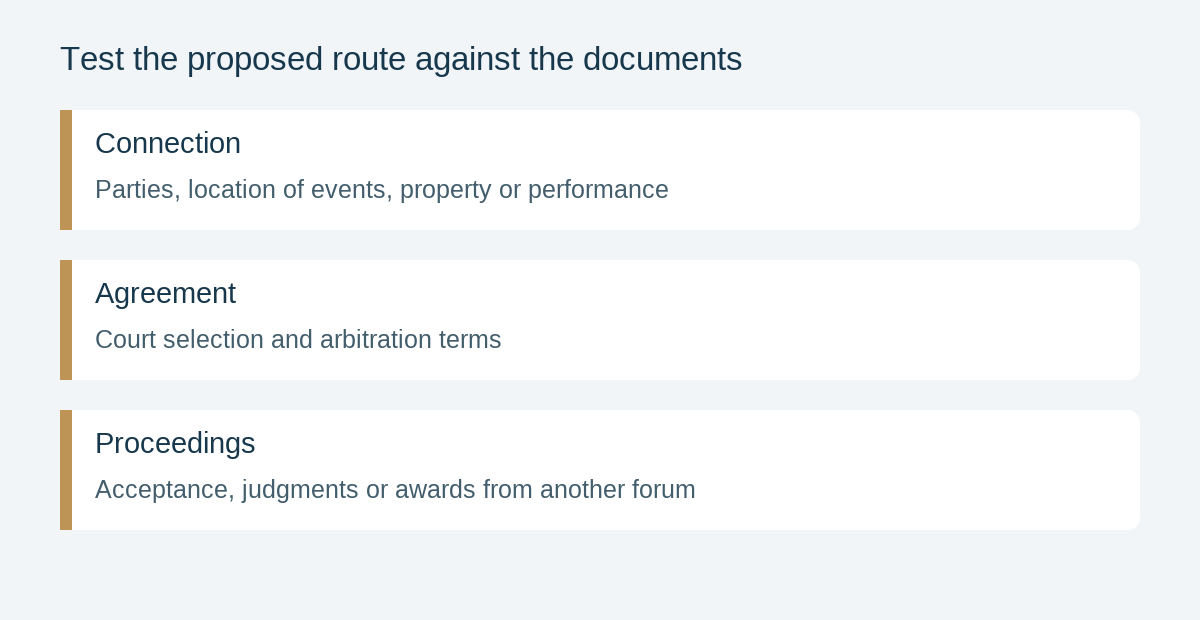
| Issue | Useful records |
|---|---|
| Parties and legal status | Identity, registration and relevant representation documents |
| Vietnam connection | Residence, office, property, performance or event records supporting the relied-upon branch |
| Forum arrangements | Contract, amendments, arbitration and court-selection terms |
| Other proceedings | Filed papers, acceptance records, judgments or awards |
| Proposed relief | Separate requests, amounts and the relationship concerned |
| Service and evidence | Verified addresses, document sources and language requirements |
A useful opinion on Vietnam court jurisdiction over foreign-related civil cases should identify its factual assumptions, the relevant legal route and unresolved points. If an asset location or an overseas proceeding has not been verified, say so. A confident conclusion based on an untested assumption is less useful than a clear list of what must be established before filing.
Jurisdiction should also be distinguished from applicable law and the merits. A Vietnamese court's ability to hear the case does not mean the claimant has proved breach, nor does it automatically answer every choice-of-law issue. Those questions need their own analysis after the route has been identified.
>>> Read more: Resolving disputes between shareholders or members of the company
>>> Read more: Resolving disputes between shareholders or members of the company
Once the route is supported, the petition should state the relevant connection and include the material needed to explain it. Our guide to drafting a lawsuit petition in Vietnam sets out how to organize parties, relief and evidence for that next stage. Filing should follow the assessment rather than be used as a substitute for it.
Jurion & Partners can assess the proposed forum and case documents within an agreed scope. Before deciding on Vietnam court jurisdiction over foreign-related civil cases, assemble the factual connections, dispute clauses and records of any proceedings abroad, then identify which assumptions still need verification.






Subscribe today to get more breaking news from Jurion Partners - Solicitors & Litigators

108 Tran Dinh Xu St., Cau Ong Lanh Ward, Ho Chi Minh City, Vietnam
(+8428) 66.701.709 - (+84) 903.419.479
contact@jurionpartners.com
Follow us
Accept payment





 English
 Tiếng Việt