Mergers and acquisitions (M&A) often involve complex contracts, multiple stakeholders, and sensitive corporate interests.
Dispute resolution in M&A begins with identifying the actual claim, the parties entitled to bring or answer it and the agreed route for resolving it. Negotiation, arbitration and litigation serve different purposes and have different requirements. A commercial preference for a confidential discussion does not remove a filing deadline, while a strong claim is of limited value if the chosen forum lacks jurisdiction or recovery has not been considered. Early organisation helps the transaction team make deliberate choices.
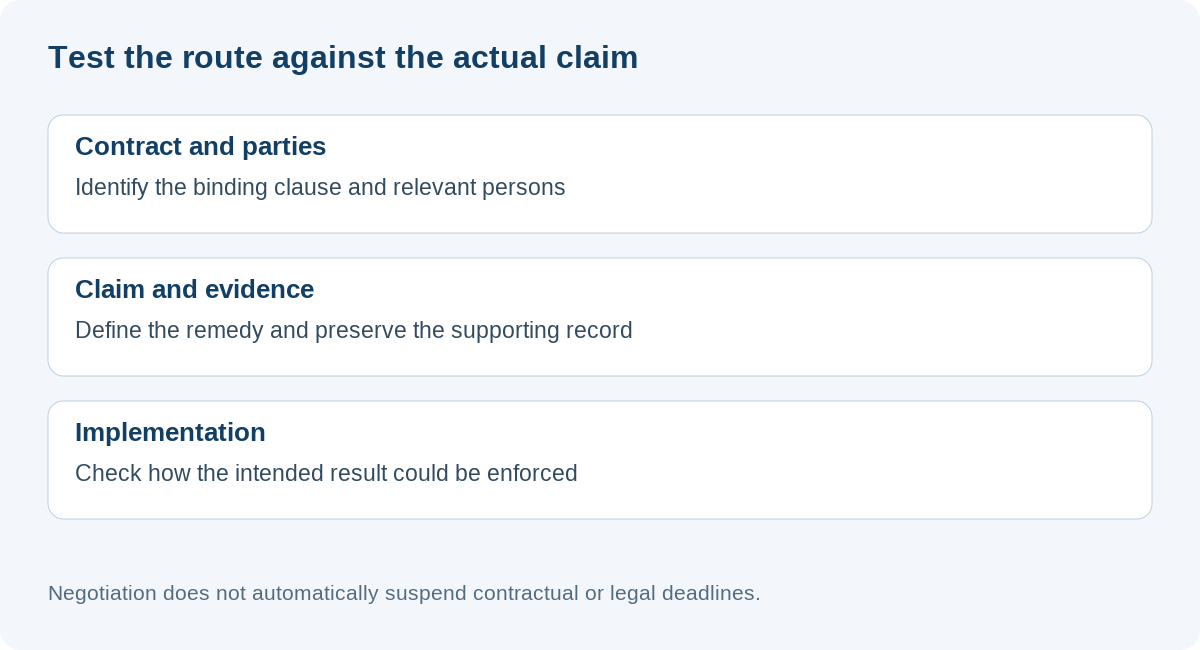
Collect the signed acquisition agreement, disclosure materials, relevant schedules, amendments and connected contracts. Identify the version governing the disputed obligation. An argument about a price adjustment may involve a calculation process different from the procedure for a warranty claim. A shareholder dispute after completion may arise under another document altogether. Do not assume that every disagreement involving the same business belongs under one clause.
Define what the claimant wants: payment, delivery of records, performance of a continuing obligation or another remedy. Then check who owes that obligation and who may enforce it. The buyer, target and shareholders are distinct persons whose rights may differ. A loss experienced by the business does not automatically establish that the buyer holds the relevant contractual claim in its own name.
Record contractual notice dates, procedural requirements and limitation questions for separate legal assessment. Do not assume that ongoing talks suspend any deadline. A request for more information from the other side may also leave existing obligations untouched. The team should identify matters that require action now while keeping commercial discussions open where useful.
Preserve the documents supporting the transaction and the disputed event, including records now held by the target or another group entity. Keep originals and context where available. A chronology should link each important assertion to its evidence and identify gaps. This is more useful than a collection of emails selected only because they support the desired outcome.
Negotiation gives the parties room to agree a result a tribunal might not be asked to impose, such as a revised payment schedule or a practical handover arrangement. Its usefulness depends on having authorised decision-makers, reliable information and a defined agenda. General invitations to “resolve matters amicably” can consume time without addressing the amount, conduct or documentation actually in dispute.
Dispute resolution in M&A through negotiation should distinguish a proposal from an admission or a binding commitment. Agree appropriate arrangements for sensitive information and check the legal treatment of settlement communications. Confidentiality should not be assumed merely because a meeting is described as private. The company team also needs guidance on who may communicate with the other side and who can approve a settlement.
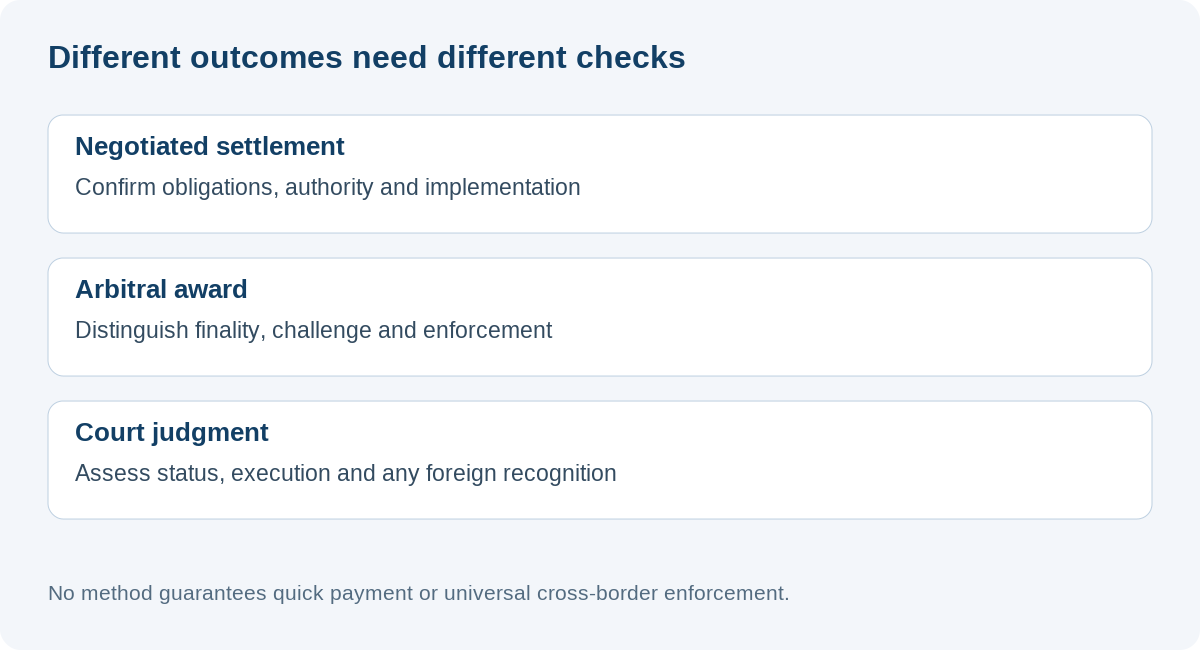
If agreement is reached, identify the parties, obligations, payment dates, conditions and consequences of non-performance. Define the claims being released and the matters preserved. Avoid saying that all disputes are resolved while leaving the key sum or delivery date for future agreement. The person responsible for implementing the outcome should be able to understand what must happen without reconstructing the negotiation.
A signed private settlement should not automatically be presented as equivalent to an executable judgment or arbitral award. Its legal form and enforcement route need assessment. Depending on the context, a court or arbitration process may provide a different mechanism for recording a lawful agreement. The parties should choose an available route deliberately, rather than assume that signature alone supplies every enforcement advantage.
Dispute resolution in M&A by arbitration requires examination of the arbitration agreement and applicable law. Review the parties bound, the scope of the clause and whether it covers the claim being proposed. Identify the institution or procedure selected and any inconsistency between connected documents. A reference to arbitration in one agreement does not automatically bind every person participating in the wider transaction.
Vietnamese commercial arbitration legislation recognises the role of an arbitration agreement and its relationship with court proceedings. A party should therefore obtain advice on validity and workability before filing in a preferred forum. Dissatisfaction with the other side's conduct does not itself permit the claimant to disregard the agreed dispute mechanism.
An arbitral award's finality should be distinguished from the available challenge process and the steps needed for enforcement. Arbitration is not an ordinary merits appeal system, but that does not justify saying there can never be a court application affecting an award. Nor does an award automatically produce payment in every country where the debtor or assets may be found.
For a cross-border matter, consider where recognition or enforcement may be required and what framework applies there. The location of assets, identity of the debtor and available resources matter. Confidential proceedings also do not mean every later recognition, enforcement or related court step will have identical treatment. Assess the complete path, not just the anticipated hearing.
Litigation may be the appropriate route where a competent court can hear the claim and no applicable arbitration arrangement prevents that course. The analysis should address the dispute type, parties, territory, relevant agreement and any foreign element. Do not select a court solely because an old contract template or historical article names a particular court level.
Current Vietnamese civil procedure places importance on the parties' claims and evidence. Preparing for court means identifying the requested remedy, supporting facts and documents, rather than expecting the court to discover the entire commercial history unaided. Where information is held elsewhere, assess lawful ways to obtain or request it and the procedural requirements for doing so.
Cross-border litigation can involve questions about service, translations, representation and the use of foreign documents. These can affect the practical timetable independently of the merits. Identify the people needed to explain the transaction and preserve access to records when staff or advisers change. A realistic budget should reflect preparation and implementation as well as the hearing stage.
A court judgment also needs to be considered together with its status, available review and execution requirements. Recognition abroad may raise separate questions. Avoid promising that selecting litigation will necessarily be cheaper, faster or easier to enforce than arbitration. The comparison must be made against the actual claim, forum, documents and assets.
Suppose the seller claims an outstanding completion payment, while the buyer says an adjustment cannot be finalised because necessary records are incomplete. The acquisition agreement contains both a calculation procedure and a general dispute clause. Before starting proceedings, the team should determine which process applies, what information is required and whether the claimed amount is already payable or depends on further steps.
Dispute resolution in M&A in this situation benefits from separating the accounting question, the obligation to provide documents and any contractual payment claim. An accounting expert may address a calculation within an agreed remit without being authorised to decide every legal allegation. The buyer's control of company records and the seller's access rights also need to be examined, rather than assumed.
The parties might negotiate a document exchange and a timetable for resolving the calculation. If they cannot agree, the formal route should follow the relevant provisions and law. Meanwhile, the team should track notices and deadlines instead of assuming that informal discussion has protected its position. This approach keeps a practical solution possible without overlooking the procedural choices.
If there is a genuine concern about evidence loss or assets, obtain advice promptly on available interim measures and their conditions. The appropriate decision-maker, supporting material and possible obligations of the applicant require assessment. A request for urgent protection should not be treated as an automatic entitlement simply because the acquisition involved a large amount.
Company personnel should avoid deleting records, withholding material outside a lawful basis or interfering with assets as negotiation pressure. Such actions may create additional exposure and damage the evidence record. Establish a proportionate preservation process and clear instructions about who handles the dispute, while allowing ordinary operations to continue where possible.
The broader service for drafting and reviewing contracts supports clearer dispute provisions before problems arise. Once a dispute exists, review the actual clause with the signed package and the events in question. A general comparison of methods cannot replace that exercise.
To prepare a focused instruction for Jurion & Partners, provide the signed documents, chronology, relevant notices and the outcome being sought. Ask which decisions are urgent, what evidence is missing and how each available route would address the claim. This helps connect legal assessment with the commercial decision the client must make.
>>> Read more: Resolving disputes between shareholders or members of the company
Dispute resolution in M&A should connect the contract, claim, evidence and recovery plan. Negotiation may produce a practical settlement, while arbitration or litigation may provide an appropriate formal decision where their requirements are met. Before choosing the next step, confirm the forum, preserve the record and check how the intended result could actually be implemented. Those foundations are more useful than treating any method as universally confidential, quick or certain.






Subscribe today to get more breaking news from Jurion Partners - Solicitors & Litigators

108 Tran Dinh Xu St., Cau Ong Lanh Ward, Ho Chi Minh City, Vietnam
(+8428) 66.701.709 - (+84) 903.419.479
contact@jurionpartners.com
Follow us
Accept payment





 English
 Tiếng Việt