Understand how withdrawing claims differs before acceptance, at first instance and on appeal, including remaining requests, costs and possible future proceedings.
Withdrawal of a lawsuit petition in Vietnam has different consequences depending on the stage, the claims withdrawn and the remaining requests of other parties. It is not always a simple way to close the file, recover every cost or preserve an unrestricted opportunity to sue again. Before making a request, identify whether the court has accepted the case, whether a first-instance judgment exists, and whether the intended step concerns the original claim or an appeal.
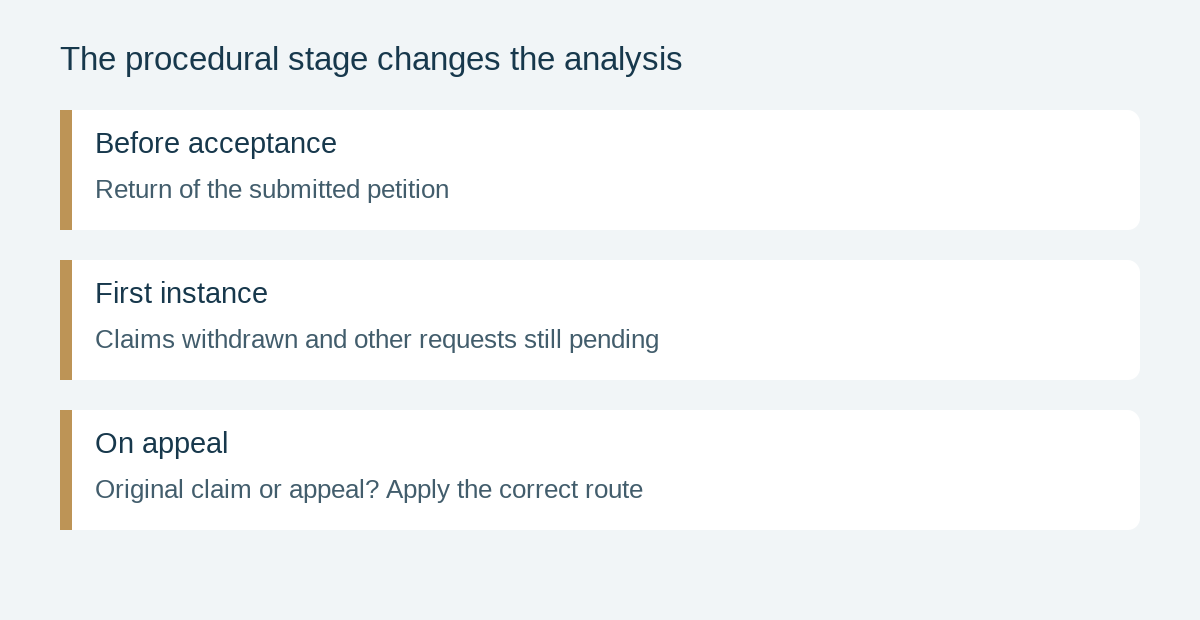
A petition awaiting acceptance, an accepted first-instance case and a case before an appellate court are distinct procedural situations. The same informal instruction to “withdraw the case” can conceal very different intentions. A claimant may want to abandon one item, stop all its own claims, withdraw an appeal or ask the court to recognize an agreement.
Start with the latest court document and a list of live requests. Confirm the case number, the court currently handling the matter, the status of any hearing and the existence of counterclaims or independent claims. Do not rely solely on the date the petition was posted or on a verbal update from the opposing party.
| Situation | Main question |
|---|---|
| Before acceptance | Is the claimant requesting return of the submitted petition? |
| After acceptance at first instance | Are all or only some claims withdrawn, and what other claims remain? |
| At the first-instance hearing | Is the withdrawal voluntary and what portion will no longer be tried? |
| On appeal | Is the original petition being withdrawn, or only an appeal? |
Article 192 of the Civil Procedure Code includes withdrawal of the petition among the grounds for its return. This differs from discontinuing a case that has already been accepted. The court's written handling of the submission should identify the procedural basis; keep the notice and the record of documents returned.
Where a return is based on the claimant's request, the claimant should still review any future filing conditions and applicable limitation issues. A decision not to proceed today does not automatically extend a legal deadline. If the intention is only to correct an error or supply a missing item, consider whether the court's amendment procedure addresses the issue without withdrawing the entire submission.
The request should identify the filed version and state clearly what is being withdrawn. Retain a complete copy even if original materials are returned. Losing the chronology or evidence because the first attempt ended can make a later assessment unnecessarily difficult.
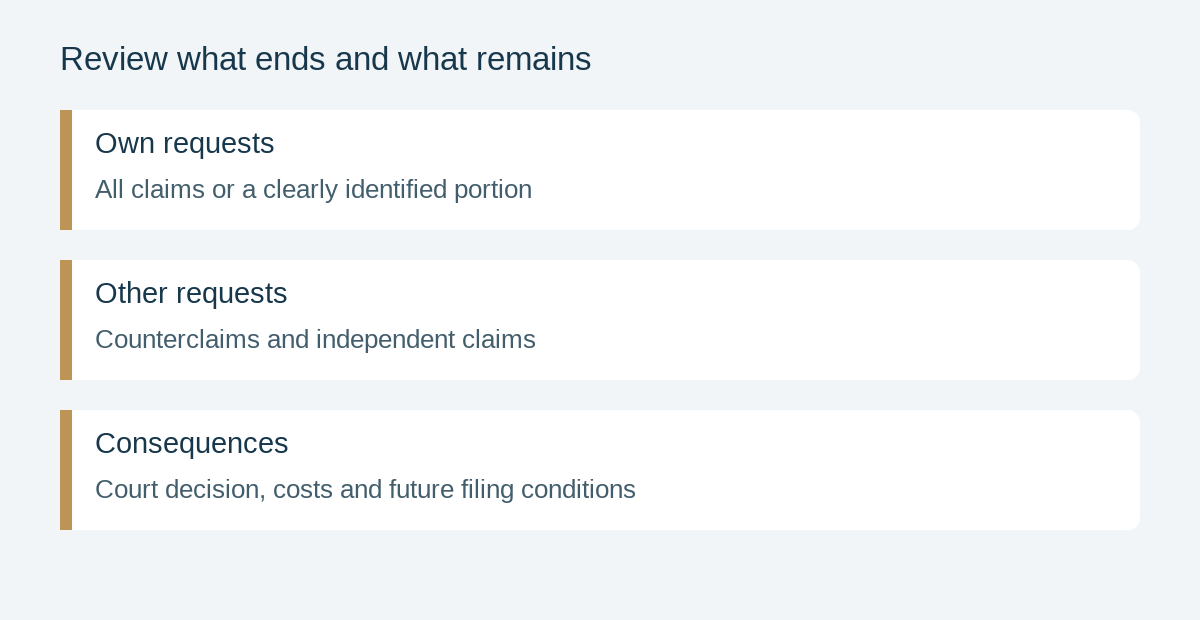
Under Article 217, withdrawal of all the claimant's claims is a ground for discontinuance, subject to the treatment of other live claims and applicable special rules. The term used here means ending the relevant proceedings, not merely pausing the case temporarily. It should not be confused with a temporary stay.
If a defendant maintains a counterclaim, the claimant's withdrawal does not necessarily dispose of that counterclaim. Article 217 provides for discontinuing the original claim while the defendant becomes the claimant and the original claimant becomes the defendant in the continuing dispute. A party cannot use withdrawal to erase another party's properly maintained request.
Where the counterclaim is also withdrawn but an independent claim remains, the Code provides a further change in procedural positions. If all relevant claims are withdrawn, the outcome is different. The correct analysis therefore requires the actual pleadings, not just a list of party names.
Suppose a seller sues for an unpaid balance and the buyer brings a counterclaim concerning defective goods. The seller later decides not to pursue its payment claim. That decision does not by itself establish that the buyer has abandoned its own request. The seller should assess its position in the continuing proceedings and keep responding to relevant court communications.
This example is illustrative. Whether a request is a counterclaim, an independent claim or a defence must be determined from the file and the procedural rules. Do not assume that every statement asking for compensation has already been accepted as a counterclaim.
Withdrawal of a lawsuit petition in Vietnam also requires precision about scope. If only an interest item or one request is being withdrawn, say so expressly and explain which other requests remain. A broad statement that the claimant withdraws “the petition” may be inconsistent with an intention to continue seeking the principal amount.
Article 244 provides that, at the hearing, the trial panel accepts a voluntary withdrawal of some or all requests and discontinues adjudication of the withdrawn portion. The panel considers the procedural requirements; a party's private note is not a substitute for the court's recorded handling of the issue.
Check that the hearing record and resulting decision reflect the intended scope. If there is a translation or communication difficulty, clarify it before confirming a withdrawal. The practical concern is not the length of the statement but whether everyone is identifying the same requests and consequences.
Article 299 addresses withdrawal before or at the appellate hearing. The appellate panel must ask whether the defendant agrees. If the defendant does not agree, the withdrawal is not accepted under that provision. If the defendant agrees, the panel accepts the withdrawal, annuls the first-instance judgment and discontinues the case.
This is why a statement that the defendant's agreement is always required, or is never required, is misleading. The appellate rule must not be presented as the general rule for every moment before any hearing. Special situations, including a first-instance retrial following cassation or reopening, also require separate examination under the Code.
Article 299 further provides a right to bring the case again through the prescribed procedure after discontinuance under its relevant branch. That does not remove the need to assess the future claim's conditions, evidence, deadlines or the effect of a separate substantive agreement.
An appellant may wish to stop challenging the first-instance outcome without withdrawing the original claim. The rules on withdrawal of an appeal and discontinuance of appellate review must then be examined separately. Other appeals or a procuracy protest may also matter. Do not describe that step as if the original judgment is automatically annulled under Article 299.
Article 218 states a general restriction on bringing the same case again after discontinuance, with statutory exceptions, including the relevant withdrawal ground in Article 217. The basis stated in the court's decision is therefore important. A party should not infer the right to refile merely from the informal word “closed”.
Separate procedural permission to initiate another case from the strength or timeliness of the underlying claim. A later filing may still require a competent court, proper parties, required preliminary steps and an assessment of limitation. Withdrawal should not be used as an assumed method of resetting time.
If the claimant has also signed a release or settlement, review that document independently. The ability to submit a new petition does not establish that an obligation already settled can be recovered again. Conversely, a private promise to pay is not proof that payment has actually occurred.
Article 218 provides for return of the court-fee advance in the specified discontinuance situation where all claims are withdrawn. That rule should not be generalized to every discontinuance ground. For example, the Code treats certain other grounds differently, and a partial withdrawal requires its own assessment.
At the appellate stage, Article 299 contains a different fee consequence: the parties remain responsible for first-instance fees as determined by the first-instance court and half the appellate fees under the applicable rules in that branch. It is inaccurate to promise a full refund simply because the claimant requests withdrawal.
Translation, expert work, valuation, other procedural expenses and the lawyer's agreed charges are separate from a court-fee advance. Check the governing rules, completed work and relevant decisions for each item. A return of one advance does not mean every participant must refund every payment already made.
Before withdrawal of a lawsuit petition in Vietnam following negotiations, distinguish an offer, a signed agreement and completed performance. If the other party promises instalments, identify what happens if payment stops and what document will support enforcement or a later claim. Do not assume that withdrawing the pending case automatically turns a private promise into a court-enforceable outcome.
Court recognition of an agreement is a different procedural route with its own conditions. Consider the available route and its effects before signing a withdrawal request. The best sequence depends on the actual dispute and agreement; there is no universal instruction to withdraw first or wait until every obligation has been performed.
>>> Read more: Compentence of Vietnam Courts over civil cases with foreign elements
>>> Read more: Resolving disputes between shareholders or members of the company
A request should identify the court and case, the person making it, the claims affected and the intended scope. Representation documents must support the action where another person acts for a party. Do not assume that authority to attend a meeting necessarily includes authority to abandon the claim.
After submitting the request, retain proof of receipt and obtain the court's formal response. Review the operative provisions, parties' changed positions, costs and any relevant rights of challenge. Keep attending to notices until the procedural position is confirmed; a submitted withdrawal request is not a reason to ignore a continuing counterclaim.
Our guide to preparing a lawsuit petition in Vietnam explains how the original requests, parties and evidence should be organized. Returning to that structure can help identify exactly which part of the pending file a proposed withdrawal affects.
Jurion & Partners can assess the case documents, proposed terms and procedural stage within an agreed scope. Before confirming withdrawal of a lawsuit petition in Vietnam, obtain a clear explanation of what ends, what remains and which obligations or deadlines still require attention.






Subscribe today to get more breaking news from Jurion Partners - Solicitors & Litigators

108 Tran Dinh Xu St., Cau Ong Lanh Ward, Ho Chi Minh City, Vietnam
(+8428) 66.701.709 - (+84) 903.419.479
contact@jurionpartners.com
Follow us
Accept payment





 English
 Tiếng Việt