Contract plays an important roles in business transaction. Written contract provide individuals and businesses a legal document reflecting agreement, expectation and mechanism to resolve potential disagreement or disputes. Therfore, it is really important
Contract drafting and review turns a commercial understanding into a document that people can use to manage performance, payment and disagreements. For a business operating in Vietnam, the task is more demanding than replacing names in a template. The agreement must reflect the transaction, the parties' authority, the practical delivery process and the legal requirements that apply to its subject. A carefully prepared contract should help the team understand what has been promised and what to do when circumstances change.
Drafting creates the structure and language of an agreement. Review tests an existing draft against the proposed transaction and the client's priorities. Both tasks begin with the same question: does the document describe the arrangement accurately enough for the parties to perform it? A polished appearance is helpful, but it cannot compensate for an unclear scope, an unworkable acceptance process or a payment obligation that depends on undefined conditions.
The appropriate approach depends on the relationship. A one-off equipment purchase, a continuing services arrangement and a distribution partnership each require different decisions. The drafter needs to understand how the transaction will operate, who will make decisions and which events are likely to cause delay. The reviewer should distinguish legal concerns from commercial choices so that the client can approve a position with its consequences in view.

A drafting brief should identify the contracting entities, the goods or services, the intended timetable and the financial structure. It should also explain the commercial purpose. For example, a buyer acquiring equipment to meet a production deadline may care about installation, testing and replacement arrangements as much as the equipment's headline specification. Those priorities should appear in the instructions before the first draft is prepared.
For contract drafting and review, collect the proposal, quotation, technical specification, correspondence and any terms already discussed. Mark provisions that are genuinely agreed and those still under negotiation. If different documents describe the same obligation differently, the inconsistency should be resolved rather than copied into separate schedules. A contract can otherwise preserve an ambiguity that the commercial team thought it had already settled.
Check the legal names of the parties and identify the capacity in which each person signs. A trading name, a project office and a company may not be interchangeable. Where someone signs under an authorisation, examine its scope, duration and any limitations. These checks are especially important when the person negotiating the transaction is different from the person who will execute the final agreement.
The legal analysis should consider the type of transaction and any rules specific to its subject. Requirements concerning form, approvals, licensing or registration cannot be answered by a general statement that all contracts follow the same process. Where an agreement involves a regulated activity or a cross-border element, the review brief should identify those features at the outset so that further questions can be investigated.
The scope should explain what must be supplied, where it must be delivered and how completion will be assessed. Avoid relying on phrases such as “as required” when the parties have different expectations about the service. If the arrangement includes recurring work, identify the method for placing orders, approving changes and recording the work performed. A schedule should support the main agreement rather than introduce unexplained obligations.
Acceptance deserves particular attention. Decide who can inspect the work, what standards will be applied, how concerns will be recorded and what happens if a defect is disputed. The process should distinguish acceptance of a milestone from a waiver of unrelated obligations. An acceptance mechanism that no one can operate is likely to create friction precisely when a payment or delivery decision is needed.
Review the relationship between the quoted amount, applicable taxes, invoicing documents and the payment timetable. If payment depends on a milestone, that milestone should be identifiable. If a customer must provide documents or access before work can progress, consider how a failure to do so affects delivery and billing. Currency, bank charges and adjustments should be addressed when they are relevant to the transaction.
Projects evolve, but an informal instruction should not automatically create uncertainty about price or responsibility. Specify who may request a change, how its effect will be assessed and when work on the change may begin. The process can be proportionate to the deal: the important point is to preserve a reliable record of what was approved and which version of the scope applies.
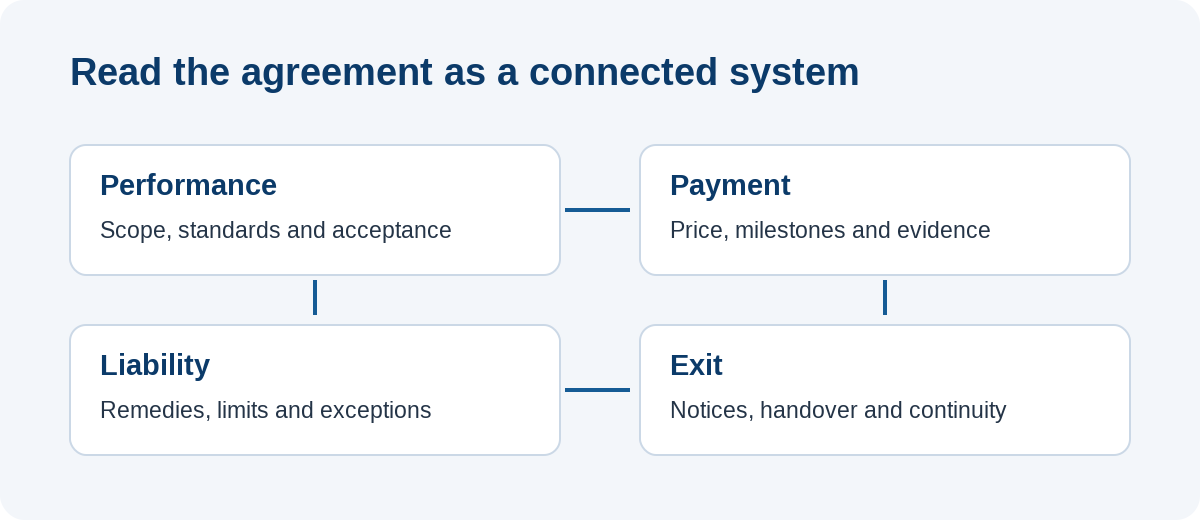
Contract drafting and review requires connected reading. A liability limitation may interact with an indemnity, insurance obligation, warranty and termination provision. An apparently balanced clause can become one-sided when an exception removes most of its practical effect. The review should therefore test how the provisions work together, including whether a remedy remains meaningful after the relevant exclusions are applied.
Use realistic scenarios. What happens if a supplier is late, the customer provides incorrect information, a subcontractor causes damage or a product does not satisfy the agreed specification? Trace each scenario through the obligations, notice requirements and available remedies. This exercise often reveals missing steps more effectively than reviewing each clause in isolation. It also allows the client to decide which risks it can accept commercially.
Confidentiality obligations should reflect the information being exchanged, who may access it and the permitted purpose of use. Consider employees, advisers and subcontractors who may need access to perform the work. The document should also address the treatment of information when the relationship ends. Requirements for personal information need their own assessment rather than being assumed to be covered by a general confidentiality promise.
Where the work produces designs, software, reports or other materials, distinguish existing intellectual property from newly created deliverables. Specify what the customer receives and what the supplier retains, taking account of third-party components. A statement about payment alone may not explain the intended licence or ownership arrangement. The business team should be able to tell whether it may modify, reuse or share the output.
Termination provisions should explain the circumstances in which a party may end the arrangement and the steps required before doing so. Consider the effect on unfinished work, prepaid amounts, confidential information, materials and continuing obligations. If services are operationally important, discuss whether transition assistance is needed. The purpose is to make the consequences understandable before the relationship becomes difficult.
Dispute provisions should be considered alongside governing law, language, the parties' locations and the nature of the transaction. A dispute clause copied from an unrelated agreement may introduce a process the parties did not intend. Contract drafting and review should identify any uncertainty about the selected mechanism and allow the business to consider practical questions about evidence, language and implementation before signing.
A useful review output separates essential changes, negotiable positions and points that require commercial confirmation. Explain the reason for a proposed amendment and, where appropriate, offer alternative wording. This makes it easier for the negotiating team to discuss the issue without turning every comment into a confrontation. A redline alone may not show whether a change is critical or merely preferred.
When seeking assistance from Jurion & Partners, a business can prepare its draft, transaction summary and priority questions so that the proposed scope of work can be discussed. The expected deliverables should be clear, such as a marked-up draft, an issues list or a discussion of unresolved points. The scope must reflect the actual request rather than assume that every review includes negotiation or representation.
Maintain a single negotiating version and record which schedules belong to it. For bilingual agreements, confirm that both language versions express the same commercial choices and that defined terms are used consistently. Translation can expose a substantive ambiguity rather than merely a wording problem. Review any clause addressing language priority in the context of the transaction and applicable requirements.
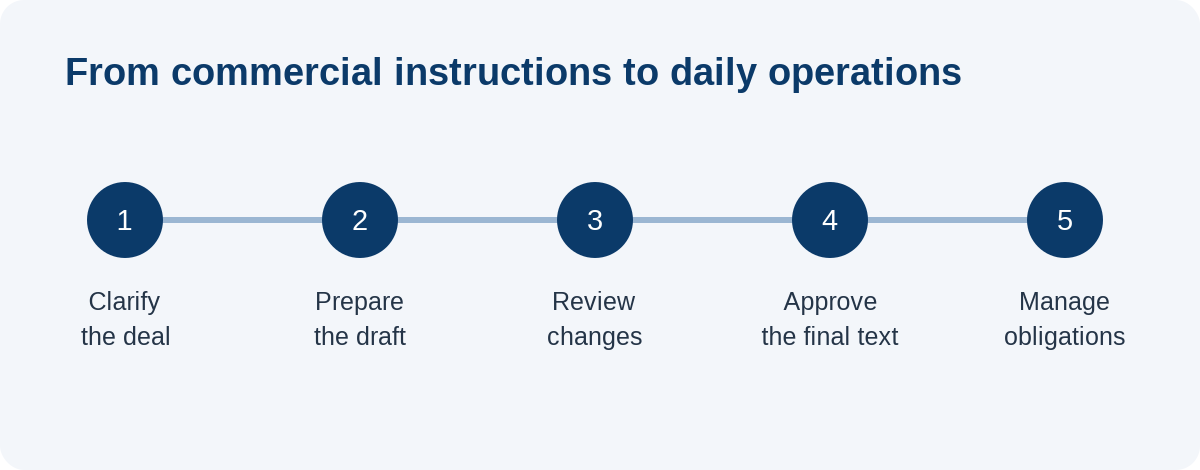
Contract drafting and review should finish with a usable execution copy and a clear handover. Confirm that the final text includes the agreed amendments, the correct schedules and the intended signing arrangements. Remove unresolved drafting notes. The operational team should know where to find the signed agreement and which obligations require monitoring, such as renewal decisions, reporting duties or notice periods.
If a disagreement later arises, preserve the agreement, change records and performance evidence before deciding on a response. A focused assessment of the contract before a potential claim can help organise the issues that need further investigation. That assessment depends on the facts and available documents rather than a general assumption that a contractual complaint will succeed.
Before approving the document, ask the people who will perform it to explain the key steps in their own words. Their questions can reveal an obligation that remains unclear even after several drafting rounds. Effective contract drafting and review produces more than a signed document: it gives the parties a practical framework for managing the transaction and making informed decisions when circumstances change.






Subscribe today to get more breaking news from Jurion Partners - Solicitors & Litigators

108 Tran Dinh Xu St., Cau Ong Lanh Ward, Ho Chi Minh City, Vietnam
(+8428) 66.701.709 - (+84) 903.419.479
contact@jurionpartners.com
Follow us
Accept payment





 English
 Tiếng Việt