A practical assessment of proposed contract terms, missing information, amendment priorities and accepted risks before signing.
Contract review helps a business understand what a proposed agreement requires before it accepts the obligations. The exercise is more than a proofreading check. It compares the document with the intended transaction, identifies provisions that may create difficulty and separates legal concerns from commercial choices. For a company working in Vietnam, a useful review should lead to clear decisions about what to accept, what to amend and what needs further investigation.
The scope depends on the question being asked. A full assessment of an unsigned agreement is different from checking a revised payment clause or examining an existing contract after a delay. Before work begins, specify the document, its status, the transaction and the decisions that need support. Without that brief, a reviewer may comment extensively on language while missing the issue that matters most to the business.
The review should consider the agreement as a connected system. Definitions influence obligations, obligations interact with remedies, and schedules can qualify terms that appear clear in the main text. A limitation in one section may remove the protection expected from another. Reading only the clauses that look unusual can therefore leave important risks undiscovered.
Begin by confirming which version is under assessment and whether all attachments are available. A contract sent without its technical schedule may not reveal the actual delivery commitment. A clean copy may hide changes made since the last negotiation. Request the relevant redline or version history where necessary and keep a record of the documents included in the assignment.
For contract review, the business should also provide the proposal, material correspondence and an explanation of the intended deal. The document may have been prepared by the other party or adapted from an earlier relationship. In either case, the reviewer needs to know whether its assumptions are correct. An apparent drafting issue can be evidence of a deeper disagreement about what the parties are buying or supplying.
Compare the party details with the entity that will actually perform or pay. Check whether the agreement uses a registered company name consistently and whether another group company appears elsewhere. Identify the proposed signatory's capacity and any authorisation that needs examination. These checks should be connected to the transaction rather than treated as a formality performed after the main terms have been approved.
The type of agreement, sector and cross-border features may raise questions about form, approvals, licensing or mandatory rules. A general review should identify those questions and explain if further investigation is required. It should not assume that a choice of governing law resolves every issue affecting performance in Vietnam. The appropriate analysis depends on the actual transaction and parties.
For agreements governed by Vietnamese law, Article 117 of the Civil Code identifies capacity, voluntary participation and lawful purpose and content as validity conditions; form is a condition where legislation requires it. This is a starting point for investigation, rather than a certificate that every signed document is enforceable. The reviewer must connect those questions to the parties, transaction and relevant specialist rules.
Article 398 addresses matters the parties may agree, including subject matter, quality, price, performance, obligations, breach and disputes. It is not a rule that putting those headings into a template makes the document complete. Article 404 also requires attention to the parties' intentions when interpreting unclear terms. Keeping the proposal and negotiation record can therefore help explain what the written terms were intended to achieve.
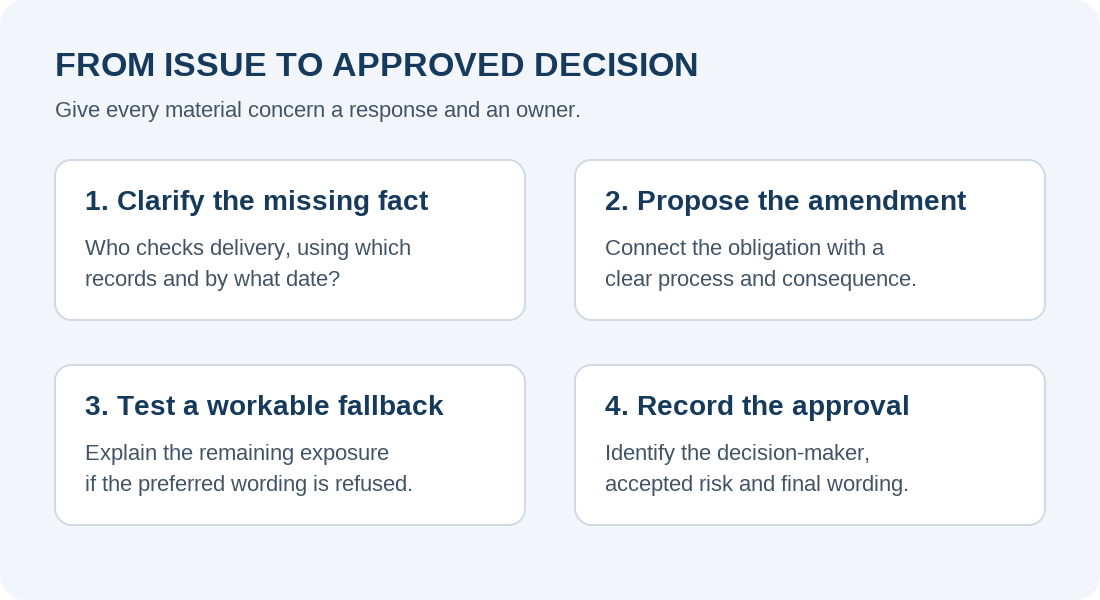
Suppose a proposed supply agreement says that payment follows satisfactory delivery without identifying who checks the goods or when a response is due. Simply changing the adjective does not resolve the problem. Ask the operations team what it will inspect, which records it can produce and how quickly it can respond. A proposed revision can then identify the inspection step, the person receiving the result and a process for dealing with a specific defect.
The commercial team should consider the fallback as well. If the customer rejects automatic acceptance, the supplier may ask for an escalation mechanism and separate treatment of undisputed deliveries. Neither position is automatically correct for every deal. The useful output is a choice with a stated consequence: which party carries the timing risk, what evidence it must keep and whether the price reflects that exposure.
A contract review may rely on information that has not been independently verified. Identify that information explicitly: for example, a manager's statement that a required licence is held, or an explanation of how a delivery system operates. Ask for supporting records where the point is material. If a technical, tax or regulatory assessment is outside the agreed assignment, allocate it to an appropriate person rather than allowing silence to be mistaken for approval.
Give each unresolved issue an owner and a response date. An issues list can distinguish awaiting business instruction from awaiting counterparty response and requires further legal analysis. That distinction helps prevent a signing deadline from turning an unanswered question into an accidental concession. When the parties settle an issue, retain the agreed wording and remove obsolete alternatives from the version to be signed.
Ask the team responsible for the work to describe how each major obligation will be performed. Can it meet the proposed delivery dates? Does it control the information needed to satisfy the reporting requirement? Is a named service level measurable? An obligation that is easy to accept during negotiation may be difficult to manage if it depends on processes the business does not have.
Contract review can use a simple performance map: identify the task, the responsible party, the trigger, the deadline and the evidence of completion. Any missing item becomes a question for the business or the counterparty. This method is particularly helpful for multi-stage projects, where one party's approval may be a condition for the next stage but the draft does not explain the approval process.
A service description may promise a broad outcome while an exclusion removes essential activities. For example, a maintenance arrangement may include inspections but exclude replacement parts, travel or emergency attendance. The reviewer should identify whether the price and expectations reflect those exclusions. The goal is to make the arrangement understandable, not to assume that every exclusion is inherently unacceptable.
Find out how the parties will decide that work is complete and how a concern must be raised. Assess whether the timetable and information requirements are practical. Then examine how changes affect the scope, price and delivery dates. A change clause that requires approval from an unnamed person may create uncertainty even when the parties agree commercially that additional work is needed.
Trace the payment obligation from the price definition to the invoice and payment deadline. Confirm the treatment of expenses, taxes, currency and adjustments where relevant. Check whether one clause permits withholding while another appears to require unconditional payment. Identify whether a payment milestone depends on an approval or document that the payer can delay without a clear response mechanism.
Consider a supplier who must purchase materials before starting work. If the customer can terminate immediately without addressing committed costs, the supplier may carry a risk it has not priced. Conversely, a customer paying in advance may need to understand what happens if delivery does not occur. A useful assessment explains the exposure and possible choices instead of simply labelling the clause “unfair”.
Contract review should test what happens when something goes wrong. Consider late delivery, defective work, loss of information or a failure by a subcontractor. Read the warranties, indemnities, exclusions, liability limits and insurance terms together. Determine whether the draft provides a clear route to a remedy and whether the proposed allocation matches the commercial value and risks of the transaction.
A reviewer should distinguish a legal conclusion from a negotiating recommendation. A clause may be legally possible but commercially unsuitable for the client. Another may require a specific legal assessment before any view on enforceability is appropriate. Comments should explain that distinction so that the business understands whether it is making a commercial concession or accepting an unresolved legal issue.
Check what information will move between the parties and who may use it. A confidentiality clause may not address the practical handling of personal information or access to a customer's systems. Identify third parties, permitted users and the arrangements needed when the work ends. Operational colleagues can help confirm whether the stated security or access obligations are achievable.
For deliverables, distinguish ownership, permitted use and restrictions on modification or sharing. Existing tools or third-party materials may need different treatment from a report created for the customer. The review should identify the intended business use and ask whether the document allows it. A customer receiving a file does not necessarily understand all the rights described elsewhere in the agreement.
Read termination rights alongside notice procedures, correction periods and the consequences of ending the agreement. Determine what happens to outstanding work, prepaid amounts, records and access credentials. If the service is critical, consider whether a transition process is needed. A broad termination right may sound protective but still leave the business without the materials or assistance it needs to continue operations.
Dispute provisions also need practical attention. Identify the chosen mechanism, language and any steps required before formal proceedings. Check for inconsistencies between the main document and incorporated terms. The review should raise questions about the proposed process where relevant, without assuming that one clause or one forum is suitable for every transaction.
A contract review report should prioritise issues. Separate points that require resolution before signing from acceptable risks and optional improvements. For each material concern, explain the effect, the suggested amendment and the decision needed from the client. Where possible, provide an alternative position so that the negotiating team can continue discussions rather than merely reject the other party's wording.
A business approaching Jurion & Partners can prepare its draft, transaction summary and list of commercial priorities to discuss an appropriate assessment scope. If the assignment is limited to selected clauses, make that limitation explicit. The team should know whether the work includes a marked-up document, an issues list or a discussion of the findings.
Not every requested amendment will be agreed. Record the final position on significant issues and identify who approved it. This helps the operational team manage the contract and prevents an accepted commercial risk from being mistaken for an unnoticed drafting error. It also gives future reviewers context when the agreement is renewed or amended.
After negotiation, compare the execution version with the approved draft. Confirm that attachments, defined terms and cross-references remain accurate and that no unresolved alternative wording survives. For bilingual documents, verify substantive consistency. The broader guide to drafting and reviewing a commercial contract explains how this final check fits with the preparation and management of the agreement.
Before signing, ask whether the business can explain the key obligations, payment events, exit process and accepted risks. If the answer is unclear, resolve the remaining questions while the document is still negotiable. A well-scoped contract review gives decision-makers a clearer basis for approval and gives the operating team a more reliable framework for performance.






Subscribe today to get more breaking news from Jurion Partners - Solicitors & Litigators

108 Tran Dinh Xu St., Cau Ong Lanh Ward, Ho Chi Minh City, Vietnam
(+8428) 66.701.709 - (+84) 903.419.479
contact@jurionpartners.com
Follow us
Accept payment





 English
 Tiếng Việt