Contract counsel, draw up contract
Contract drafting advice helps a business turn an intended transaction into clear instructions, workable clauses and a reliable signing document. The starting point is the commercial arrangement, not the template. Before anyone drafts, the parties need to know what they are exchanging, which decisions remain open and how performance will be organised. A document prepared without that understanding may look complete while leaving the most important questions unanswered.
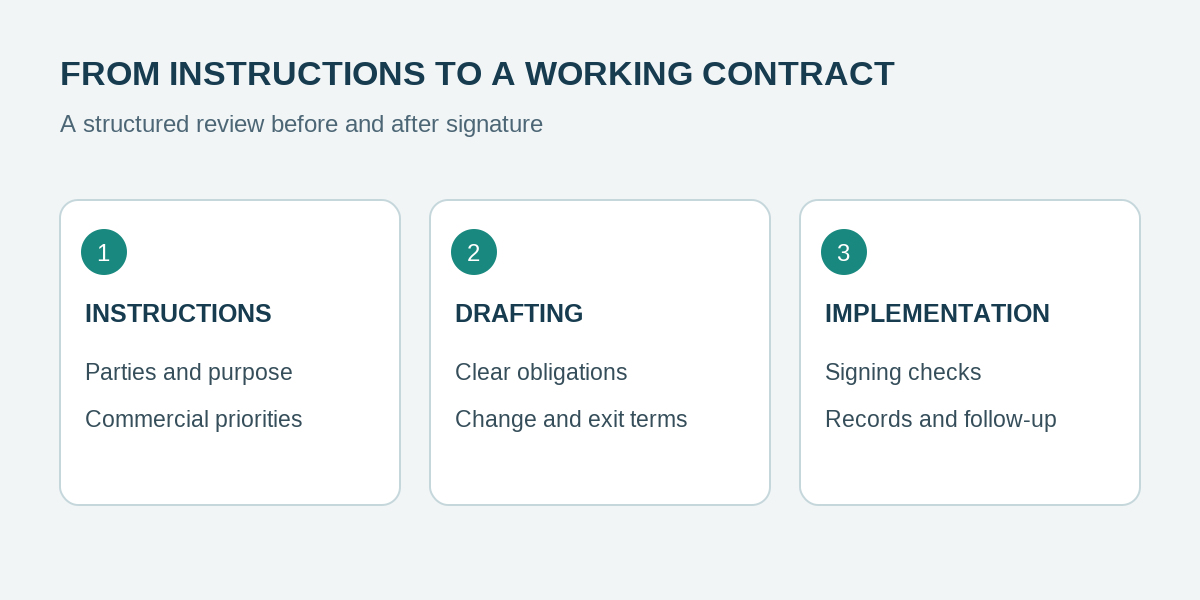
A business may need a new agreement when it introduces a service, works with a different type of customer or enters a transaction that its existing terms do not cover. Advice can also be useful when several documents have developed informally and no longer describe the arrangement consistently. The drafting exercise should establish a coherent account of the deal rather than simply combine old clauses into a longer document.
Consider a company appointing a maintenance provider. A price and a general promise to maintain equipment may not explain response times, access to the site, spare parts, reporting or the treatment of work outside the original scope. Those details need commercial decisions before they can become meaningful obligations. Identifying them early reduces the chance of discovering a major disagreement only after the document is sent for signature.
The most useful brief explains the transaction in ordinary language. Identify the intended parties, the objective of the arrangement, the proposed duration and the expected exchange of goods, services or payment. Explain what would make the transaction successful and what failure would look like. This information helps the drafter recognise which protections matter and which provisions might add complexity without serving a real purpose.
For contract drafting advice, distinguish instructions from assumptions. A price discussed in a meeting may still need approval. A proposed delivery date may depend on another supplier. A customer might expect ownership of the final report while the service provider expects to retain rights to its underlying materials. Marking those points as unresolved gives the negotiating team a clear list of decisions to make.
The pack should be organised rather than exhaustive. Explain why each document matters and identify its current version. If a proposal has been superseded, retain it as background only and mark that status. Otherwise, an obsolete price or specification can reappear in the draft and create a disagreement that the business thought had already been resolved.
A single project may be covered by one agreement with attached specifications. An ongoing relationship might need a framework agreement with separate orders. A collaboration could require a different structure again, especially where the parties share resources or develop materials together. The choice should reflect how work will be approved and performed, including whether individual transactions need their own commercial terms.
The drafter should also consider the legal requirements relevant to the subject and the parties. A general commercial template does not answer every question about form, authority, approvals or sector restrictions. These issues should be investigated as part of the instructions where they apply. The purpose is to determine what the proposed transaction requires, rather than assume that the same signing process works for all arrangements.
Use the main document for the legal and operational framework, then place detailed specifications or pricing tables in schedules where that improves readability. Define how the documents fit together and resolve conflicting provisions deliberately. A priority clause should not become an excuse to leave obvious contradictions unresolved. The team should be able to understand its obligations without making difficult interpretive choices during performance.
Contract drafting advice should move beyond statements of good intention. Describe what each party must do, when it must happen and which information or access the other party must provide. If a task depends on approval, identify the approver and the process. If delivery depends on site readiness, explain how readiness is confirmed and how a delay will be addressed.
Take a training services agreement as an example. The document may need to distinguish preparation, delivery, attendance records and post-session materials. If the customer cancels a session, the consequence may depend on notice and costs already incurred. If the provider changes a trainer, the customer may want a way to assess the replacement. These are commercial choices that precise drafting can make visible.
Acceptance should relate to standards the parties can actually apply. Software, equipment, reports and advisory services cannot always be assessed in the same way. Identify the review period, the information needed to raise a concern and the process for addressing a disputed result. Consider whether acceptance of one stage affects later stages and whether a correction requires another review.
Connect the price to the scope and identify the event that triggers each payment. Consider supporting records, invoice requirements, applicable taxes and expenses where relevant. If work may be suspended for non-payment, review how that right interacts with notice requirements and ongoing obligations. A business should understand both the financial commitment and the practical consequences of a missed payment.
A new agreement should anticipate how the parties will respond to changes without attempting to predict every event. Establish who may request additional work and who may approve its price and timing. Describe how an instruction is recorded. A short, usable change process can be more valuable than a detailed clause that no one follows because it does not match daily operations.
Contract drafting advice also examines dependencies outside the parties' immediate control. These may include information from a customer, a third-party licence or access to premises. The drafting should identify the relevant dependency and allocate responsibility for communicating problems. A general statement about unexpected events may not explain what happens when one specific input is missing.
Termination provisions require decisions about both the trigger and the consequences. Ask whether a problem can be corrected, what process is appropriate and what happens to work already performed. Consider unfinished deliverables, return of materials, access credentials and transition needs. These questions can be particularly important where a customer depends on the service for continuing operations.
The agreement should explain which obligations continue after termination where appropriate. Confidentiality, use of intellectual property and outstanding payment questions may need different treatment. Avoid copying a broad list of surviving clauses without checking its effect. The intended result is a clear exit process that the business can understand before the relationship becomes difficult.
A drafting project often reveals matters that require a commercial decision rather than a purely legal answer. A higher liability limit may be acceptable for one contract and disproportionate for another. An exclusive arrangement may support investment but restrict future opportunities. Explain the available choices and their implications so that the person approving the transaction can make an informed instruction.
When discussing a drafting assignment with Jurion & Partners, prepare the transaction brief and identify the issues that need priority attention. The proposed scope can then distinguish drafting from negotiation, translation or a separate review of existing obligations. A clear assignment helps establish what the finished work should contain and which questions still require confirmation from the client.
Consolidate internal comments before sending instructions to the drafter. Contradictory directions from several teams can produce a document that satisfies no one. Nominate a person to coordinate commercial decisions and maintain an issues list. Record the reason for significant changes so that later drafting rounds do not reopen a point unintentionally or remove a protection without approval.
Contract drafting advice should include attention to the final assembly. Check defined terms, cross-references, dates, amounts and schedule numbers. Confirm that the intended parties and signing capacities remain correct after negotiation. Remove drafting notes and unresolved alternatives. For bilingual documents, compare the substantive meaning rather than assume that matching formatting proves the versions are equivalent.
A broader explanation of drafting and reviewing commercial agreements can help the team see how the drafting stage connects to risk review, negotiation and contract management. The final check should also involve the people responsible for performing the agreement, because they may identify an impractical instruction that was not obvious during legal discussion.
Once signed, prepare a short handover of the main operational obligations. Record the dates that need monitoring, the approvals required for changes and the records that should be retained. The signed document should be accessible to the people who need it, while sensitive information is handled according to the agreed arrangements. A contract that disappears into storage will do little to guide day-to-day decisions.
Begin the project by writing down the intended transaction and the questions that still require agreement. Bring the commercial and operational teams into that discussion early, then use the draft to test whether the arrangement is complete. Effective contract drafting advice helps create a document that reflects deliberate choices and supports a workable business relationship.






Subscribe today to get more breaking news from Jurion Partners - Solicitors & Litigators

108 Tran Dinh Xu St., Cau Ong Lanh Ward, Ho Chi Minh City, Vietnam
(+8428) 66.701.709 - (+84) 903.419.479
contact@jurionpartners.com
Follow us
Accept payment





 English
 Tiếng Việt