Set clear instructions, connect concessions with conditions, manage sensitive information and record approvals before the agreement is signed.
Contract negotiation support helps a business explain its position, assess proposed compromises and translate an agreed deal into workable terms. Negotiation is rarely just a contest over wording. It involves priorities, operational constraints and decisions about who will bear particular risks. A structured approach allows the team to understand what it needs, where it has flexibility and how a change in one clause affects the rest of the agreement.
The assignment should begin with the transaction and the stage of discussions. A team negotiating its first draft needs different assistance from a team resolving a small number of final issues. Establish whether the work involves preparing comments, attending meetings, developing alternative wording or reviewing the resulting document. A clear scope helps the business understand what decisions it must make and what information its advisers need.
The objective is an agreement that the parties can perform with a shared understanding of the main obligations. Securing every preferred clause is not always necessary or commercially realistic. Some provisions may be essential, while others can be adjusted in exchange for a suitable change elsewhere. The team should evaluate those choices deliberately rather than respond to each comment as though it has equal importance.
Before exchanging amendments, identify the deal's commercial purpose, the expected benefit and the main downside risks. Ask the people responsible for performance which terms they can realistically meet. A proposed service level may sound acceptable to a sales team but require resources the operations team has not budgeted. Internal alignment prevents the business from offering a concession that it later needs to withdraw.
For contract negotiation support, prepare a mandate distinguishing essential positions, preferred outcomes and matters that require further approval. Record who may approve a change to price, scope, liability or timing. The negotiating representative should know when to pause discussions and obtain instructions. An internal approval boundary is most useful when it is clear before a meeting, not discovered after a commitment has been made.
A proposed clause may reflect a genuine operational problem rather than an attempt to transfer every risk. Ask what the other party is trying to protect. If a customer requests a broad replacement obligation, the underlying concern may be continuity of service. If a supplier requests a minimum volume, it may need certainty before investing in stock. Understanding the concern can reveal alternatives that are more workable for both sides.
List each open point, the current wording, the concern and the proposed response. Add the person responsible for the decision and the status of the discussion. Keep the list concise enough to use in a meeting. An uncontrolled collection of email comments makes it difficult to distinguish an unresolved issue from an amendment that has already been accepted in principle.
Some points require an assessment of applicable law or transaction requirements. Others are choices about value, cost or risk appetite. Those categories should be explained clearly. A negotiator should not describe every preferred position as legally required, because that can undermine the discussion and prevent a sensible compromise. Equally, a genuine legal question should not be treated as resolved merely because the business wants to proceed quickly.
Where an agreement has a cross-border element or concerns a regulated activity, identify the questions that need investigation before finalising the relevant clauses. These may concern authority, approvals, form or the proposed dispute process. The appropriate analysis depends on the parties and subject matter. A clause used successfully in another transaction is useful background, but it is not a substitute for checking the present arrangement.
Contract negotiation support is most effective when the parties can see how a provision will operate. Instead of debating an abstract phrase about satisfactory performance, discuss the inspection process, the evidence of completion and the steps for correcting a problem. Specific examples make it easier to identify the real disagreement and draft a response that both teams understand.
Consider a customer who wants payment only after final acceptance and a supplier who needs to finance materials. Possible structures might include a limited advance, staged payments or a defined acceptance timetable. The suitability of any option depends on the deal. The useful negotiation question is how to connect payment with verifiable progress while addressing the parties' actual constraints.
A party may accept flexibility in the scope if there is a reliable method for assessing the effect on cost and delivery. Identify who can request changes, what information must be provided and how approval is recorded. Avoid a compromise that grants a broad change right in one clause while leaving the original fixed price and deadline untouched elsewhere.
Response times, staffing commitments and reporting duties should be checked against actual capacity. If the team cannot meet a proposed obligation consistently, consider a different service level or pricing structure. An ambitious promise that will be breached from the beginning is unlikely to improve the relationship. It can also distract the parties from a more realistic arrangement that serves the commercial objective.
Negotiation can involve legal duties before the final contract exists. Article 387 of Vietnam's Civil Code addresses information affecting the other party's acceptance and the handling of confidential information received during contract formation. It also addresses compensation where breach of those duties causes damage. The relevant facts must be examined; an unsuccessful negotiation alone does not establish a breach or a right to compensation.
Prepare a controlled information pack rather than sending every commercial record at the first meeting. Identify what the other party needs to evaluate the proposal, who may receive it and which facts require explanation. Where sensitive material is necessary, agree appropriate access and confidentiality arrangements. A business should also check the information it provides for accuracy and avoid making a statement broader than the facts support.
Imagine a supplier offers a lower unit price if the customer accepts a minimum purchase commitment. A meeting summary that records only the lower price loses the reason for the concession. Write down both components, the proposed measurement period and what remains subject to approval. When the draft returns, confirm that the price and volume provisions still express the same arrangement.
Contract negotiation support should make these dependencies visible without turning an ordinary discussion into a threat. A concise response might explain that the proposed price depends on the stated quantity and ask whether the customer prefers that package or the existing flexible arrangement. The decision then concerns a commercial mechanism that both parties can evaluate, rather than competing claims that one wording is more reasonable.
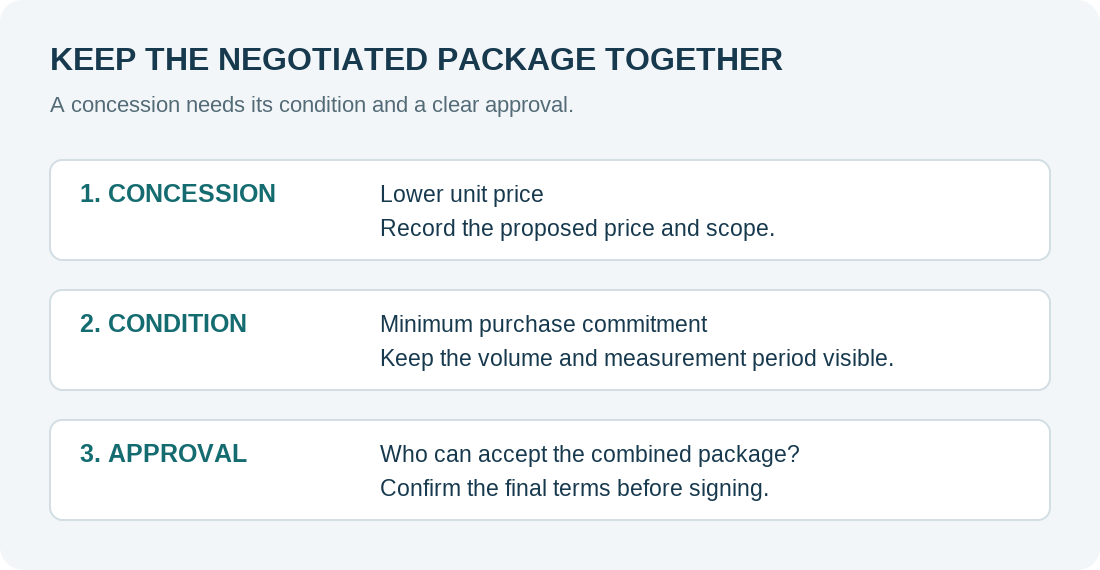
Before issuing a meeting note or revised proposal, check what it says about acceptance, approval and outstanding points. A document's effect depends on its contents and circumstances, not just its filename. Avoid assuming that an unsigned email can never matter or that adding a label automatically resolves every question. If there is uncertainty about whether an exchange has already created obligations, obtain an assessment before sending a contradictory message or acting on a different assumption.
At the next meeting, reopen the actual unresolved issues rather than silently revisiting an approved package. If new information changes the position, explain the change and ask for fresh instructions. This protects the reliability of the negotiation record and gives decision-makers a reasoned basis for accepting, modifying or declining the revised arrangement.
Liability negotiations often become difficult because the parties discuss large concepts without agreeing what events they are concerned about. Use scenarios such as delayed delivery, damage to equipment or unauthorised use of confidential information. Examine the relevant obligations and remedies together. Determine which party can prevent the risk, what evidence would be available and what financial exposure each side is prepared to accept.
Contract negotiation support should also identify interactions between provisions. A liability cap may mean little if broad exceptions remove most claims from it. An indemnity may overlap with another remedy. A termination right may require transition obligations that are not addressed. The negotiating team needs to understand the combined effect before it offers or accepts a compromise.
Use an agreed agenda for substantive discussions and confirm which participants have authority to make decisions. Record conclusions accurately, including points subject to internal approval. If agreement is only provisional, describe that status clearly. A meeting note should not transform an exploratory suggestion into an unconditional commitment or omit an important qualification that shaped the discussion.
A business seeking assistance from Jurion & Partners can prepare its current draft, negotiation history and priority issues to discuss the proposed role. It should also explain the preferred communication process and approval structure. This preparation helps distinguish legal input from commercial instructions and avoids uncertainty about who is speaking for the business on a particular point.
Some issues are connected. A longer service commitment may depend on a different price or a clearer termination mechanism. When discussing a package, identify its components and whether acceptance of one depends on the others. Keep a record of the overall balance so that a later drafting round does not retain the concession while accidentally removing the related protection.
When a point remains unresolved, explain its practical effect and ask for the information needed to assess alternatives. Escalate to decision-makers when there is a genuine commercial choice or approval question. Repeating increasingly forceful wording is unlikely to resolve a disagreement about cost or responsibility. A short explanation of the available options is usually more useful than another lengthy exchange of positions.
Nominate the current version and keep changes visible. Record agreed points in the document rather than rely only on a separate email. If multiple people edit the same text, reconcile their comments before issuing the next version. For bilingual agreements, update both versions consistently and check that an accepted change has the same substantive meaning in each language.
Contract negotiation support should include a final comparison between the agreed position and the proposed signing copy. Check the schedules, definitions, amounts and dates as well as the clauses that received the most attention. A late formatting or compilation change can reintroduce old wording. The final document should reflect the negotiated deal without unresolved drafting alternatives or contradictory attachments.
A negotiation may reveal information that changes the transaction, such as a different contracting entity, a new licensing question or a dependency that was not previously disclosed. Pause the affected issue and assess the new facts. The existence of a commercial deadline does not make the uncertainty disappear. The business should decide how to proceed with a clear understanding of what remains unresolved.
The guide to drafting and reviewing a commercial contract provides the wider framework for turning those decisions into a coherent document. Negotiated amendments should be considered within that whole structure, especially where they affect risk allocation, performance or the way the agreement may end.
After approval, brief the people responsible for performance on the negotiated obligations and accepted risks. Explain any unusual notice process, reporting requirement or approval condition. Retain the final agreement and the decision record so that renewals or disputes can be considered in context. The work of negotiation should support implementation rather than end with an unexplained signing document.
Prepare your priorities, decision boundaries and supporting documents before the next negotiation round. Use each discussion to clarify the arrangement and test whether a proposed compromise can work in practice. Effective contract negotiation support helps the business reach an informed agreement and carry that understanding into the relationship that follows.






Subscribe today to get more breaking news from Jurion Partners - Solicitors & Litigators

108 Tran Dinh Xu St., Cau Ong Lanh Ward, Ho Chi Minh City, Vietnam
(+8428) 66.701.709 - (+84) 903.419.479
contact@jurionpartners.com
Follow us
Accept payment





 English
 Tiếng Việt