Build a chronology, separate each requested sum and evaluate the evidence, counterarguments and relevant time rules before selecting a dispute response.
Pre-litigation contract assessment helps a business examine a disagreement before deciding whether to pursue a formal claim. A missed payment, rejected delivery or disputed termination may look straightforward in correspondence, yet the legal and evidential questions can be more complex. The purpose of the assessment is to organise the facts, identify the contractual issues and explain the choices that need further consideration. It should provide a reasoned basis for a decision rather than a promise about the outcome.
The initial questions are practical: what obligation is said to have been breached, what evidence supports that position and what result does the business want? A claim for payment may require different preparation from a request to stop unauthorised use of information. Clarifying the objective helps define the investigation and avoids spending time on a lengthy legal discussion that does not address the client's immediate decision.
A written opinion or issues report should identify the documents reviewed, the relevant assumptions and any missing information. It should distinguish established facts from the client's account of disputed events. Where conclusions depend on further evidence or legal analysis, those conditions should be stated. The document is most useful when the business can understand both the reasoning and its limits.
Collect the signed agreement, schedules, amendments and records of performance. Preserve relevant correspondence, delivery documents, invoices, payment records and notices. Keep original files and their available context rather than relying only on selected screenshots or extracts. A message can have a different meaning when read with the conversation that preceded it or the attachment it accompanied.
For pre-litigation contract assessment, create a chronology that identifies the event, date, people involved and supporting document. Mark events for which no record has yet been located. The aim is not to create a persuasive story at the expense of accuracy. It is to establish a reliable account that can be tested, including facts that may weaken the proposed position.
A clause discussed during negotiation may not appear in the signed version. A later order may modify part of the original arrangement. Identify which documents are relied on and how they relate to one another. If the status of a document is uncertain, treat that as a question for assessment rather than assuming that every favourable statement became part of the contract.
The person who holds a document may not know why it was created or what happened during performance. Identify staff members who can explain delivery, inspection, approval or payment processes. Record their knowledge accurately and distinguish direct involvement from information received from others. This can reveal gaps that a document-only review would miss.
Start with the obligation, then compare it with the conduct complained of. A general complaint about poor performance may involve several separate issues, each with different evidence and consequences. Identify the relevant contractual wording, the event that triggered performance and any qualification or dependency. If the client had obligations that affected the other party's performance, those should also be considered.
Pre-litigation contract assessment should examine alternative explanations. A supplier may say that delivery was delayed because the customer changed the specification. A customer may argue that an invoice was not payable because acceptance was incomplete. The assessment should test these positions against the documents rather than assume that one party's description settles the legal question.
Identify any notice requirements that may be relevant and check what was actually sent, by whom and through which channel. Preserve delivery or receipt records where available. Review subsequent communications and conduct, including any proposed correction, replacement or revised timetable. These facts may affect the analysis and can be important even when the original complaint is well documented.
A business may have incurred several types of cost, but the amount it wishes to recover is not automatically the amount supported by the evidence and applicable rules. Build a calculation with supporting records and identify assumptions. Separate unpaid invoices, replacement costs and other claimed items so that each can be assessed. Avoid presenting an estimated total as though every component has already been established.
A pre-litigation contract assessment should identify the applicable time rule and the event from which it runs. Article 429 of Vietnam's Civil Code provides a three-year court-claim period from when the entitled party knew or should have known of the infringement. Article 319 of the Commercial Law provides a two-year period for commercial disputes from the infringement, subject to its stated exception. These rules cannot be treated as interchangeable deadlines for every contractual complaint.
Ask the adviser to identify the legal basis, relevant dates and any issue concerning exclusion, suspension or recommencement that needs examination. A contractual notice deadline, a complaint period and a limitation period may require separate attention. Sending a demand or continuing settlement discussions should not be assumed to preserve every right. Where a date is uncertain, identify the uncertainty promptly rather than waiting until the evidence review has finished.
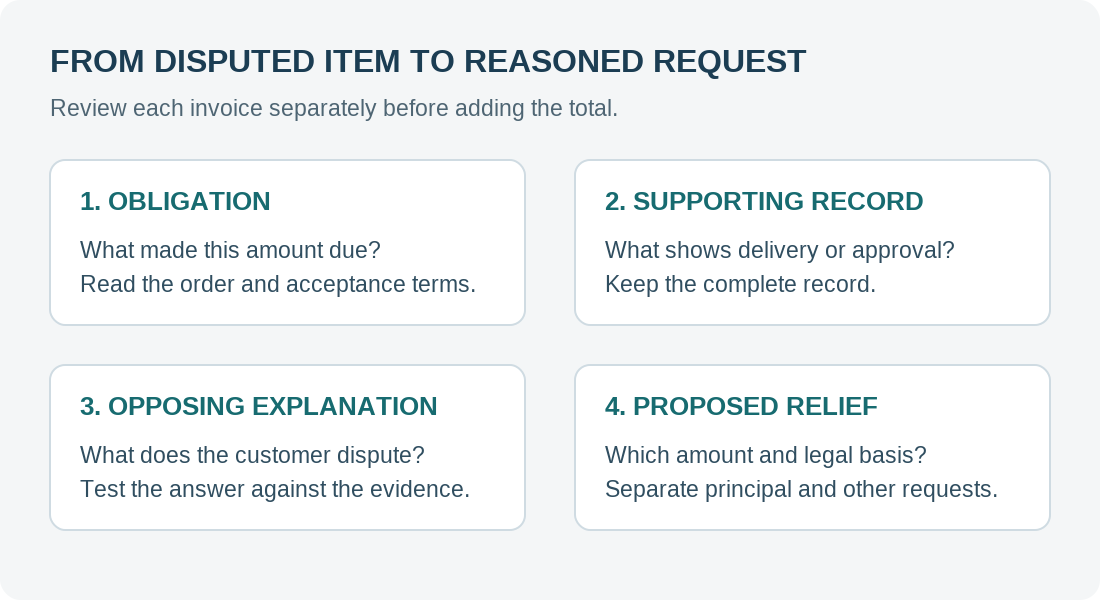
Suppose a supplier has issued three invoices, but the customer says only two deliveries were accepted. Begin by separating the transactions. For each invoice, identify the order, delivery record, acceptance requirement, proposed due date and payment received. Then match the customer's explanation to the relevant item. The existence of a total balance in an accounting ledger does not by itself answer whether each amount is due under the agreement.
The assessment may reveal different issues: one invoice is supported by an acceptance record, another depends on a disputed inspection, and a third includes work requested outside the written scope. The supplier should preserve the change instruction and identify who gave it. It should also provide any credit note, replacement offer or payment allocation that affects the calculation. These facts may narrow the disagreement more effectively than repeatedly sending the same total demand.
Present the proposed relief in separate lines: principal, any contractual penalty, interest and compensation, with a distinct basis and calculation for each. Avoid combining the same cost twice or treating a penalty as proof of actual loss. The legal opinion should explain what supports each request, what the counterparty may dispute and which documents could change the conclusion. This is a method for organising a hypothetical dispute, not a prediction that any listed sum will be awarded.
The agreement may contain provisions about negotiation, mediation, arbitration or court proceedings. Those provisions need to be read carefully and considered with the parties, subject matter and applicable law. A preferred route should not be assumed available without assessment. The analysis may need to address the forum, the scope of the dispute clause and any steps required before formal action.
Pre-litigation contract assessment should anticipate the other party's principal arguments. These might concern the meaning of the scope, acceptance of work, a change instruction or the client's own performance. Consider whether the documents support a counterclaim or a different calculation. Testing the position early gives the business a clearer view of the dispute than considering only the facts that favour its initial complaint.
Practical questions matter as well. Identify the correct counterparty, its role in the transaction and any information relevant to implementation of a potential outcome. Consider language, document availability, technical evidence and the resources needed to manage proceedings. A legal route can involve significant work even where the contractual argument appears strong. Those factors belong in the decision-making discussion.
A reasoned assessment may identify several options: seek clarification, propose a correction, negotiate a settlement, prepare a formal demand or investigate a potential claim further. The appropriate sequence depends on the circumstances. The business should understand what each option is intended to achieve, which information is still needed and what consequences may follow from the proposed communication or action.
Negotiation should have a defined objective and an approval structure. A proposal might address payment timing, replacement performance, return of materials or the end of the relationship. If the business is considering a settlement, the terms need their own assessment. Resolving one complaint should not inadvertently leave uncertainty about continuing obligations or other issues the parties intended to address.
List the available route, the intended outcome, the main evidence needed and the practical disadvantages. Identify decisions that require management approval. The matrix should not disguise uncertain estimates as precise forecasts. Its purpose is to make the choices comparable and help the business explain why it prefers one approach over another.
A request for advice should identify the transaction, the dispute and the decision that must be made. Specify whether the assignment concerns liability, a proposed termination, a payment demand or broader litigation preparation. Provide the complete relevant record and explain any deadline already known. If the matter changes during the review, update the instructions rather than assume that an earlier scope covers every new issue.
When discussing assistance with Jurion & Partners, prepare a chronology, the operative agreement and a short list of questions. The proposed work can then distinguish an initial assessment from detailed evidence review, negotiations or representation. The deliverable should make clear what has been considered and which additional steps would require separate instructions.
Pre-litigation contract assessment is not a substitute for the facts or for the decisions of a competent forum. A conclusion may change when a missing document is produced or the other party explains its position. Review the assumptions and qualifications alongside the recommended next step. If the business does not understand a material limitation, ask for clarification before relying on the conclusion.
A useful opinion will also identify what would improve the assessment. That might be a technical explanation, a clearer loss calculation or confirmation of the contracting entity. Allocate responsibility for obtaining those items and keep the chronology current. The review should produce an organised work plan, not simply a document that is filed away while the dispute continues to develop.
A disagreement can reveal a recurring weakness in the business's contracting process. The scope may have been vague, approval records inconsistent or changes agreed informally. After addressing the immediate matter, consider how the findings should influence future documents and operational controls. The guide to drafting and reviewing commercial agreements provides a framework for addressing those issues before another transaction is signed.
Preserve the evidence, define the decision and examine the strongest available account of both parties' positions. Then choose the next step with a clear understanding of the legal questions, missing information and practical constraints. Careful pre-litigation contract assessment supports a proportionate response and helps the business act on reasons it can explain.






Subscribe today to get more breaking news from Jurion Partners - Solicitors & Litigators

108 Tran Dinh Xu St., Cau Ong Lanh Ward, Ho Chi Minh City, Vietnam
(+8428) 66.701.709 - (+84) 903.419.479
contact@jurionpartners.com
Follow us
Accept payment





 English
 Tiếng Việt