How to scope and conduct an acquisition legal review, assess ownership and operating documents, investigate evidence gaps and produce a decision-focused report.
Legal due diligence in M&A examines whether the business a buyer intends to acquire is supported by the rights, permissions and arrangements on which its value depends. The work goes beyond collecting registration certificates. Lawyers examine ownership, authority, contracts, assets, employment and disputes, then explain what the available evidence establishes and what remains uncertain. A useful review gives the buyer a reliable basis for questions and decisions before it commits to the transaction.
The review connects the proposed acquisition with the legal position of the target and the interests being transferred. It asks whether the seller can deliver the intended interest, whether the business can operate as expected, and whether obligations or restrictions could materially affect the buyer's objective. The answer depends on the particular company and structure; there is no single document that proves the entire business is legally sound.
Legal review also has boundaries. It does not replace a financial audit, technical inspection, environmental assessment or tax investigation. These workstreams should exchange relevant findings. For example, a financial model may assume continued use of a site, while the lease reveals a short remaining term. Identifying that inconsistency allows the team to test the valuation assumption against the actual legal arrangement.
Start with the transaction outline: the purchaser, seller, target entities, interests or assets involved, proposed ownership percentage and intended timetable. Clarify whether the review concerns the whole group, one subsidiary or selected assets. Otherwise, a large data room can create the impression of thoroughness while leaving the decisive entity outside the assignment.
Ask the buyer which features justify the investment. A manufacturing acquisition may depend on premises, equipment and operating permissions. A software business may depend on intellectual property ownership, customer contracts and key personnel. That commercial explanation helps counsel prioritise the right questions without assuming that less prominent areas can be ignored altogether.
Agree the reporting format, materiality approach, review period, language arrangements and intended users of the report. State exclusions and any agreed sampling. If time allows only a focused review of critical risks, explain that limitation explicitly instead of presenting it as a comprehensive examination.
The initial request should cover the target's legal structure and the main operational areas, with tailored questions for its activities. Request complete documents, amendments and relevant schedules. A contract's signature page alone rarely establishes its commercial restrictions, and a permit cover page may omit conditions or the description of the authorised site.
Use a request register with an identifier for each item. Record whether a document has been provided, is said not to exist, is unavailable, or has been replaced by another record. These are different answers. A blank response should remain an unanswered question rather than silently becoming confirmation that the issue does not arise.
Follow up in stages. Once the first documents reveal how the business actually works, refine the request rather than repeatedly sending the same generic checklist. A disclosed loan, for example, may call for security documents, repayment records, amendments and consent provisions that were not apparent from the original company overview.
Examine establishment documents, amendments, ownership records, capital contributions and relevant corporate decisions. Trace the seller's claimed interest and investigate inconsistencies between certificates, registers and transaction history. Confirm the authority of the people approving and signing the proposed transaction; a familiar job title does not by itself answer every question about signing power.
Public information can help test the material supplied. The National Business Registration Portal provides business search and information services, but the scope and currency of the information obtained must be understood. A successful search is not confirmation of every beneficial interest, internal approval, historical payment or undisclosed obligation.
Identify the activities the target actually conducts, where it conducts them and which entities contract with customers. Compare that operating model with the relevant registrations, licences and conditions. The question is not merely whether a certificate exists, but whether the permissions and continuing requirements correspond to the business being acquired.
Separate permissions held by the target from those held by a founder, affiliate or landlord. Review the implications of the proposed ownership or asset transfer under the rules applicable to that business. Do not assume that all approvals transfer automatically or that every acquisition requires the same regulatory steps.
Review important customer, supplier, distribution, borrowing and security arrangements. Look beyond price and term to termination rights, exclusivity, renewal, restrictions on assignment, change of control provisions and obligations triggered by default. Determine which contracts are essential to revenue or operational continuity.
Reconcile the documents with the commercial account of the business. If management describes a customer relationship as exclusive and long term, check whether the agreement actually provides that protection. Where an amendment is unsigned or arrangements are described as oral, report the evidence and the resulting uncertainty rather than supplying missing terms from assumption.
Identify who owns or has permission to use each material asset. For premises, consider the relevant title or lease documentation, permitted use, restrictions and remaining availability. For equipment, examine ownership, financing and any disclosed security interests. Physical possession alone does not establish an unrestricted right to transfer.
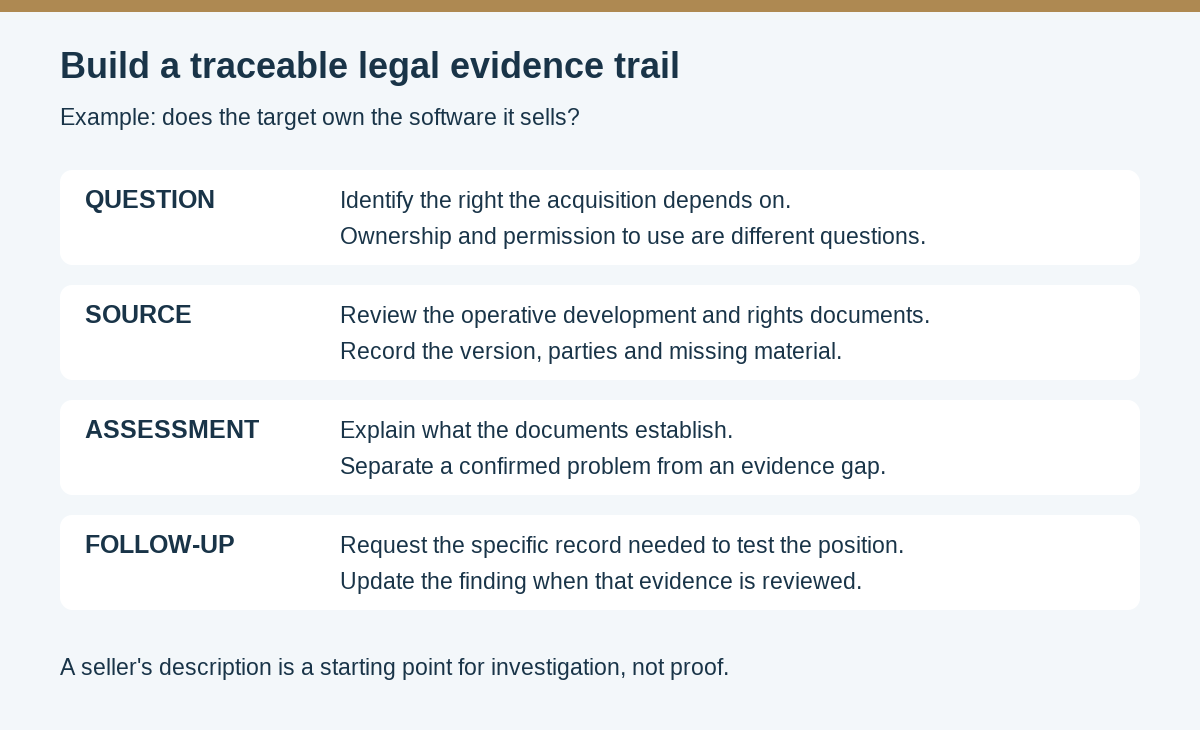
For intellectual property, examine ownership and usage rights separately. A registered mark does not prove ownership of software written by an outside developer, and payment of an invoice may not resolve every contractual rights issue. Request the relevant development, assignment, licensing and employment documents and examine their relationship with the products actually sold.
Review the workforce arrangements material to the business, including key roles, employment terms, relevant internal rules and disclosed disputes. Coordinate with the appropriate specialists on outstanding payments, social insurance and other compliance concerns. Avoid treating a small sample as proof that every employee arrangement is compliant.
Ask about litigation, arbitration, regulatory enquiries, complaints and threatened claims, then seek the underlying correspondence and procedural documents. Management's description of a case as “closed” should be supported by evidence explaining what ended and whether obligations remain. A demand letter and an enforceable decision carry different implications.
Good legal due diligence in M&A distinguishes the source of a statement from the conclusion drawn from it. A management interview can explain an apparent inconsistency, but an explanation should be checked against the relevant documents where possible. Note unresolved contradictions and identify the evidence that could resolve them.
Cross-check dates, entity names, registration numbers and defined terms. A permission granted to an earlier entity, a contract signed before a restructuring, or a document referring to an unprovided schedule may require further investigation. Translations should preserve qualifications and obligations; an informal summary should not silently replace the operative document.
Keep a traceable reference for each important finding, including the document version and date reviewed. Record assumptions and the review cut-off. This allows another team member to reproduce the analysis and prevents a later replacement file from obscuring the basis on which the original conclusion was reached.
A data room should give reviewers the information needed for the agreed task while protecting material that should not be distributed broadly. Consider access groups, redaction, download restrictions and a record of disclosures. Sensitive commercial information may require a separate review arrangement, particularly where the buyer and target compete.
Employee, customer and other personal information needs separate attention under applicable data protection requirements. A confidentiality agreement alone does not establish that every disclosure or use is lawful. Ask whether an anonymised summary or restricted review can answer the question, and obtain advice on the lawful basis and any additional requirements before sharing identifiable records.
The report should distinguish confirmed problems, unresolved information gaps and matters requiring specialist assessment. For each material item, explain the relevant facts, the legal concern, its connection to the acquisition and the proposed next step. Avoid a long catalogue of documents without an assessment of what they mean.
A concise executive summary can identify issues requiring immediate decisions, while detailed schedules preserve the supporting analysis. Risk descriptions should explain their basis and uncertainty. A colour or numerical score is useful only if readers understand what it measures; it should not turn a tentative observation into an apparently certain conclusion.
Suppose management says the target owns the platform responsible for most of its revenue. The data room contains a developer's invoice and a customer presentation, but no development agreement or assignment. The correct initial finding is an evidence gap concerning ownership and usage rights, not an automatic conclusion that the platform belongs to someone else.
The follow-up request should seek the operative agreement, amendments, relevant employee or contractor arrangements and any licence terms. If the material establishes only a restricted licence, the team can then assess whether the intended transaction and future operation fit that licence. This sequence keeps the conclusion proportionate to the evidence and directs effort toward the fact that matters.
Read more: The proposed direction of the problem handling of the lawyers after the LDD
Read more: The Pros and Cons of Mergers and Acquisitions
Before opening the data room, prepare the transaction outline, entity list, commercial objectives and the documents already available. Jurion & Partners can assist with defining the legal review and organising the questions that need evidence, so that the investigation follows the acquisition rather than an untailored checklist.
The broader legal due diligence guide provides context for planning the assignment. Effective legal due diligence in M&A combines a clear scope, reliable document review and candid reporting of uncertainty, giving the buyer a stronger basis for deciding what must be clarified before the deal moves forward.






Subscribe today to get more breaking news from Jurion Partners - Solicitors & Litigators

108 Tran Dinh Xu St., Cau Ong Lanh Ward, Ho Chi Minh City, Vietnam
(+8428) 66.701.709 - (+84) 903.419.479
contact@jurionpartners.com
Follow us
Accept payment





 English
 Tiếng Việt