Mergers and acquisitions (M&A) are often driven by strategic goals, but at their core, they are financial transactions with significant implications for investors and stakeholders.
The financial advantages and disadvantages of mergers and acquisitions depend on the price paid, the cash the acquired business can generate and the resources needed to make the transaction work. Combining two income statements may increase reported revenue, but it does not establish that the investment creates value. Investors need to examine funding, operating requirements and downside exposure together before committing to a deal.
This guide focuses on the financial questions behind an acquisition decision, including transactions involving a Vietnamese business. It distinguishes possible benefits from assumptions requiring evidence, explains why profit and cash can tell different stories, and shows how transaction terms can allocate uncertainty. The appropriate accounting and tax treatment must be determined for the actual entities and structure rather than inferred from a general description of M&A.
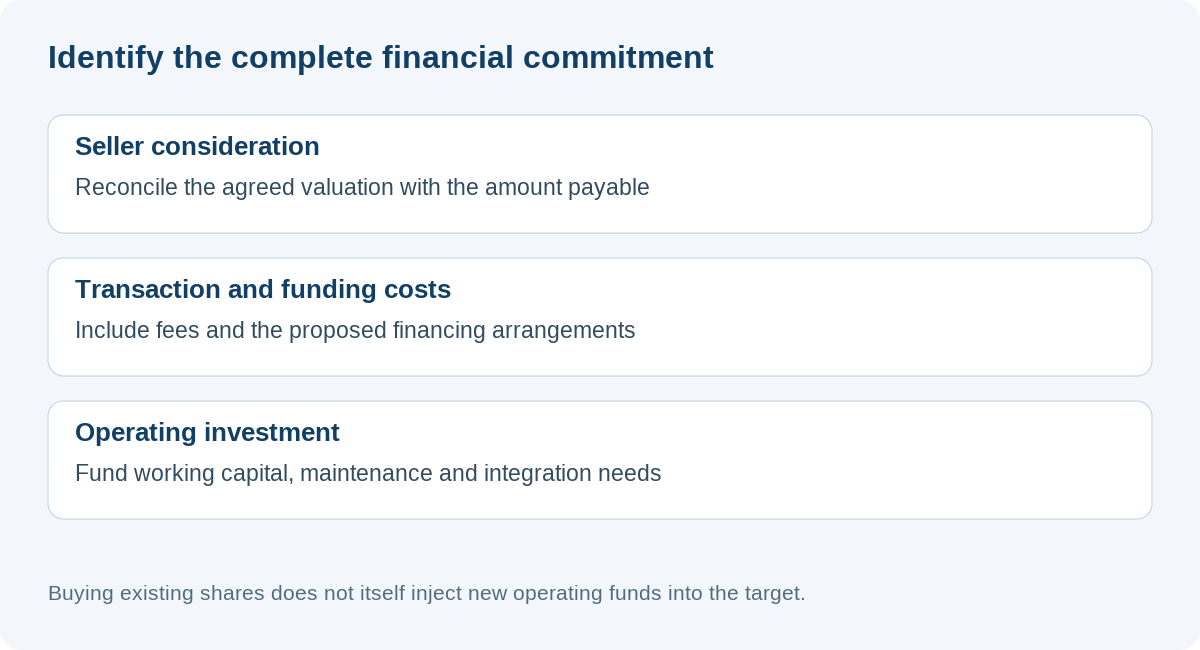
The purchase price is only one part of the buyer's financial commitment. A useful investment model also identifies transaction expenses, financing costs, immediate operating needs and planned integration expenditure. If the buyer intends to refinance debt or fund overdue maintenance, those uses of money should appear explicitly.
Separate payments made to selling shareholders from money introduced into the target. Buying existing shares can transfer ownership without providing additional operating funds to the business. If the growth plan requires new inventory, equipment or staff, identify who will fund those needs and when the funds must be available.
Transaction discussions may use enterprise value, equity value and cash consideration as if they were interchangeable. They are not a substitute for an agreed calculation. Define the valuation basis and explain how debt, cash, working capital and other agreed adjustments affect the amount payable to the seller.
The contract should identify the relevant accounting policies, measurement date and treatment of disputed items. Labels such as “debt-free” or “normal working capital” need definitions that can be applied to the target's records. An apparently settled price can still produce disagreement if the adjustment mechanism leaves essential terms unclear.
Combining operations may reduce duplicate costs or improve purchasing terms. The financial case should specify the action that creates each saving, the cost of implementing it and the earliest realistic benefit date. Distinguish a recurring reduction from a one-off release of cash.
For example, combining administrative systems may reduce future software expenditure while requiring migration work and parallel subscriptions during transition. The forecast should include both sides. A saving should not be counted twice because it appears in the target's improvement plan and the buyer's integration plan.
A target's products, customers or capacity may help the combined group earn revenue it could not readily obtain alone. Estimate the associated margins and cash collection, rather than counting sales alone. Additional revenue can require inventory, credit extended to customers and new service resources before it produces usable cash.
Test whether the underlying relationships and rights support the forecast. A major customer might not need the buyer's additional products, or a supplier agreement might restrict the proposed sales channel. Financial advisers and legal reviewers should investigate the same assumptions so that the valuation reflects the business the buyer can actually operate.
Combining businesses with different demand patterns may reduce some forms of concentration. This potential benefit needs examination of customer overlap, seasonality and exposure to common economic factors. Two businesses serving different industries may still depend on the same customer group or financing conditions.
Do not assume that a larger group automatically receives cheaper credit. Funding terms depend on the lender's assessment, security, cash flow and contractual conditions. Obtain financing proposals and test their requirements before treating improved borrowing terms as part of the acquisition benefit.
Assessing the financial advantages and disadvantages of mergers and acquisitions requires a view of what happens when performance falls short. A transaction can remain profitable on paper while creating a difficult cash position. Examine the timing of payments and receipts, not just the total expected return.
A buyer may pay for anticipated improvements before establishing whether they are achievable. Separate the target's existing performance from benefits requiring the buyer's resources or execution. Examine the evidence behind the growth rate, margins, customer retention and capital expenditure assumptions.
A lower-priced distressed business is not necessarily inexpensive in economic terms. It may require significant working capital, repair expenditure or support for continuing losses. The relevant comparison is the total commitment needed to achieve a credible operating outcome, including the risk that the turnaround takes longer than planned.
Borrowing can reduce the initial equity contribution, while introducing interest, repayment and other contractual obligations. Review payment dates, variable-rate exposure, refinancing assumptions and financial covenants. Model the consequences of weaker operating cash flow before selecting the proposed financing structure.
Identify which entity owes the acquisition debt and how it is expected to obtain money for repayment. Cash held within the target should not simply be treated as immediately available to any group company. The proposed flow of funds needs legal, tax, financing and operational review for the actual structure.
Reported earnings may coexist with slow customer collections, ageing inventory or overdue expenditure. Examine receivables by age and recoverability, inventory by usability and liabilities by payment date. Review whether the business has postponed essential maintenance or relied on unusually extended supplier credit.
The buyer should distinguish a genuine improvement in working capital from a temporary position around completion. Collecting a receivable earlier does not necessarily improve the customer's underlying demand, and delaying a supplier payment does not remove the obligation. The investment model should reflect sustainable operating requirements.
Under IFRS 3, business-combination accounting addresses the recognition and measurement of acquired assets, liabilities and goodwill, together with disclosures about the acquisition. This is different from deciding whether the buyer paid an economically attractive price. The applicable reporting framework and the transaction's accounting classification need confirmation before drawing conclusions from the financial statements.
IAS 36 requires annual assessment of recoverability for goodwill acquired in a business combination. An impairment can affect reported results without representing a new payment at the time it is recognised. It can nevertheless signal that expectations supporting the recorded value need reassessment. These IFRS principles should not be applied automatically to every set of Vietnamese statutory accounts.
Investors should therefore ask for a reconciliation between accounting performance and cash available after operating investment and funding obligations. A change in reported earnings, asset values or goodwill does not by itself show that the acquisition has delivered its intended return.
The financial advantages and disadvantages of mergers and acquisitions are affected by how the parties allocate uncertain amounts and future performance. A fixed price, completion adjustment or contingent payment creates different incentives and dispute risks. Choose the mechanism that can be supported by reliable records and workable procedures.
If the payment changes with completion accounts, agree the relevant definitions, preparation process, information access and method of resolving disagreement. Test the mechanism against actual balance-sheet items before signing. Unusual customer advances, related-party balances or disputed liabilities can expose gaps in otherwise familiar wording.
An earn-out may bridge different expectations about future performance, but it also creates questions about who controls that performance. Define the measurement period, accounting approach and treatment of changes to the business. Consider information rights and the process for addressing disputed calculations.
A seller whose additional payment depends on revenue may resist changes that the buyer considers commercially necessary. Conversely, the buyer may need freedom to integrate products or adjust pricing. The agreement should address the specific sources of tension rather than relying solely on a headline target.
A promise to compensate the buyer for a defined historical exposure should be evaluated alongside claim procedures and practical recoverability. Retention, security or other negotiated support may reduce some risks while affecting the seller's expected proceeds. These arrangements do not replace investigation of the underlying issue.
The guide to legal due diligence in M&A explains how legal findings can inform that negotiation. Coordinate the findings with financial and tax work so that the same issue is not omitted from, or counted twice in, the agreed price.
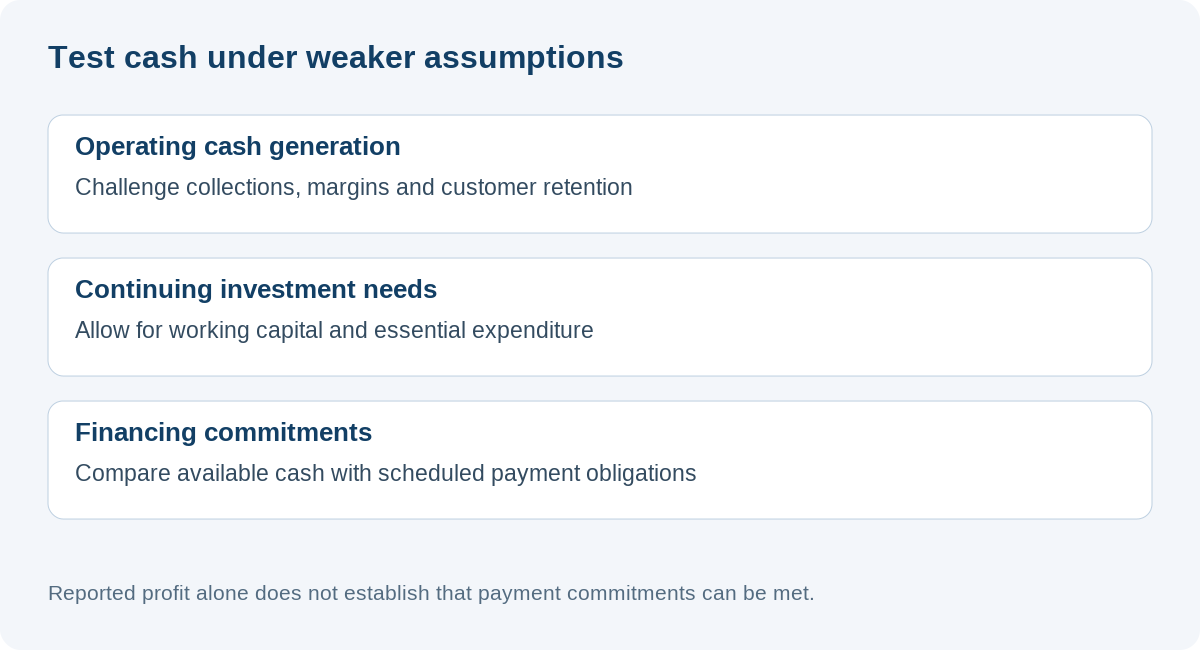
Consider a simplified forecast using arbitrary monetary units. The target is expected to generate 15 units of operating cash before additional working capital and capital expenditure. If those needs consume 5 units and scheduled financing payments require another 8, only 2 units remain before any other applicable costs. The illustration is a planning exercise, not an accounting formula or forecast for a particular business.
If slower collections reduce the first amount to 11 while the other commitments remain unchanged, the model shows a shortfall of 2 units. The buyer should investigate whether expenditure can be staged, additional liquidity is available or the proposed debt structure needs revision. A forecast of accounting profit alone would not answer those questions.
Tax assumptions should also be checked independently. An acquisition does not establish that one entity can use another entity's losses or that a historical incentive will continue on the same basis. Any projected benefit needs transaction-specific advice and supporting evidence before it is included in the investment case.
A review of the financial advantages and disadvantages of mergers and acquisitions should end with decisions about price, funding and acceptable uncertainty. Record the total expected commitment, the sources of funds and the assumptions most likely to change the outcome. Include a downside case and identify who can authorise a response if additional money is needed.
Jurion & Partners can help connect material legal findings with payment provisions, completion conditions and contractual recovery mechanisms. An effective review brief includes the proposed price calculation, funds-flow plan and the financial assumptions that depend on legal rights or permissions.
>>> See more: Signing M&A Contract, what are the noteworthy points?
>>>Read more: Legal due diligence in M&A transaction
The financial advantages and disadvantages of mergers and acquisitions become decision-useful when the investor connects price, cash generation and continuing commitments. Verify the projected benefits, distinguish accounting outcomes from usable cash and test the funding plan under weaker conditions. A credible acquisition case remains understandable after those checks, with clear responsibilities for managing the risks that remain.






Subscribe today to get more breaking news from Jurion Partners - Solicitors & Litigators

108 Tran Dinh Xu St., Cau Ong Lanh Ward, Ho Chi Minh City, Vietnam
(+8428) 66.701.709 - (+84) 903.419.479
contact@jurionpartners.com
Follow us
Accept payment





 English
 Tiếng Việt