A practical review of the rights and permissions behind an acquisition, covering ownership history, ongoing use, protection status, restrictions and transaction actions.
IP due diligence in M&A examines the intellectual property rights and permissions on which the target business depends. A portfolio may include registered marks, inventions, designs, software, creative works, confidential know-how and licences, but their commercial value depends on ownership, scope and continued availability. The review should establish which rights the buyer will obtain, which belong to someone else and what could prevent the business from using them after the transaction.
Start with the products, services and activities that generate value. A technology manufacturer may depend on patents and technical information; a consumer business may depend on branding, designs and licensed content. Not every business owns every category of intellectual property, and counting registrations alone does not reveal which assets matter.
Identify the target entities and the structure proposed. In a share purchase, the target generally remains the holder of its rights and licences, but contractual change of control restrictions may still matter. An asset purchase may require assignments or new permissions. A reorganisation requires its own assessment of succession and implementation requirements.
Agree the territories, product lines, materiality approach and review date. If a proposed expansion into another country is part of the valuation, include that objective in the brief. The scope should distinguish a portfolio review from any specialist patent clearance or technical assessment required.
Request a register of material rights with the owner or applicant, relevant numbers, territory, status, expiry or renewal dates and supporting documents. Match the list against the products and brands actually used. A registration for a discontinued product may be less important than a critical licence omitted from the portfolio schedule.
Record owned rights separately from rights licensed into the business and rights licensed out. Include relevant development, employment, consultancy, distribution, franchise and joint venture agreements. Domain names and online accounts may also require examination where they support trading, without assuming that domain registration creates trademark ownership.
Different rights arise in different ways. Under Vietnam's IP Law, copyright does not depend on registration, while industrial property rights have different bases of establishment. Trade names and trade secrets need analysis of their particular legal conditions. An absent registration certificate is therefore not a universal test that no right exists.
The company using an asset may not be its owner. Review the relevant creation, employment, commissioning and assignment documents, including amendments. Check whether a founder, affiliate, employee, contractor or joint development partner retains rights material to the business. The answer depends on the legal rules and agreements applying to the particular work or invention.
For commissioned or assigned creative work, Article 39 of the IP Law provides ownership rules for specified rights, subject to contrary agreement. The review should therefore establish the relationship and contractual terms rather than assume that every creator retains all rights or that payment of an invoice always proves unrestricted ownership.
An effective IP due diligence review also checks the chain of earlier transfers. A gap may require a missing agreement, confirmation from the appropriate party or another lawful corrective step. A disclosed ownership dispute requires assessment of its basis and consequences; it should not be replaced by an unsupported universal statement that every disputed asset is legally incapable of transfer.
Review the actual protection and current status, rather than relying on the title of a certificate or an old portfolio summary. For a trademark, the protected sign and goods or services matter. For a patent, the claims require specialist interpretation. A right obtained in one territory does not automatically provide equivalent protection in every intended market.
Verify pending applications, grants, renewals, maintenance payments and relevant cancellation or termination proceedings. A pending application should not be presented as a granted right. Equally, a certificate may need further status checks before it is treated as currently effective.
Article 27 distinguishes specified moral rights protected indefinitely from publication and economic rights subject to a term. The applicable term depends on the category of work and relevant facts, including authorship and publication. It is incorrect to describe copyright generally as both time-limited and perpetual without explaining which rights are meant.
For national trademark registrations, Article 93 provides an initial term ending ten years from the filing date, with successive ten-year renewals available. This is not an automatic renewal and should not be calculated from the grant date. Other rights and international registrations require their own analysis.
A licence can be commercially valuable without transferring ownership. Examine the permitted activities, products, territory, exclusivity, duration, royalties, termination rights and restrictions on assignment or sublicensing. Confirm whether the target is the actual licensee and whether the planned use remains within the permission granted.
For software and digital products, involve technical reviewers where needed to identify third party components, access rights and relevant licence obligations. A right to use a finished product may differ from a right to modify, distribute or sublicense its underlying material. Availability of a repository or administrator password does not itself resolve ownership.
Also review licences granted to others. Exclusivity or other commitments may restrict what the buyer expects to exploit. Inbound and outbound arrangements should be read together, so that the company does not promise customers rights broader than those it has obtained.
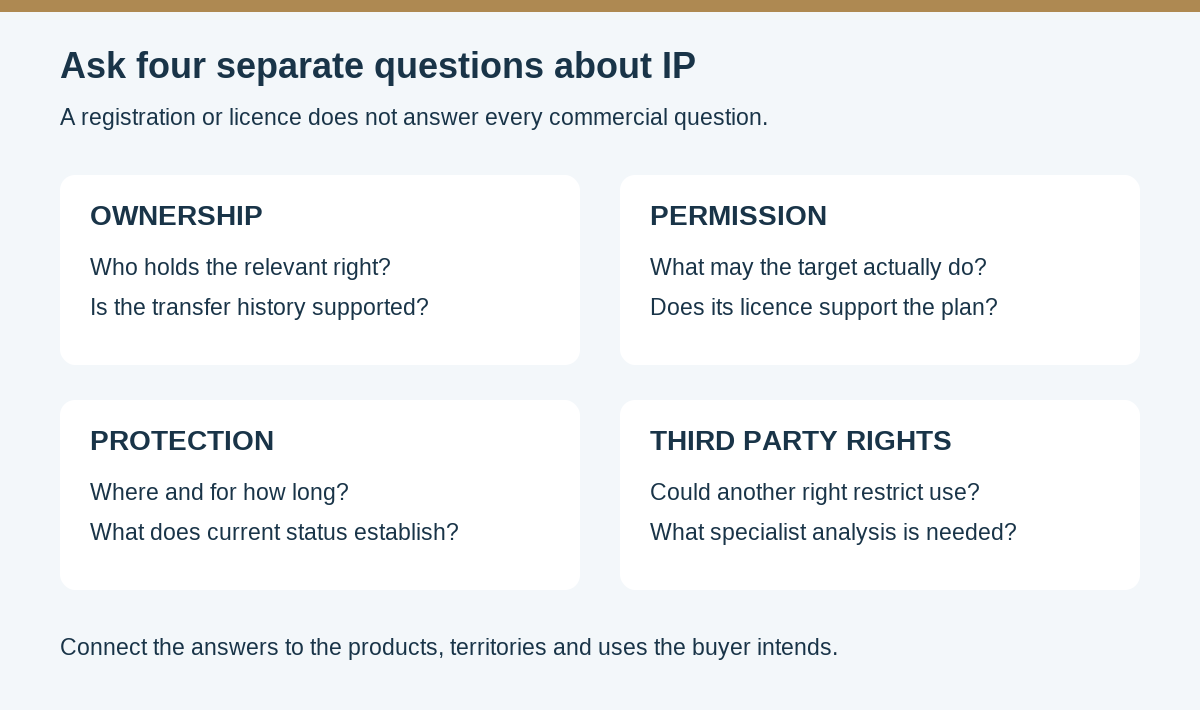
Owning a patent does not necessarily mean that the target can commercialise a product without affecting another party's rights. A broader patent or another relevant restriction may still matter. A freedom to operate analysis therefore asks a different question from whether the target owns a valid registration.
Where appropriate, specialist work should examine the actual product or process, relevant claims, territories and legal status of potentially blocking rights. A search result is a starting point for analysis, rather than a guarantee of non-infringement. The review should state its scope, date and limitations.
Examine disclosed infringement allegations, opposition or cancellation proceedings, settlement agreements and enforcement activity. Distinguish a third party's allegation from an established infringement and consider any continuing obligations under a settlement. IP due diligence should identify what the evidence supports and what needs further technical or legal investigation.
Do not assume that every IP right can be transferred in the same way. Articles 138 and 139 address written industrial property assignments and relevant restrictions. For example, geographical indication rights are not assignable, and a trade name is subject to a business-transfer condition. Trademark transfers also have specific statutory restrictions.
Article 148 distinguishes assignment and licensing formalities. For the registration-based industrial property rights covered by that provision, an assignment contract takes effect upon registration with the competent authority. The treatment of licence effectiveness and effect against third parties differs, including an exception concerning trademark licences. Identify the rule for the actual right instead of applying one recordal requirement to every asset.
Build the necessary documents, consents and registration steps into the transaction plan. If the target merely has a limited licence, the buyer needs a lawful basis for the intended future use; a general seller assurance does not itself enlarge the permission granted by the owner.
Suppose a target sells products under a mark registered to a founder's separate company. The target has a licence covering Vietnam, while the buyer's valuation assumes exports to additional markets and unrestricted use after completion. The key question is not simply whether the brand appears on the target's packaging.
The team should examine the licence, the rights available in the proposed export markets and the owner's ability to grant the required permission. Depending on the facts, the transaction may require an amended licence, a lawful assignment or a revision of the expansion plan. The price and completion conditions should reflect the solution actually available.
Trade secrets and confidential technical information require careful disclosure arrangements. Review how the target obtained the information and the measures used to preserve its secrecy. A document labelled confidential is not, by that label alone, conclusive proof of every condition for trade secret protection.
Use a proportionate review process for sensitive material, with appropriate access restrictions and confidentiality arrangements. Technical specialists may be able to verify a point without distributing the underlying formula, source material or detailed process widely. Consider the risk that an unnecessarily broad disclosure could damage the value being investigated.
See more: Why is Legal Due Diligence important in M&A transaction?
See more: Signing M&A Contract, what are the noteworthy points?
Report the material rights, supporting evidence, identified limitations and proposed response, with clear responsibility and timing. Jurion & Partners can assist with organising the legal questions and coordinating the findings with the acquisition documents and any specialist review required.
The broader legal due diligence guide explains how this work fits into the transaction investigation. Careful IP due diligence connects the rights actually available with the products, markets and uses on which the buyer's investment depends, allowing the parties to address material gaps before they become operational problems.






Subscribe today to get more breaking news from Jurion Partners - Solicitors & Litigators

108 Tran Dinh Xu St., Cau Ong Lanh Ward, Ho Chi Minh City, Vietnam
(+8428) 66.701.709 - (+84) 903.419.479
contact@jurionpartners.com
Follow us
Accept payment





 English
 Tiếng Việt