A practical guide to responding to material acquisition risks through a verified remedy, revised structure, price negotiation or carefully defined contractual protection.
Handling legal due diligence findings turns an investigation into decisions about an acquisition. A report may identify missing approvals, uncertain ownership, contractual restrictions or historical liabilities, but identifying those issues does not itself protect the buyer. The next task is to decide which findings prevent the transaction, which require corrective action, and which can be addressed through price, contractual protection or a different structure. Each recommendation should explain its commercial effect and the evidence needed to implement it.
A useful recommendation connects four things: the established facts, the applicable legal requirement, the effect on the proposed acquisition, and the available response. An unsigned document is not automatically a fatal defect; equally, a seller's explanation is not proof that a necessary approval exists. Counsel should distinguish confirmed noncompliance from incomplete evidence and identify what further information could change the assessment.
The buyer's objective matters. A defect affecting a minor supply arrangement may be manageable, while uncertainty over the principal operating site can undermine the entire investment. The report should therefore explain significance by reference to the business being acquired, rather than assigning an alarming label to every missing document.
For each material issue, record an owner, an action, a deadline and an acceptance standard. A recommendation to “regularise the position” leaves too much unanswered. Identifying the particular approval, the responsible applicant and the document demonstrating completion gives the transaction team something it can actually monitor.
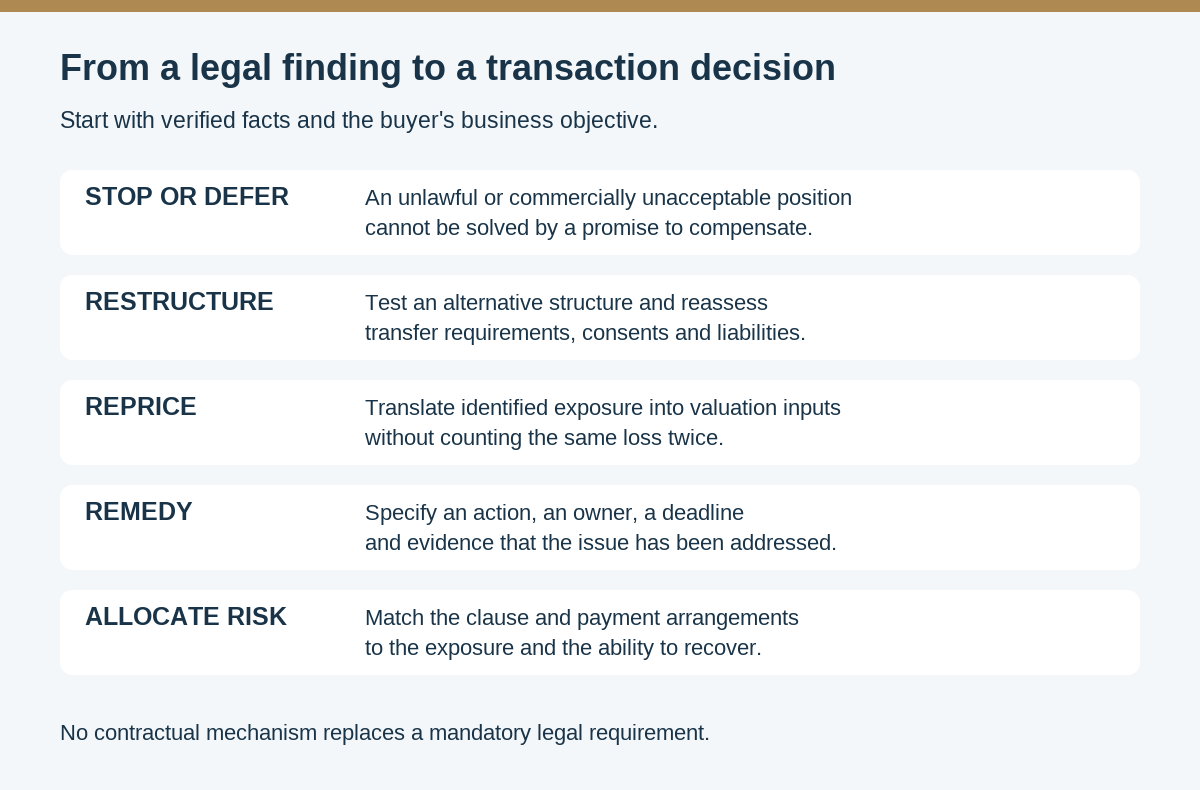
Some findings cannot be solved by allocating financial risk between buyer and seller. If the proposed acquisition would contravene a mandatory prohibition, a promise to compensate the buyer does not make it lawful. The same practical concern arises where the seller cannot establish its entitlement to transfer the essential interest or asset and no credible corrective route is available.
The Civil Code's requirements concerning capacity, voluntary participation, lawful purpose and content, and legally required form remain relevant. Specific investment, corporate, competition, land or sector rules may impose additional requirements. The review must identify those applicable requirements for the actual transaction instead of treating a general contractual clause as a substitute for compliance.
Postponement may be more proportionate than withdrawal where a necessary document can realistically be obtained. However, the buyer should test the proposed timetable, cost and dependencies. If the business opportunity depends on immediate operation, a technically available remedy taking an uncertain period may still make the deal commercially unsuitable.
A share purchase and an asset purchase expose the parties to different issues. Acquiring shares generally leaves the target company in place with its existing legal history. An asset transaction requires careful identification of what can be transferred, how title passes, and whether associated contracts, employees, permissions or liabilities need separate treatment.
Switching structures should therefore trigger a fresh assessment. A buyer might avoid acquiring a company with disputed historical obligations, yet discover that the operating authorisation or key customer contract cannot simply follow the assets. A new structure can also change tax, financing, consent and implementation requirements. Those consequences need coordinated legal and financial review.
Consider an acquisition intended to secure a distribution business. If the key distribution agreement contains a change of control restriction, changing from a share purchase to selected asset transfers may still require the supplier's agreement. The sensible recommendation is to examine the contract and obtain a workable consent or replacement arrangement, rather than describing asset acquisition as an automatic escape.
Legal findings can affect valuation through additional expenditure, lost income, restricted asset use or uncertainty about business continuity. Counsel should describe the legal exposure and its factual basis. Financial specialists and the buyer can then assess how that exposure affects the valuation model and negotiating position.
A price reduction is most useful where the buyer understands and accepts the underlying problem. It may be unsuitable if the exposure is open ended or threatens the core business. Distinguish the estimated cost of a defined corrective project from a contingent claim whose likelihood and amount remain uncertain.
Also check for overlap. A liability already reflected in net debt, working capital or a specific adjustment should not inadvertently produce a second recovery through another mechanism. The drafting should explain how different protections interact, including how an unresolved amount will be determined and disputed.
Contract drafting for handling legal due diligence findings should follow the nature of the issue. Statements about existing facts, promises about future conduct, conditions to completion and financial remedies perform different functions. Using these labels interchangeably creates uncertainty about what the seller must do and what happens if it does not.
A representation or warranty can address the accuracy of a defined factual position, such as ownership or the absence of specified disputes. Its scope, qualifications and consequences depend on the contract and applicable law. The parties should identify the relevant date and any agreed disclosure process rather than assuming that the familiar English label supplies a complete remedy.
Known defects need particular attention. If a problem has already been disclosed, a broadly qualified statement may provide little useful protection against it. The buyer should consider a specific corrective obligation or agreed risk allocation, and ensure that disclosure does not unintentionally defeat that protection.
A covenant specifies conduct: obtaining a consent, delivering a missing record, pursuing an agreed correction or refraining from a particular action before completion. It should identify who must act, the required standard of effort or result, the timetable and the evidence to be delivered.
Distinguish what the seller controls from what depends on a regulator, lender or other third party. Requiring an application is different from guaranteeing its approval. Where the result is essential, the buyer may need a completion condition as well as an obligation to pursue the required process.
A completion condition makes a specified step relevant to the parties' obligation to complete. It should explain the documentary test, the responsible party, the deadline, and the consequences if the condition remains unsatisfied. Conditions are not necessarily events wholly outside the seller's control; some concern actions the seller must carry out.
The parties should also address whether a condition may lawfully be waived and by whom. A buyer's contractual waiver cannot remove a mandatory statutory approval. The agreement should distinguish conditions protecting a private commercial interest from requirements that the parties must satisfy as a matter of law.
A negotiated indemnity may allocate an identified historical exposure, such as a particular dispute or compliance issue. Its value depends on more than an undertaking to “compensate all losses”. Define the covered event, persons entitled to claim, recoverable amounts, exclusions, limits and the treatment of third party proceedings.
Include practical rules for notification, defence, settlement and payment. Consider the seller's ability to meet the obligation and whether any proposed security is legally and commercially workable. A contractual allocation does not bind a regulator or an outside creditor who has not accepted it, and describing a clause as an indemnity does not guarantee every claimed amount will be enforceable.
Holding back part of the price or using an agreed escrow arrangement may support a remedy where money could otherwise be difficult to recover. The parties need clear release events, a procedure for disputed amounts, and provisions dealing with the institution holding the funds. Check applicable payment, banking and foreign exchange requirements before adopting a mechanism used in another jurisdiction.
Deferred consideration should not become an informal substitute for deciding what the buyer is accepting. If a missing operating consent is essential, retaining money does not solve the inability to operate. Likewise, a retention intended to secure a particular claim needs a duration and amount that reasonably reflect that exposure.
Suppose a target operates from leased premises, but the material supplied during review does not establish the landlord's consent to the proposed change of control. The first step is to verify the lease, amendments and actual consent requirement. An incomplete data room and a confirmed prohibition call for different recommendations.
If consent is required and achievable, the seller could undertake to seek it, with delivery of an acceptable written consent as a completion condition. The commercial team should consider what happens if consent is delayed, refused or offered only with additional rent. Any proposed price adjustment should reflect the agreed allocation of that additional cost.
If the premises cannot lawfully remain available and relocation defeats the acquisition rationale, a strong warranty does not restore the missing business benefit. The recommendation may be to postpone or abandon the transaction. This is why the final response must be linked to the buyer's objective, rather than selected from a standard list of clauses.
Read more: Legal Due Diligence (DD)
Read more: The Pros and Cons of Mergers and Acquisitions
Before signing, ask the legal and commercial teams to agree which risks are unacceptable, which must be remedied before completion, and which the buyer knowingly accepts with protection. Jurion & Partners can assist with reviewing the findings against the proposed transaction documents and identifying the questions that require a negotiated answer.
The broader guide to legal due diligence explains how the underlying investigation supports these decisions. An effective approach to handling legal due diligence findings requires an agreed response, clear drafting and evidence of implementation, so that a report becomes a practical basis for proceeding, renegotiating or walking away.






Subscribe today to get more breaking news from Jurion Partners - Solicitors & Litigators

108 Tran Dinh Xu St., Cau Ong Lanh Ward, Ho Chi Minh City, Vietnam
(+8428) 66.701.709 - (+84) 903.419.479
contact@jurionpartners.com
Follow us
Accept payment





 English
 Tiếng Việt