M&A is becoming a global investment trend and developing strongly in Vietnam, prospering in 2013 and strongly increasing in the last few years. It is predicted that in 2016 and the following years, with the introduction of the Trans-Pacific Partnership (T
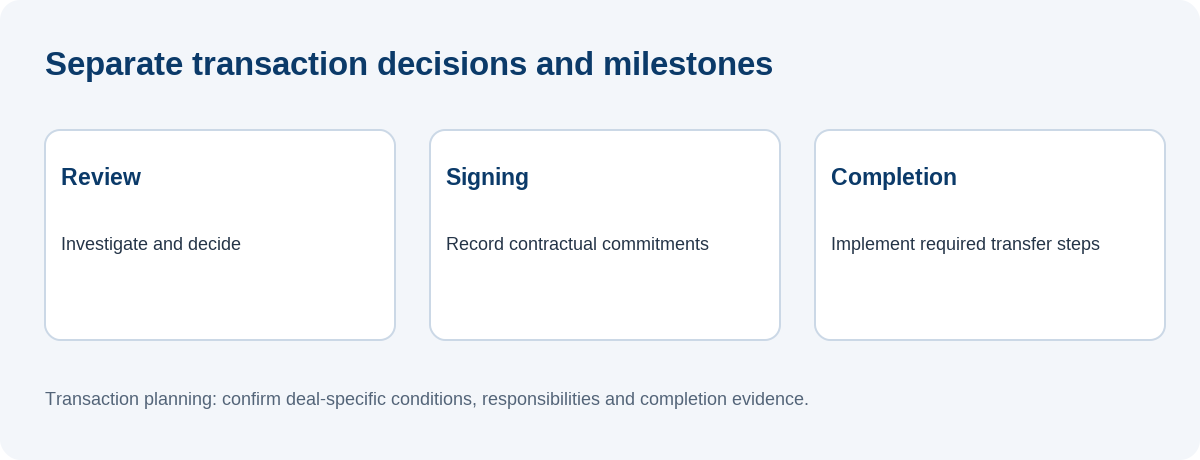
An M&A due diligence process works best when the parties understand which decisions must be made at each stage of the deal. Reviewing the target, negotiating a purchase agreement, signing and completing the transfer are connected activities, but they are not interchangeable. A transaction can be signed while approvals or other completion conditions remain outstanding. Integration follows a different workstream again. A practical timetable identifies these dependencies instead of treating an acquisition as a single document-signing exercise.
Identify what is being acquired and by whom. A share purchase, a subscription for new capital and an asset acquisition can require different evidence and implementation steps. Define the target entities, assets, liabilities and business operations within the intended perimeter. If the parties have not settled the structure, record the alternatives and the information needed to choose between them. A document request prepared without this context may miss the rights the buyer actually needs.
Agree the commercial objectives before setting the review timetable. Is the buyer seeking control, a minority investment, access to technology or selected operating assets? What must remain with the business after completion? The guide to legal due diligence in Vietnam explains the review's substantive scope. This article focuses on coordinating that work with the sequence of an M&A transaction.
Initial screening should identify major questions that could change the decision to proceed. Confirm the target's identity, the seller's relationship to it, the business description and the proposed ownership outcome. Ask whether the activity or asset is subject to restrictions that affect the buyer. At this stage, the objective is to expose assumptions and determine the next investigation, not to issue a clean conclusion from a short management presentation.
A term sheet or letter of intent may record price principles, exclusivity, confidentiality and proposed conditions. Its legal effect depends on the actual wording and applicable rules, rather than its title alone. Distinguish intended binding provisions from matters still subject to negotiation. If a deposit, exclusivity period or cost allocation is proposed, review the consequences before signing. Preliminary paperwork can create material obligations even though the acquisition documents are not complete.
The seller should organise records that correspond to the agreed perimeter, while the buyer's advisers prepare targeted requests. Establish a data-room index, version control and a channel for follow-up questions. Decide who may access commercially sensitive information and how personal or confidential material will be handled. Giving every participant unrestricted access is not a substitute for an appropriate information-sharing arrangement.
Record missing information explicitly. A folder marked complete may contain an expired licence or a contract without its amendments. Ask the seller to explain gaps and provide follow-up evidence. Interviews can clarify operations, but material answers should be recorded in the agreed manner and checked against documents where possible. Keep a distinction between receiving an answer, verifying a fact and resolving a risk.
The legal, financial, tax, technical and other relevant teams need a shared understanding of the transaction. Agree how cross-cutting issues will be raised and who will assess the consequence. For example, a site permission issue may affect operational assumptions, while a disputed customer contract may affect the revenue analysis. Each adviser should state the boundaries of their work so that no team assumes another has verified an unresolved point.
The M&A due diligence process should produce early escalation of potential obstacles rather than save every finding for a report at the end. A missing operating right, a disputed ownership interest or a consent essential to business continuity can influence the structure and timetable. Identify the evidence behind the concern and the options for addressing it. Avoid treating every minor documentary defect as equally important.
Keep a decision log showing which findings require further investigation, seller remediation, contractual protection or commercial acceptance. The buyer may need more information before deciding whether a risk is acceptable. If management chooses to proceed despite a limitation, record the limitation and the decision clearly. Silence in the document request log should not be interpreted as confirmation that a missing fact is satisfactory.
A Vietnam transaction may raise foreign-investment, competition, enterprise-registration or sector-specific questions, as well as private contractual consent requirements. These tracks address different issues. Determine which are relevant to the actual transaction and when action is required. A landlord's consent cannot replace a regulatory approval, and enterprise registration does not establish that all operating conditions have been satisfied.
Use current rules rather than old transaction precedents. Vietnam's Ministry of Industry and Trade reported changes to certain economic-concentration notification thresholds effective from 1 July 2026, with different treatment for specified financial-sector businesses. The transaction team should assess the applicable criteria and data at the relevant time. Do not conclude that notification is unnecessary merely because the target appears small or the acquisition concerns only one company.
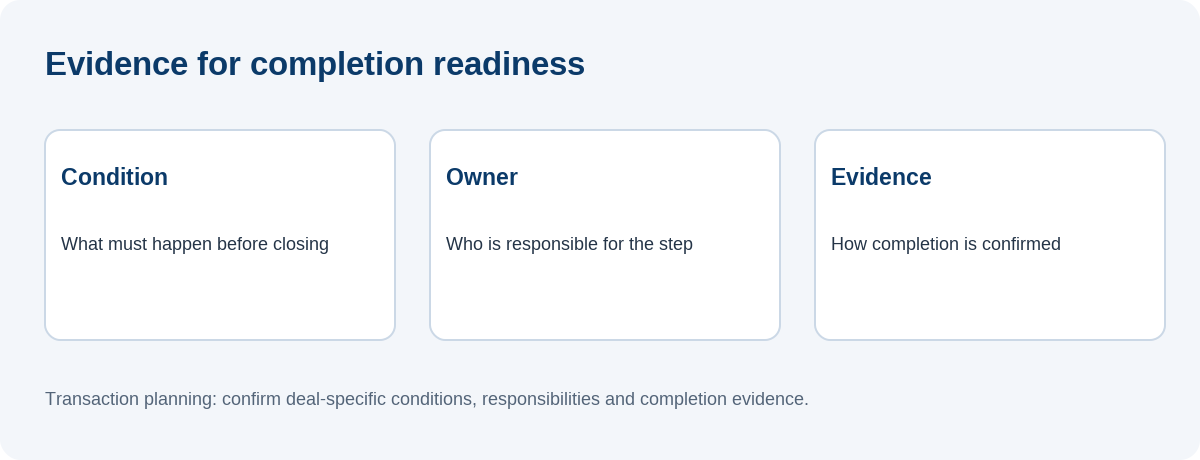
For each required step, identify the responsible party, documents, prerequisites and expected review period. Distinguish a statutory processing period from the time needed to produce a complete application or respond to questions. The parties can then negotiate appropriate completion conditions and a long-stop date. A timetable should also show what happens if a consent is refused or arrives subject to conditions that affect the commercial deal.
Due diligence should inform the purchase or investment documents. A finding may lead to a pre-completion correction, a condition, a price adjustment, a specific indemnity or another negotiated response. Identify which response addresses the particular concern and what evidence will establish compliance. A broad warranty is not necessarily enough where the buyer needs an actual permission or an operational dependency resolved before proceeding.
Reconcile the main agreement with disclosure materials, schedules and ancillary documents. Define the rights being transferred, payment arrangements and completion deliverables consistently. If material information emerges during negotiation, return it to the review team and update the assessment. Signing pressure should not make an unresolved issue disappear from the report simply because the parties want to announce progress.
Signing records the agreed contractual commitments. Completion implements the transaction in accordance with those commitments and the applicable legal requirements. Some deals can sign and complete together; others require an interval. The correct sequence depends on the structure and conditions. A signed agreement does not itself prove that every ownership record, registration, consent or payment step has been completed.
During an interval, agree how the target may operate, what changes require consent and how material developments are reported. Check that any interim controls are lawful and appropriate for the deal. The buyer should not assume that signing gives unrestricted authority to run a business it has not yet lawfully acquired. Continue monitoring matters that could affect the original decision or the agreed completion conditions.
List each deliverable, the person responsible and the evidence needed to mark it complete. Reconcile resolutions, transfer instruments, consents, releases and payment instructions with the agreed transaction. If a condition is proposed to be waived, check whether waiver is legally available and who may approve it. Parties cannot waive a mandatory legal requirement simply because they both want the timetable to move faster.
Identify the payer, recipient, accounts, currency and documentary basis for each payment. Check the applicable banking and foreign-exchange requirements with the relevant specialists and bank. A primary capital contribution and a purchase price paid to an existing owner should not be treated as the same flow. The funds-movement plan needs to match the actual structure and the completion documents.
Keep confirmations and reconcile the amounts with the completion statement. Where obligations are simultaneous or staged, define how evidence is exchanged and who authorises release. Avoid relying on an informal message that documents will be supplied later when they are necessary to establish the transfer or payment. Record outstanding implementation items and their legal significance rather than marking the entire deal complete for convenience.
Post-completion integration can involve governance, bank authorities, systems, employment arrangements and ongoing contracts. Assign owners and deadlines for these tasks before completion. Changes to business operations may require further legal review even when the acquisition itself has completed. The integration team should receive the relevant diligence findings and limitations instead of only the signed purchase agreement.
Remediation identified in the review should remain traceable. A post-completion action needs a responsible person, a realistic deadline and evidence of completion. If the buyer accepted a risk or deferred a correction, preserve that decision for management. This prevents a useful report from becoming an archive that no one consults while the same unresolved issue continues in the business.
An M&A due diligence process benefits from one coordinated timetable, clear escalation and an accessible record of decisions. Advisers can examine legal questions and prepare documents, but commercial valuation, operational capacity and investment decisions need appropriate client input. Do not assume that every acquisition requires an identical package or that one adviser covers every specialist topic without an agreed scope.
To prepare a transaction discussion with Jurion & Partners, identify the proposed parties, structure, business perimeter and target completion date. Add the matters already agreed and those still open. These facts allow the review, negotiation and implementation tasks to be organised around the actual deal, with dependencies and limitations visible to the decision-makers.
A well-managed M&A due diligence process connects investigation with negotiation, completion and the work that follows. Confirm the structure, escalate material findings and keep evidence for every important implementation step. Treat signing, transfer and integration as distinct milestones so that the parties can understand what has been agreed, what has actually happened and what still needs to be done.






Subscribe today to get more breaking news from Jurion Partners - Solicitors & Litigators

108 Tran Dinh Xu St., Cau Ong Lanh Ward, Ho Chi Minh City, Vietnam
(+8428) 66.701.709 - (+84) 903.419.479
contact@jurionpartners.com
Follow us
Accept payment





 English
 Tiếng Việt