Although law has been published largely throughout the nation so that anyone was acquainted, only lawyer may give advices that can help you improve legal situation.
Legal consultancy helps a person or organisation understand a legal issue, assess available choices and decide what to do on the facts of a particular matter. It goes beyond collecting rules: the adviser connects relevant requirements with the client's documents, objectives and uncertainties. The outcome might be an explanation, a written opinion, comments on an agreement or a practical action plan. Its value depends on a clearly defined question and reliable information.
Someone starting a business, reviewing a proposed contract or responding to a disagreement may need different kinds of assistance. This article explains what an advisory engagement can cover, how it differs from general information and representation, and how to prepare for a useful consultation. It also addresses common misunderstandings about what a discussion with an adviser does and does not establish.
Under the Vietnamese Law on Lawyers, a lawyer's advisory work includes guidance, opinions and assistance preparing documents concerning the client's rights and obligations. That definition is more useful than saying advice tells a person “what to do” while information explains “how to do it.” Both an informational guide and an individual consultation may discuss possible steps. The important distinction is whether the analysis addresses the particular circumstances and the agreed question.
For example, a public explanation may describe what a termination clause commonly addresses. A specific review asks which agreement was signed, whether later changes exist, what happened, what evidence supports it and which rules govern the proposed action. An adviser may then identify options, missing information and consequences. The client can evaluate those options against commercial or personal priorities rather than rely on a general example.
It is inaccurate to describe every form of advice in Vietnam as work that only a privately retained lawyer may perform. The legal framework also provides for legal advice centres and other lawful assistance arrangements. Their role, personnel and operating requirements should be distinguished from those of a law firm. Identify the provider and the basis on which it offers the requested service rather than infer qualifications from a job title or website description.
For a proposed engagement, establish who will be responsible, what expertise the matter needs and whether the provider can accept the work. A company may need advice involving several jurisdictions or disciplines. Clarify which questions will be answered locally and which require another specialist. An adviser should be able to explain the boundaries of the proposed work without promising expertise in every field.
General information can help a reader identify terminology, recognise an issue and prepare questions. Its usefulness does not disappear because it is published online or provided without a fee. However, it may concern a different date, transaction, legal system or set of facts. Before applying it, check whether the assumptions match the actual matter and whether the source remains current.
Individual advice examines the issue within an agreed scope. Its conclusions may depend on documents supplied by the client or facts that have not been independently verified. Those limitations should be explained. A preliminary discussion can identify what needs investigation without resolving every question; describing the result as preliminary is more helpful than presenting uncertainty as a definitive answer.
Representation is a further question. Receiving an opinion does not itself mean the adviser has agreed to negotiate with another party, sign documents, submit an application or appear in proceedings. Establish separately what action is authorised and what formal requirements apply. Keep responsibility for a deadline clear, especially when the initial enquiry arrives shortly before a response or filing is due.
Advice is often useful while a decision remains open. A business considering a distribution arrangement can ask which obligations need clearer drafting before signing. A founder can identify matters to resolve between owners before money is contributed. The purpose is to test the proposed arrangement, expose assumptions and help the client choose a workable approach while changes remain possible.
This does not require every question to become a large project. A narrowly defined document review may be appropriate where the transaction is clear and the client needs help with specific terms. A broader investigation may be needed where the available records are incomplete or the proposed structure is uncertain. Match the engagement to the decision rather than order a lengthy report without knowing how it will be used.
A later change can create questions that the original documents do not answer clearly. The parties may alter delivery arrangements, add a new participant or disagree about payment. A review should reconstruct what was agreed and what subsequently occurred before recommending a response. Separating documented facts from assumptions often changes which options are realistic.
In that setting, legal consultancy can help organise the issues and identify the next decision. It should not be confused with a guarantee that a claim will succeed or that another party will accept a proposal. Outcomes can depend on contested evidence, procedural requirements, the other side's conduct and decisions outside the adviser's control.
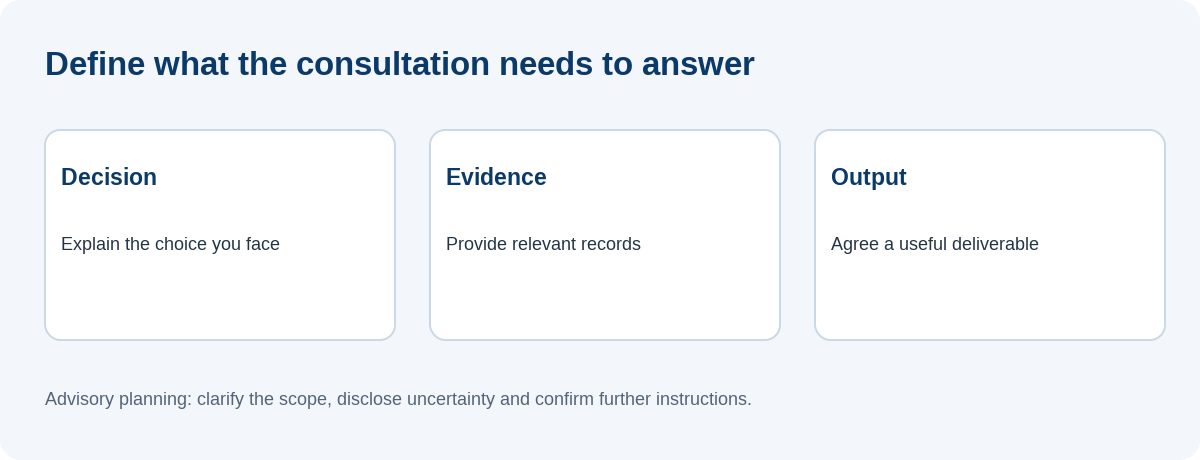
Begin with a short description of what you need to decide. “Can we sign this version?” is different from “Which terms should we renegotiate?” Similarly, understanding a notice is different from instructing someone to challenge it. Explain the desired result and any practical constraints, including a meeting, proposed payment or known response date. Provide the document showing a deadline rather than only a remembered date.
Identify the relevant people and organisations accurately. Include the capacity in which each person acted and distinguish a company from its owners or employees. These details can affect which agreement or obligation is under review. If another adviser has already worked on the matter, explain that involvement so the proposed scope can address the remaining questions.
Prepare a chronology with supporting records: the signed document, amendments, notices and relevant communications. Label drafts and executed versions clearly. Where translations exist, identify their source and retain the underlying document. A short explanation of why each record matters is often more useful than an unsorted folder containing repeated copies.
Be candid about missing records, disputed facts and information that comes from another person. Advice based on an incomplete account may need revision when further evidence emerges. Avoid editing a document to make the history appear simpler. Instead, tell the adviser which point remains uncertain and ask what additional evidence would help resolve it.
A legal consultancy engagement should make clear what work is included and what is excluded. Discuss the questions, assumptions, documents to be reviewed and expected output. An oral meeting, a short written answer, a detailed opinion and a marked-up agreement serve different purposes. Choose the format that supports the client's decision and makes unresolved points visible.
Clarify the proposed fee basis, expenses, timetable and process for work outside the initial scope. Ask how new information or a changed instruction will be handled. Where several people can issue instructions, identify the authorised contact and the person who will approve significant decisions. This reduces contradictory requests and helps the adviser distinguish an internal discussion from a final instruction.
Agree how sensitive material will be shared and who may receive the output. Lawyers have confidentiality obligations subject to applicable legal exceptions; this should not be converted into an unlimited promise about every person, platform or onward disclosure. Discuss necessary involvement of translators, external specialists or other recipients before distributing the file widely.
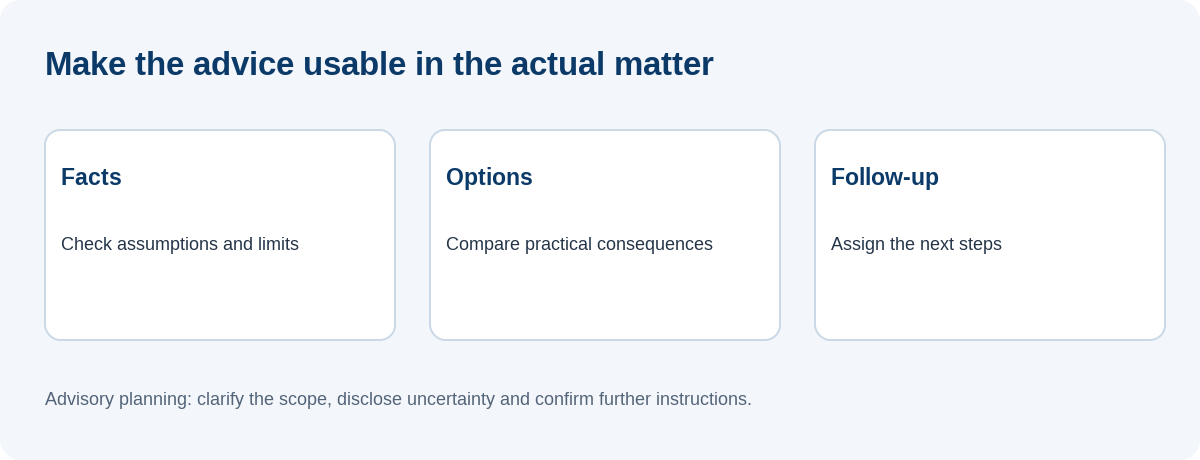
The most useful legal consultancy output answers the agreed question in language the client can use. It should distinguish established facts from assumptions, explain the relevant reasoning and identify material limitations. Where several options exist, it should make their practical consequences clear. A document that merely lists provisions may leave the client unable to decide which step is suitable.
Ask which issues could change the conclusion. A recommendation might depend on confirming a signature, obtaining a missing annex or checking the actual sequence of events. Those dependencies should become an action list. Identify who will obtain each item and whether further review is required before the client acts.
A drafting project illustrates this connection between advice and delivery. The guide to contract drafting advice explains how commercial instructions can be translated into a usable agreement. The advisory question comes first; the document should then reflect deliberate choices about obligations and implementation rather than simply reproduce a template.
Check that the answer addresses the question you intended to ask. Seek clarification where an assumption is wrong or a recommendation is unclear. Do not silently extend a conclusion about one contract or date to a different transaction. If the facts change, tell the adviser and establish whether the previous analysis still applies.
Record the decision taken and the follow-up responsibilities. A recommendation to collect evidence, revise a clause or seek a further assessment is not complete merely because the client has read it. Assign a person to the next step and retain the relevant versions and communications. Where action by the adviser is required, confirm that instruction and its scope.
For an initial discussion with Jurion & Partners, prepare the decision you face, a concise chronology and the available supporting documents. That allows the proposed assistance to be shaped around the matter and the required output. Questions about representation, negotiations or filing work can then be addressed expressly rather than left implicit.
Effective legal consultancy connects a well-defined question with reliable facts, reasoned options and practical follow-up. Before commissioning work, decide what you need to understand or achieve, agree the scope and explain what remains uncertain. That preparation makes the resulting advice easier to assess and use responsibly.






Subscribe today to get more breaking news from Jurion Partners - Solicitors & Litigators

108 Tran Dinh Xu St., Cau Ong Lanh Ward, Ho Chi Minh City, Vietnam
(+8428) 66.701.709 - (+84) 903.419.479
contact@jurionpartners.com
Follow us
Accept payment





 English
 Tiếng Việt