Three professional principles explained through practical client work: thoughtful conduct, serious development of knowledge and skill, and responsible service.
A professional lawyer earns trust through the quality of the work and the care taken with another person’s interests. A legal matter may affect a family, a business, a career or a decision that cannot easily be reversed. At Jurion & Partners, our understanding of professionalism begins with that responsibility: legal knowledge must be matched by sound judgment, clear communication and respect for the client’s right to make an informed choice.
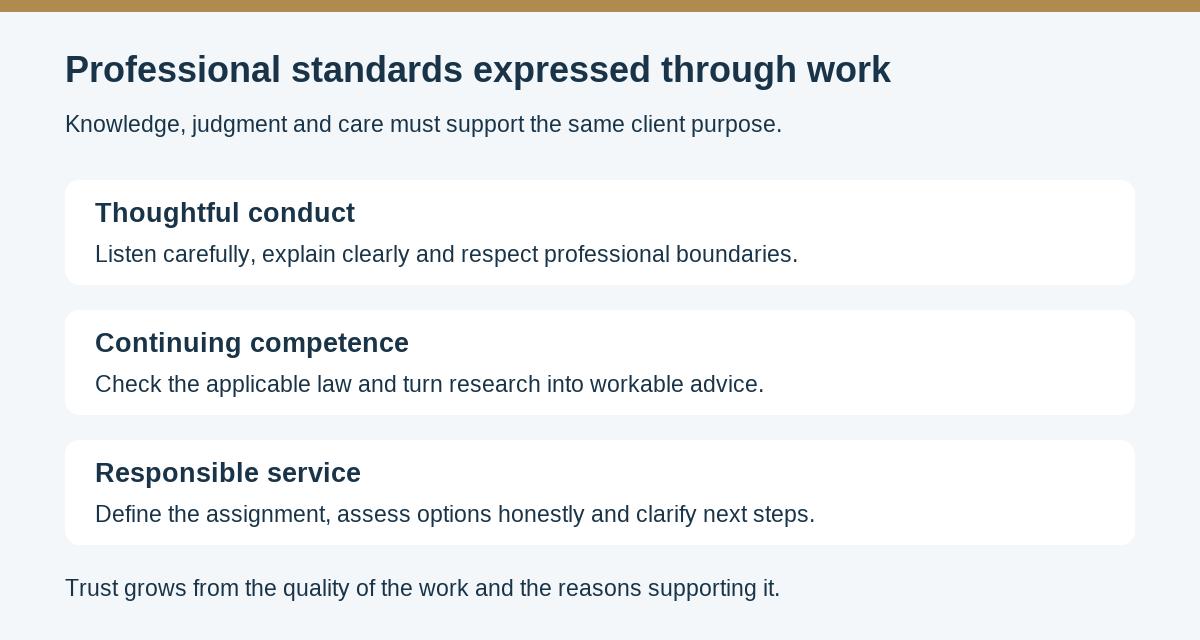
This understanding rests on three connected principles. The first is conscious professionalism in everyday conduct. The second is serious development of knowledge and practical skill. The third is pride in responsible service, expressed through the work itself. None is complete on its own. Knowledge that cannot be explained is difficult to use; confident communication without sufficient analysis is unreliable; and effort without a clear purpose can leave the client uncertain about the next step.
The first responsibility is to understand the decision the client actually faces. A request to review a document may arise because a transaction is about to close, a payment is overdue or a relationship has become difficult. Those circumstances can change which issues matter most. Listening carefully helps avoid producing an answer that is technically interesting but misses the client’s immediate concern.
Understanding the objective does not mean accepting every assumption without examination. Relevant facts may be incomplete, a document may contradict the account given, or a preferred course may carry an overlooked risk. Respectful questions are part of the work. They help distinguish what is known from what still needs to be established.
A useful initial discussion should identify the parties, the relevant dates, available records and the outcome sought. It should also clarify the limits of the proposed assignment. Is the lawyer being asked to advise, negotiate, draft, file an application or participate in proceedings? These are different responsibilities, and an engagement should make the intended work understandable.
Professionalism means helping the client understand the choices, the reasons behind the advice and the responsibilities attached to the next step.
The client should have room to ask questions. Legal advice often arrives at a stressful moment, and familiarity with a process cannot be assumed. Explaining a term or revisiting an important point is part of making the advice usable. A courteous manner matters because it allows concerns to surface before they become misunderstandings.
Communication should connect the legal issue with its practical consequences. If a contract contains a broad indemnity, the discussion should explain what obligation it could create, when it could arise and what a proposed revision would change. Merely marking the clause as “high risk” leaves the client without enough information to assess it.
A professional lawyer must also be prepared to give unwelcome advice. The client may prefer an immediate claim, while the available evidence supports a narrower request or further investigation. The task is to explain the difficulty clearly, assess lawful options and allow the client to decide with a better understanding of the position.
Consider a fictional client who wants to accuse a business partner of misconduct based on one unexplained payment. A responsible review would examine the agreement, payment records and surrounding facts before choosing a legal characterization. Strong language should follow reliable analysis; it should not be used to conceal uncertainty.
Trust also depends on how information is handled. Article 25 of the Law on Lawyers addresses information learned about clients and matters during practice, with the specified exception for written client consent or another legal provision. Confidentiality should therefore be understood carefully, without making an absolute promise that ignores the applicable law.
In practical terms, sensitive records require attention to who needs them, how they are shared and what purpose the sharing serves. A client’s story should not become promotional material merely because it illustrates an interesting legal issue. Permission and applicable obligations must be considered before information is disclosed.
Professional independence requires attention to conflicts as well. Article 9 prohibits providing legal services to clients with opposing interests in the same matter within the scope it specifies. A conflict question should be assessed before substantive work proceeds, rather than postponed because the assignment appears commercially attractive.
These boundaries support the client relationship. They make it possible to discuss difficult facts with a clearer understanding of the lawyer’s role. They also distinguish lawful advocacy from promises of personal influence, concealment or an outcome that no adviser can properly guarantee.
Legal competence requires more than remembering an article number. A rule must be checked against the facts, its effective date, relevant amendments and the procedure through which it operates. An answer based on an outdated form or an earlier allocation of authority can create difficulty even when the underlying subject is familiar.
Continuing professional development should therefore remain connected with actual practice. Reading a new law is only the beginning. The lawyer needs to understand what changed, which earlier matters may be treated differently and what the change means for a client’s proposed action. Learning becomes valuable when it improves judgment and the accuracy of the work.
A professional lawyer should recognize the limits of an initial assessment. Some matters require additional documents, specialist input or clarification from a competent source. Identifying that need is a sign of disciplined practice. It allows the scope, cost and timing of further work to be discussed openly.
Good research begins with a precise question. If the issue is whether a person may sign a particular agreement, the review should identify the relevant entity, role, authorization and transaction. Collecting unrelated legal provisions does not resolve the question. The analysis should show how the sources relate to the facts and where a conclusion remains conditional.
For cross-border work, language adds another layer of responsibility. A translated document may be readable while still leaving a material term unclear. Names, defined terms, dates and obligations should be compared carefully. The goal is to preserve legal meaning and make the advice understandable to the people who must act on it.
Drafting and negotiation require attention to implementation. A settlement promise should explain what must be done, by whom and on what terms. A contract revision should fit the rest of the agreement. A procedural request should identify the relief sought and the material supporting it. Precision reduces the risk that different readers give the same document different meanings.
The same discipline applies to reviewing work. Checking figures, names, annexes and references is not a minor administrative exercise when those details define an obligation or a deadline. Professional care includes both the central legal reasoning and the details needed to carry it into effect.
For us, pride in the profession concerns the standard of the work rather than a claim to win every matter. Clients need candid assessment, careful preparation and lawful representation. Results can depend on evidence, another party’s conduct, administrative review or judicial determination. Responsible service should distinguish the work that can be undertaken from an outcome that cannot be promised.
A professional lawyer should help the client compare options in a balanced way. Litigation may be appropriate in one situation, negotiation in another, and a preventive revision before signing in a third. The comparison should consider the legal basis, practical objective, evidence, time and foreseeable cost. The most forceful-looking option is not automatically the most useful.
Commitment also means taking adverse information seriously. A missing receipt, an unfavorable message or a contractual limitation may affect the strategy. Ignoring it does not protect the client. Explaining its effect and considering lawful responses gives the client a more reliable basis for deciding how to proceed.
Throughout an assignment, updates should explain material developments and what they mean for the client. If further instructions are needed, the request should identify the choice and relevant deadline. If an assumption changes, the advice should be revisited. Communication is useful when it supports action, rather than simply announces that work is continuing.
The ordinary legal-services contract provides an important foundation. Article 26 of the Law on Lawyers requires a written contract in the circumstances it governs and specifies its principal contents, including the services, duration, rights and obligations, fees, expenses and dispute arrangements. The statutory exceptions should not be overlooked, but neither should the value of a clear written scope for an ordinary engagement.
Before work starts, the client should understand what is included and what may require a separate instruction. A fixed-fee document review and participation in extended negotiations are not necessarily the same assignment. If the matter expands, the additional work and relevant cost should be addressed clearly instead of left to conflicting expectations.
Accountability also matters at the end. The client should be able to identify the work delivered, significant unresolved points and any further action required. An opinion may depend on specified facts; a signed agreement may still require performance; a court outcome may need an implementation step. Closing the assignment should make those remaining responsibilities visible.
Before approaching Jurion & Partners, prepare a concise account of the matter, relevant documents and the decision you need to make. Identify any urgent date and explain what has already been done. Those inputs support a focused discussion about the appropriate scope and the information still needed.
For a document-based assignment, the guide to drafting and reviewing contracts can help organize the initial materials. The value of a professional lawyer lies in connecting knowledge with judgment and care. That is the professional standard this article sets out: understand the client’s purpose, explain the legal position honestly and take responsibility for the quality of the work.






Subscribe today to get more breaking news from Jurion Partners - Solicitors & Litigators

108 Tran Dinh Xu St., Cau Ong Lanh Ward, Ho Chi Minh City, Vietnam
(+8428) 66.701.709 - (+84) 903.419.479
contact@jurionpartners.com
Follow us
Accept payment





 English
 Tiếng Việt