Mergers and acquisitions (M&A) are among the most strategic moves for business growth in Vietnam
M&A contract safeguards should connect the commercial bargain with the facts uncovered during investigation. A purchase agreement cannot eliminate every transaction risk, but it can explain which conditions must be satisfied, what information the parties rely on and how identified problems will be handled. The drafting task is therefore more specific than adding a standard warranty schedule. It begins with the transaction structure and the decisions that the buyer and seller actually need to make.
Identify what is being acquired: shares, a capital interest, specified assets or a business through another arrangement. The object of the transaction affects the documents, liabilities and completion steps that require assessment. A share purchase does not describe the same legal transfer as an asset sale. The agreement should reflect the selected structure rather than rely on the transaction's broad commercial label.
Also identify the parties and the source of their authority. The person negotiating a sale may not own the interest or have authority to bind its holder. Where several sellers participate, decide how their obligations are allocated. A single reference to “the sellers” can conceal important differences in ownership, knowledge and the ability to perform a particular undertaking.
Prepare a short list of assumptions supporting the proposed price and structure. These might concern a key customer, a licence, a property arrangement or the continued involvement of management. Identify which assumptions have been verified and which remain subject to further work. The drafting should show how uncertainty is addressed rather than present an untested assumption as an established feature of the business.
A due diligence finding needs a transaction decision. The buyer might seek further evidence, require a matter to be resolved before completion, propose a price adjustment or negotiate a particular allocation of responsibility. Different findings may need different responses. Sending the entire report to the drafter without identifying the agreed commercial response can leave an important issue unaddressed in the document.
For M&A contract safeguards, maintain an issues-to-clauses table. Record the finding, its significance, the proposed treatment and the corresponding provision. Include the person responsible for confirming whether the treatment is acceptable. The table helps distinguish a problem that has been resolved from one that has merely been described in more polished language.
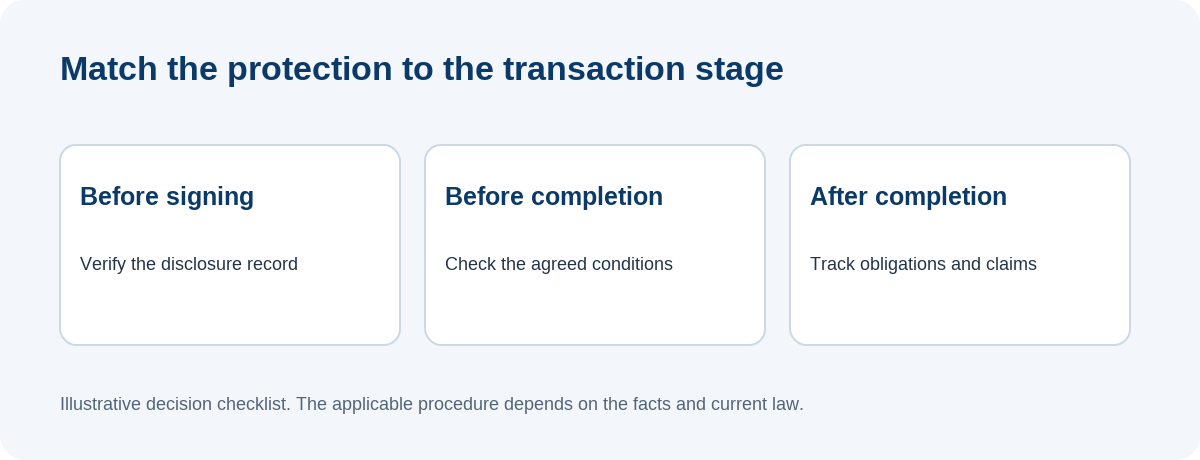
Conditions should identify what needs to happen before the parties complete the transaction. The appropriate list depends on the deal and any applicable approvals. Consider the documents needed to establish satisfaction, the person responsible for the work and the process for confirming the result. A condition described only as “all necessary matters completed” may leave the parties disagreeing about whether completion can occur.
Do not assume that every condition can be waived by agreement. A contractual decision cannot replace a mandatory regulatory requirement. Separate conditions that protect a party's commercial position from matters that need a legal assessment of the applicable framework. The document should also address what happens if a condition remains unsatisfied by the agreed date, including any extension or termination mechanism.
If signing and completion occur at different times, define the arrangements for the intervening period. Identify restrictions, information rights and permitted actions that are proportionate to the transaction. The parties should understand who continues to manage the business and which decisions require consent. These provisions need careful assessment so that the contractual arrangement does not assume rights that cannot yet be exercised.
M&A contract safeguards often include warranties concerning the target and the transaction. Their usefulness depends on the wording, the relevant time and the qualifications attached to them. A warranty list copied from another deal may ask about matters that do not apply while overlooking the target's main risk. Review the schedule against the business rather than treating its length as a measure of protection.
Decide how disclosures are made and recorded. A general reference to a data room can raise questions about which documents were available, when they were uploaded and what the reference is intended to qualify. Agree a reliable disclosure record and examine its legal effect within the whole agreement. Both sides should be able to identify the information forming part of the negotiated allocation.
A proposed qualification based on knowledge needs more than a familiar phrase. Identify whose knowledge is relevant and what investigation, if any, is contemplated. Consider whether the person giving the statement can reasonably speak to the subject. The drafting should reflect a deliberate decision about the scope of the promise, rather than leave that scope to be argued after a claim arises.
A known problem may require a specific provision rather than reliance on a general warranty. Define the event, responsibility, calculation and process the parties intend to use. For example, an unresolved claim or a particular compliance issue may need its own treatment. The commercial team should decide whether the transaction can proceed with that allocation or whether further investigation is necessary.
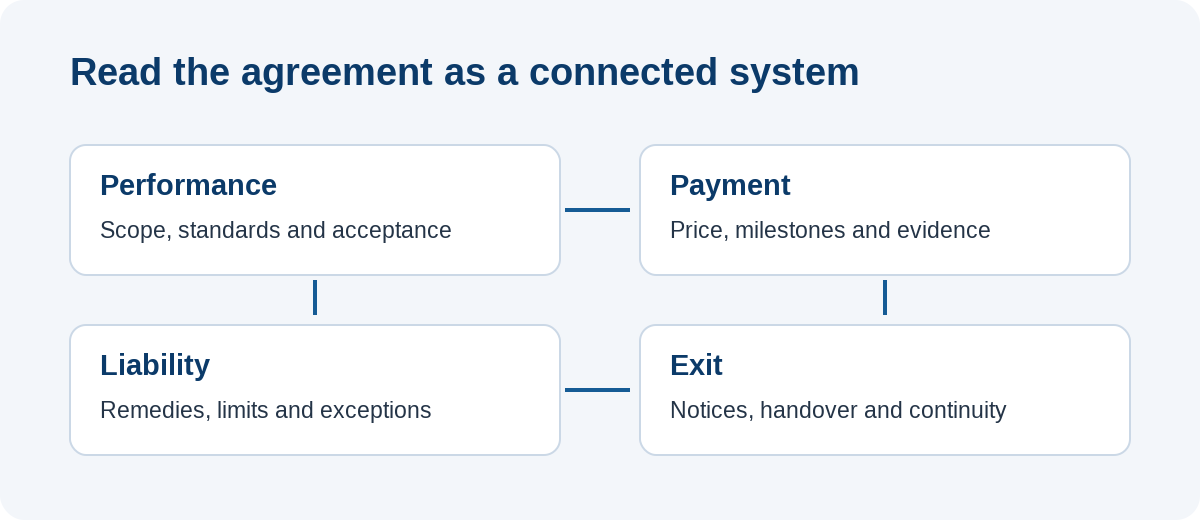
Read specific protections together with the liability limits, exclusions and claim procedures. A provision that appears generous in one section may be materially restricted elsewhere. Test a realistic example through the proposed language: who gives notice, what information is required, what period applies and which limitations affect the claim? This exercise reveals practical gaps before the document becomes binding.
Consider a buyer that discovers a disputed supplier invoice shortly before signing. A statement that the company has “no undisclosed debts” does not by itself settle whether the price assumes payment of that invoice, whether funds should be retained or how the seller will participate in the dispute. Document the commercial decision, identify the supporting records and test the proposed clause against a later settlement. The purpose of the exercise is to allocate this identified issue, not to suggest that one contractual device is suitable for every acquisition.
| Finding | Decision required | Document check |
|---|---|---|
| A material agreement contains a change-of-control provision | Determine whether consent is required and how its absence affects completion | Read the actual provision and reconcile the agreed treatment with the conditions |
| A significant customer balance is disputed | Agree how the disputed amount is treated in the price calculation | Check the reference accounts, adjustment definitions and dispute procedure together |
| Records will be delivered after completion | Identify who must deliver them and how the buyer can verify completeness | Specify the delivery obligation, format and evidence of performance |
M&A contract safeguards should support the price structure the parties have actually selected. If the price depends on financial information or a later calculation, explain the reference date, records, accounting approach and dispute process. The lawyers and financial advisers need to coordinate their work. A legal definition cannot resolve a commercial calculation that the parties have not agreed.
For deferred or conditional amounts, identify the trigger and the evidence used to determine whether it has occurred. Consider who controls the relevant information after completion. The agreement should explain the review process and the decisions needed if figures are disputed. Avoid a mechanism that appears precise but relies on information one party cannot obtain or verify.
List the documents, payments and actions intended to occur at completion. Identify dependencies and the sequence in which they need to happen. Confirm who holds the required signatures and approvals. A checklist prepared independently of the final agreement can omit a negotiated condition or include a document that is no longer relevant, so reconcile the two before the closing meeting.
Review corporate, investment and sector requirements under the framework applicable to the transaction. Some steps may have legal consequences that cannot be changed by the parties' preferred timetable. The project should record the relevant analysis and assumptions rather than promise that the transfer is effective simply because a purchase price has been paid.
Record post-completion undertakings and assign an owner to each. These might concern delivery of records, cooperation with a filing, transition arrangements or a continuing payment mechanism. Identify what evidence will show performance. A business can lose a negotiated benefit if no one monitors the obligation after the transaction team disperses.
Consider the claim process as well. The parties should understand how a potential issue is reported and which records must be preserved. Where a clause depends on a notice or approval, the operational team needs a usable explanation. A legal team should not assume that colleagues administering the agreement will infer the required steps from a lengthy schedule.
A business seeking assistance from Jurion & Partners can prepare the agreed structure, current draft, due diligence findings and priority issues. Explain which commercial decisions remain open and what the intended signing process involves. The proposed scope can then distinguish drafting, negotiation and a separate assessment of approvals or completion requirements.
The wider guide to drafting and reviewing commercial agreements explains the discipline of connected reading, version control and operational handover. Apply that discipline to the acquisition documents, while retaining the transaction-specific treatment of disclosure, conditions, price and post-completion obligations.
>>> Read more: Resolving disputes between shareholders or members of the company
M&A contract safeguards should be traceable to identifiable concerns and decisions. Before approval, ask whether each material finding has a treatment, whether the completion steps are workable and whether the final schedules reflect the negotiated position. Resolve unexplained changes rather than assuming they are only drafting improvements.
Bring the commercial, financial and operational teams into the final check. Their understanding of the proposed transfer is essential to a document that can be implemented. Carefully designed M&A contract safeguards give the parties a clearer account of what they are agreeing and a more practical framework for managing the risks that remain.






Subscribe today to get more breaking news from Jurion Partners - Solicitors & Litigators

108 Tran Dinh Xu St., Cau Ong Lanh Ward, Ho Chi Minh City, Vietnam
(+8428) 66.701.709 - (+84) 903.419.479
contact@jurionpartners.com
Follow us
Accept payment





 English
 Tiếng Việt