In Vietnam, a consensual divorce is typically a smoother process compared to unilateral divorce. However, when disputes over common property arise, even a consensual divorce can become complex. Understanding the legal framework governing property division during a divorce in Vietnam is crucial for both parties involved. This article, APOLO LAWYERS - Solicitors & Litigators: (+8428) 66.701.709 - (+84) 903.419.479 will provides insight into how Vietnamese law handles property disputes in a consensual divorce and the role of legal representation.
A consensual divorce occurs when both spouses agree to end the marriage and have mutually agreed on significant matters such as child custody, spousal support, and property division. In accordance with Article 55 of the 2014 Law on Marriage and Family, when both parties agree to divorce but cannot agree on the division of common property, the court will settle the property dispute based on legal principles.
While consensual divorce simplifies many aspects of the divorce process, disputes over common property can prolong and complicate the proceedings.
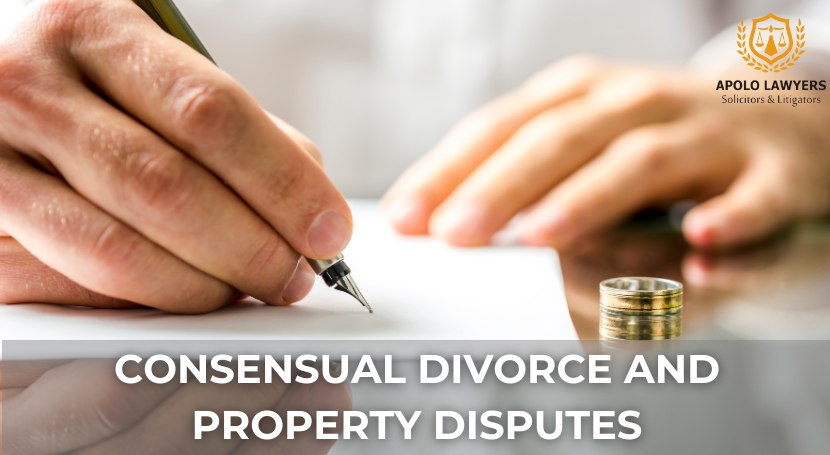 Consensual Divorce and Property Disputes
Vietnamese law clearly defines what constitutes common and separate property during a marriage. The division of common property follows these key principles:
Equality: Both spouses are entitled to an equal share of the property acquired during the marriage.
Contribution: The court considers each spouse with their contribution to the creation, maintenance, and development of the property. This includes non-monetary contributions like child-rearing or homemaking.
Protection of Legitimate Interests: The law protects the interests of minor children and other dependent family members.
Circumstantial Consideration: Factors such as the length of the marriage, each spouse their health, and their economic conditions are also considered in property division disputes.
In a divorce in Vietnam, even when the spouses agree on ending the marriage, disputes may arise over the following:
Real Estate: Land and house ownership disputes are among the most common. Vietnamese law stipulates that any property acquired during the marriage, unless otherwise agreed upon, is considered joint property and must be divided fairly.
Business Assets: When a spouse operates a business, disputes can arise regarding ownership and value division. The court will determine the division based on the contribution of each spouse.
Savings and Investments: Bank accounts, savings, stocks, and other investments made during the marriage are treated as common assets. The court may divide these based on their current value and each spouse contribution.
 Consensual Divorce and Property Disputes
If both spouses cannot agree on how to divide the common property, the court will intervene. The process of property division during a divorce in Vietnam generally involves:
Assessment of Common Property: The court will first assess which properties are common and which are separate. Documentation, such as property titles and contracts, plays a crucial role in this determination.
Valuation: In cases involving real estate or business assets, the court may appoint an independent expert to evaluate the property of worth. This valuation ensures a fair division based on actual market value.
Mediation: Before resorting to a court ruling, Vietnamese courts encourage mediation between the two parties. Mediation can help resolve property disputes without prolonging the legal process.
5. Spousal Agreements and Pre-nuptial Contracts
Although not as common in Vietnam as in other countries, pre-nuptial contracts can play an essential role in property disputes during a divorce. These contracts, agreed upon before or during the marriage, can define what constitutes common and separate property and how it should be divided in case of a divorce. If a valid pre-nuptial agreement exists, the court will usually respect the terms when settling disputes.
6. Legal Support for Property Disputes
Seeking legal assistance during a divorce in Vietnam is highly recommended, especially in cases where property disputes arise. A knowledgeable lawyer can provide the following support:
Legal Advice: A lawyer will help you understand your rights and obligations in property division. They will also assist in gathering necessary documentation to support your claims.
Negotiation: If possible, a lawyer can help negotiate a fair settlement with your spouse, preventing lengthy court proceedings.
Representation in Court: In cases where negotiations fail, your lawyer will represent you in court, ensuring that your rights are protected throughout the process.
While a consensual divorce is often simpler than a contested one, property disputes can add significant complexity to the process. Understanding the legal principles of property division in Vietnam, along with seeking professional legal representation, is crucial to ensuring a fair and just outcome. Whether the dispute involves real estate, business assets, or savings, it is essential to approach the situation with a clear understanding of the law.
By seeking guidance from experienced legal professionals, you can ensure that your rights are protected, and the property division is handled according to Vietnamese law, helping you move forward with confidence after the divorce.
APOLO LAWYERS












 English
 Tiếng Việt