A practical preparation guide to divorce in Vietnam, including agreed and disputed routes, current courts, foreign documents and attendance.
How to divorce in Vietnam is a practical question about choosing the right procedure, assembling reliable evidence and deciding which issues the court needs to resolve. Start with your own circumstances: where each spouse lives, whether both genuinely agree to divorce, whether there are children, and whether property or debts remain disputed. A clear account of those facts is more useful than downloading a generic form and assuming it fits every marriage.
Locate the marriage registration record and check the names, dates and identifying details against your current documents. Explain any name changes, different spellings or replacement identity documents. If the marriage was registered abroad, identify the foreign record and any relevant Vietnamese civil-status recording. If a foreign divorce decision already exists, disclose it before starting another divorce application: recognition or recording of that decision may need to be considered instead.
Write a short chronology covering registration, shared residence, separation and the present arrangements. Distinguish events you personally witnessed from information supplied by someone else. A factual chronology helps identify missing evidence and avoids contradictory accounts across the application, witness statements and discussions with an adviser.
For a foreign-related family, nationality is only one part of the assessment. Current residence, the location of assets and an existing overseas proceeding may also matter. Do not conceal an application already lodged in another country, even if it has not yet produced a decision. The legal effect of parallel proceedings requires an individual assessment.
An agreed route needs a genuine, voluntary position rather than a signature obtained through pressure. Prepare clear proposals about children, support and property. Specify whether property arrangements have been settled or division is not being requested; silence about a substantial asset can create unnecessary uncertainty. The court still examines the applicable conditions and the protection of the wife’s and children’s legitimate interests.
For example, spouses may agree to end the marriage but disagree about taking their child overseas. That disagreement should be identified openly rather than hidden beneath a sentence saying that all matters are settled. Separate the points already agreed from the decisions still required, and assess whether the proposed procedural route remains appropriate.
A disputed divorce requires the relevant legal grounds and supporting circumstances. A spouse’s refusal to sign does not by itself establish every condition for divorce, but it also does not give that spouse an unlimited veto. Explain the actual breakdown and identify evidence that can lawfully support the account, including relevant records of violence or serious breaches of marital obligations where applicable.
Article 51 of the Law on Marriage and Family restricts a husband’s right to request divorce during the specified pregnancy, childbirth and care-of-a-child-under-twelve-months circumstances. It does not create a blanket prohibition on the wife seeking divorce. Where these circumstances arise, they should be checked before filing rather than treated as a minor detail to explain later.
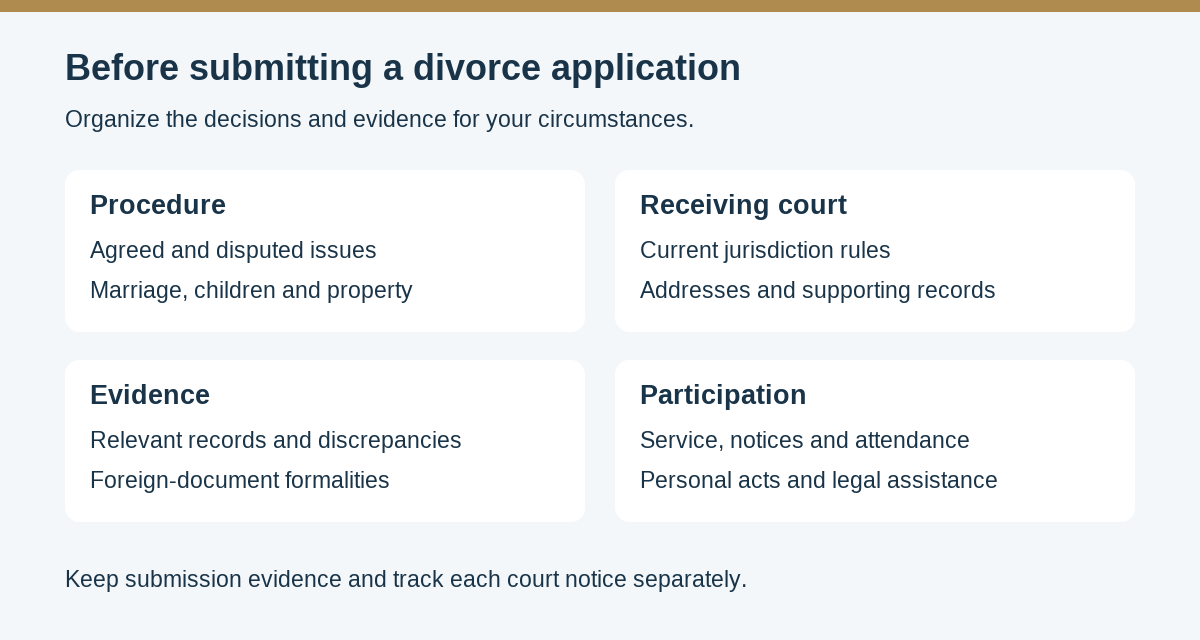
Check both the category of court and its territorial jurisdiction. The current Civil Procedure Code assigns the listed first-instance family matters to regional People’s Courts under Article 35, subject to the applicable allocation and exceptions. Older guidance that directs every foreign-related divorce to a provincial court should not be followed without checking the amended provisions.
The territorial connection depends on the kind of proceeding and the facts. A disputed case and a joint consensual request are not necessarily filed on identical grounds. Establish each spouse’s actual address, distinguish residence from a temporary mailing address, and identify the documents supporting the proposed court’s jurisdiction. The wedding venue or a convenient lawyer’s office does not automatically determine the receiving court.
Where a spouse or important evidence is overseas, first assess whether Vietnamese courts have jurisdiction over the matter. Then identify the appropriate domestic court. These are separate questions. Check the court’s current official name and territorial coverage rather than reusing an address from an old article or a friend’s completed case.
A working file should explain what each document proves. Keep an inventory showing the document, its issuer, whether an original or copy is available, the language used and the action still needed. This makes it easier to distinguish a missing essential record from a document that is merely helpful.
Do not invent a substitute when an original marriage certificate is unavailable. Establish whether a certified extract or another lawful record can be obtained from the relevant authority, and explain the difficulty to the court where necessary. A photocopy certified by an unrelated foreign office is not automatically equivalent to every form of marriage registration evidence.
For foreign-issued papers, check legalization requirements and applicable exemptions separately from translation. Foreign-language evidence must meet the relevant Vietnamese procedural requirements; an informal translation prepared for a discussion may be insufficient for filing. The correct treatment depends on the document and applicable rules, rather than a universal statement that every foreign paper must always be legalized.
Compare names, addresses, dates and requested outcomes across the whole file. If an account statement shows a loan balance different from the figure in the application, explain the date and reason. Label copies clearly, retain originals safely, and keep proof of material submitted. Never alter a record to remove an inconvenient detail or obtain private information through unlawful access.
A parenting proposal should describe daily care, schooling, health needs, contact and financial support. Explain how it would operate in practice, especially when the parents live far apart. The court considers the child’s interests under the applicable rules; income alone does not settle custody, and a child’s wishes are not the only factor.
Where support is proposed, identify the expenses concerned, payment arrangements and the evidence of needs and financial capacity. Avoid vague promises such as “reasonable support whenever necessary” if a more workable arrangement can be discussed. Keep the child’s care needs separate from bargaining over an unrelated asset.
For property, list what each spouse says is common or separate, how it was acquired and what evidence supports that position. Record outstanding loans, security interests and possible third-party rights. A private agreement between spouses does not automatically release either person from obligations owed to a lender. If overseas immovable property is involved, obtain advice about the relevant jurisdiction and applicable law before proposing a Vietnamese order concerning it.
Use a filing method permitted for the relevant proceeding, such as direct submission, postal submission or an authorized electronic channel where its conditions are met. Keep a dated copy and submission evidence. Sending a scanned application to an unverified email address should not be assumed to constitute a valid filing.
Read any request for correction or additional documents carefully. Make a checklist of each item, its deadline and how it will be supplied. A submission receipt, a notice to pay an advance and formal acceptance are different procedural events. Record them separately instead of assuming that the entire case timetable starts when the first envelope is posted.
Pay the amount required by the proper notice and retain the receipt. The fee treatment depends on the proceeding, the requests, property issues and any applicable exemption. Avoid treating a quoted basic amount as a complete budget covering valuation, translation, service abroad and professional fees. Ask for the basis and scope of each expected expense.
A lawyer can review the file, advise on disputed issues and provide permitted procedural assistance. However, Article 85 does not permit ordinary authorization for another person to participate as a spouse’s representative in divorce proceedings. The specific statutory situation involving eligible relatives is different from a routine power of attorney. Do not sign a service agreement on the assumption that a lawyer can automatically replace every required personal act.
If attendance is difficult, identify the precise event concerned and ask what lawful arrangements the court can consider. Overseas residence does not itself guarantee permission to miss a hearing. Equally, it should not be described as making every divorce impossible. Provide accurate service details, communicate genuine difficulties promptly and preserve the court’s responses.
Understanding how to divorce in Vietnam also means planning for communication: who will receive notices, how documents will be translated when required, and how deadlines will be checked while travelling. Agree on a reliable way to review incoming papers. Do not assume that a former shared address remains suitable simply because it appears on an old certificate.
Check exactly what the judgment or decision resolves and when it takes legal effect. An agreement signed privately, a successful mediation record and an effective divorce decision are not interchangeable. The applicable rules on effectiveness and review differ between a recognized consensual divorce and a disputed judgment; ask about the particular document received rather than relying on a general appeal deadline.
Retain the effective outcome and consider the practical steps it requires, including support payments, property implementation and any relevant civil-status records. Where the document will be used abroad, ask the receiving authority what recognition, authentication or translation requirements apply. A Vietnamese divorce outcome is not automatically usable for every overseas administrative purpose without further checks.
Before asking Jurion & Partners to review your circumstances, prepare a concise chronology, a list of agreed and disputed issues, and an inventory of available records. Identify the decisions you need help making: the appropriate route, a missing document, a jurisdictional question or a proposed parenting arrangement. This gives the initial discussion a concrete purpose.
Use the guide to drafting a lawsuit petition in Vietnam to organize the written request once the procedural route is clear. Resolve inconsistencies before submission, and keep a record of subsequent changes. Knowing how to divorce in Vietnam becomes useful when each next step is supported by accurate facts, a realistic proposal and the documents needed to explain it.






Subscribe today to get more breaking news from Jurion Partners - Solicitors & Litigators

108 Tran Dinh Xu St., Cau Ong Lanh Ward, Ho Chi Minh City, Vietnam
(+8428) 66.701.709 - (+84) 903.419.479
contact@jurionpartners.com
Follow us
Accept payment





 English
 Tiếng Việt