A practical guide to identifying marital assets, reviewing division factors and preparing a property resolution that respects creditor and third-party rights.
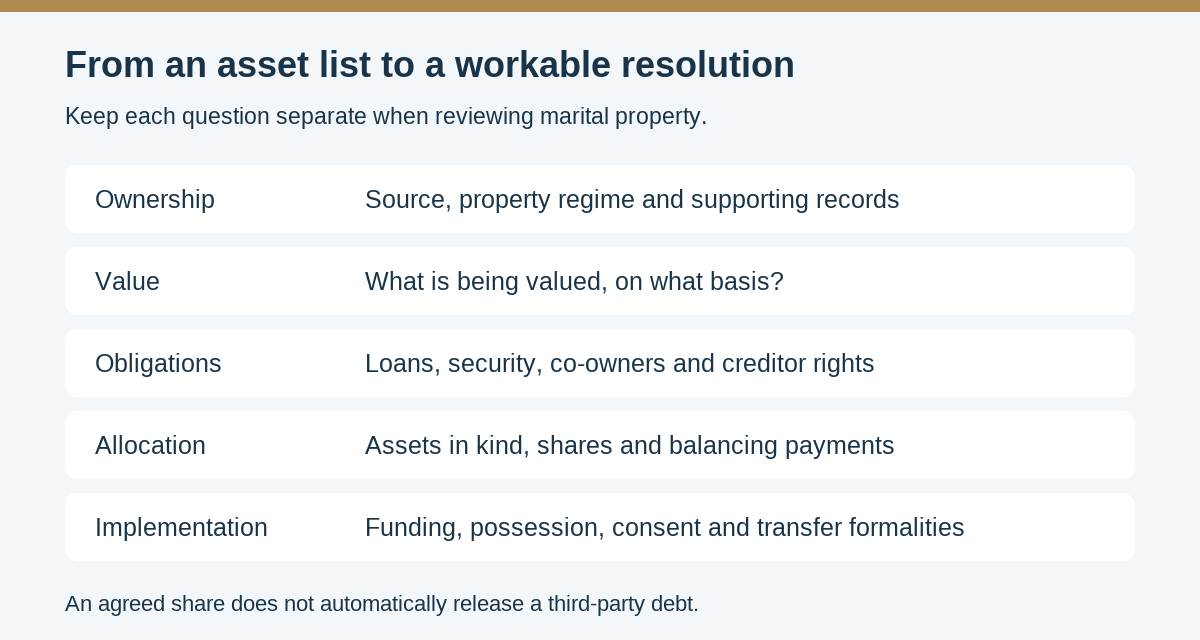
Resolving the common property in divorce requires more than deciding who receives a house, a bank balance or a vehicle. The spouses must identify the property available for division, establish the relevant ownership and financial history, and address obligations involving other people. A workable resolution also explains valuation, payment and transfer arrangements, so that a proposed share can become an outcome capable of implementation.
First establish whether the spouses are subject to the statutory property regime or a valid agreed regime. Under Article 59 of the Law on Marriage and Family, an applicable property agreement affects the assessment; the relevant statutory provisions address matters not adequately or clearly covered. Do not assume that every document called a marriage agreement is valid or answers every later dispute.
Collect the original agreement, any amendments and documents explaining how it was made. Distinguish an agreement about the property regime from a later proposal to settle the divorce. Their purposes and legal requirements are not necessarily the same. A review should identify which document is relied upon and which issues it actually covers.
If there is no relevant agreement, organize the facts needed to apply the statutory rules. The useful starting point is the acquisition and financial history of each significant item, rather than a list of whose name appears on a certificate.
Prepare an inventory of real estate interests, savings, vehicles, business interests and other material assets. For each item, record when it was acquired, the source of funds, the registered holder, present possession and any security or ownership dispute. Include assets said to be separate so that the classification can be reviewed rather than silently assumed.
Article 33 addresses common property, including relevant earnings and acquisitions during marriage, joint inheritance or gifts, and other agreed common property. Article 43 addresses separate property, including qualifying premarital property and individual gifts or inheritances. Income and returns from separate property require their own assessment under the applicable rules; the source asset and the income it produces should not be treated as identical questions.
Where the spouses dispute classification and there is no basis proving the property is separate, the statutory presumption concerning common property matters. Nevertheless, do not abandon a properly documented separate-property claim simply because the asset was later sold or replaced. Trace the transaction and consider whether funds were combined or property was incorporated into the common pool.
A property record in one spouse’s name should be examined with the acquisition documents and relevant law. It is not safe to conclude that the holder must own the whole asset separately. Equally, the fact that a transaction occurred during marriage does not eliminate every statutory exception. The evidence should explain the actual source and legal basis of the claim.
For example, an individual inheritance may have been used towards a later purchase funded partly by marital earnings. Identify the inheritance, payment path and any relevant agreement. Do not describe the entire purchase as separate or common merely by choosing the most convenient date.
Under the statutory framework, Article 59 takes equal division as the starting point while requiring consideration of the specified factors. These include the spouses’ and family’s circumstances, contributions, legitimate business and professional interests, and fault in violating marital rights and obligations. The protection of the wife’s and qualifying children’s lawful interests is also part of the provision.
Domestic work is recognized as income-generating work for the contribution assessment. A spouse should not be treated as having contributed nothing merely because the other person received the salary. Explain childcare, household responsibilities and contributions to maintaining or developing the assets alongside financial payments.
Fault is a relevant factor, not a published penalty table assigning a fixed extra percentage for each alleged incident. Claims should be supported and assessed in their legal context. An affair, a low salary or a difficult personal situation does not automatically produce a predetermined property share.
Article 59 provides for division in kind and, where that is not possible, by value. A spouse receiving assets worth more than the share awarded must pay the appropriate difference. The first question is therefore not always where to draw a line through a parcel of land, but whether the proposed allocation is lawful and workable.
Land-use rights require attention to Article 62 and the applicable land rules. The type of land, the relevant rights and the feasibility of subdivision matter. Even if a proposed division uses equal values, it does not follow that each spouse can receive half the physical area or that a separate certificate can automatically be issued.
Where a home remains with one spouse, consider the amount and timing of any balancing payment, actual funding and the necessary transfer formalities. A proposal that cannot be financed may postpone rather than resolve the dispute. Housing needs and care of children are relevant circumstances, but they do not create an automatic rule that the direct caregiver always receives the whole home.
Assume a fictional couple agree that one spouse should retain a home but disagree on its value. One relies on an old purchase price; the other relies on an informal advertisement for a different property. Before negotiating the balancing amount, clarify the valuation basis, the property actually being valued and the evidence supporting the figure. Then check how payment could be made and what happens if the proposed arrangement cannot be performed.
List the lender, borrower, purpose, outstanding amount and security for each relevant obligation. Distinguish a debt said to be common from a personal obligation, and keep the supporting loan and payment records. A transaction in one spouse’s name is not automatically irrelevant to the family, nor is every liability incurred during marriage necessarily shared.
Article 60 preserves property rights and obligations involving third parties after divorce unless the spouses and the relevant third party agree otherwise. An arrangement between spouses about who will pay a bank loan does not, by itself, release the other person from the lender’s rights. Any proposed release or refinancing needs the appropriate separate agreement and formalities.
Identify co-owners and other people claiming an interest early. Property belonging to a wider family or a company cannot simply be placed in the spouses’ inventory as if nobody else had rights. Where the spouses lived with a family and contributed to its property, Article 61 may require a distinct assessment of their interest before division between them.
A spouse’s business interest and the assets owned by a separate legal entity are different things. Obtain the relevant ownership records, financial information and agreements before valuing the interest. A company’s bank account should not automatically be treated as a personal account available for division between spouses.
Article 64 addresses common property used in business and the relevant allocation and balancing payment, subject to business-law requirements. Consider whether the proposal would preserve lawful operations, how the interest is valued and what restrictions or third-party rights apply. Do not promise a transfer that the holder is not legally able to make.
Where information is incomplete, identify the missing records and the proper method of obtaining them. A party may need procedural assistance concerning evidence or valuation. Avoid replacing unavailable financial information with an unsupported claim that the business is worthless or worth the full amount of its turnover.
A useful draft identifies each asset accurately, states the proposed allocation and addresses payments, possession and required documents. Separate agreed facts from disputed ones. If a valuation is provisional, say so and identify how it will be resolved rather than allowing both parties to sign with different assumptions.
Do not trade a child’s care or support for an unrelated property concession. Children’s interests and parental obligations require their own lawful assessment. Likewise, avoid a settlement intended to hide assets or defeat legitimate creditors. A divorce agreement is not a mechanism for removing another person’s lawful rights.
Identify the precise decisions requested from the court: classification, division, a balancing payment or determination of a disputed obligation. Keep documents organized by asset and issue. Clear requests help distinguish a genuine ownership dispute from a disagreement about value or the method of allocation.
For overseas assets, consider jurisdiction, applicable law and eventual enforcement. Article 127 contains a specific rule for foreign immovable property in foreign-related divorces. A Vietnamese proceeding should not be presented as automatically resolving and transferring every asset worldwide. Obtain advice about the countries and assets actually involved.
Before a review of resolving the common property in divorce, bring earlier agreements, ownership records, transaction evidence and a list of missing information. If there is a genuine risk concerning disposal of disputed property, ask about available lawful measures and their conditions. Do not conceal or transfer property on the assumption that doing so will settle ownership in your favour.
>>> Read more: Does resolving a consensual divorce take a long time?
>>> Read more: Get custody of children in case of divorce
A review with Jurion & Partners can begin with an asset-and-obligation schedule showing what is agreed, what is disputed and which records are available. Identify your preferred allocation and any practical constraint, such as refinancing or the need to preserve a business operation. This allows the discussion to address the actual dispute.
The guide to drafting a lawsuit petition in Vietnam helps structure the written requests and supporting material. A sound approach to resolving the common property in divorce connects lawful ownership, fair assessment and practical implementation, so that the proposed outcome explains both what each spouse receives and how it can be achieved.






Subscribe today to get more breaking news from Jurion Partners - Solicitors & Litigators

108 Tran Dinh Xu St., Cau Ong Lanh Ward, Ho Chi Minh City, Vietnam
(+8428) 66.701.709 - (+84) 903.419.479
contact@jurionpartners.com
Follow us
Accept payment





 English
 Tiếng Việt