Prepare a foreign-related divorce in Vietnam: court jurisdiction, agreed or disputed issues, overseas participation, documents, children, property and next steps.
Divorce in Vietnam for foreigners begins with identifying the marriage, the spouses’ connections with Vietnam and the decisions each person needs from the court. Nationality alone does not select the procedure. A couple who agree to separate may still disagree about their child’s residence, a housing loan or the treatment of an overseas asset. Those unresolved issues need to be identified before a document is described as a complete agreement.
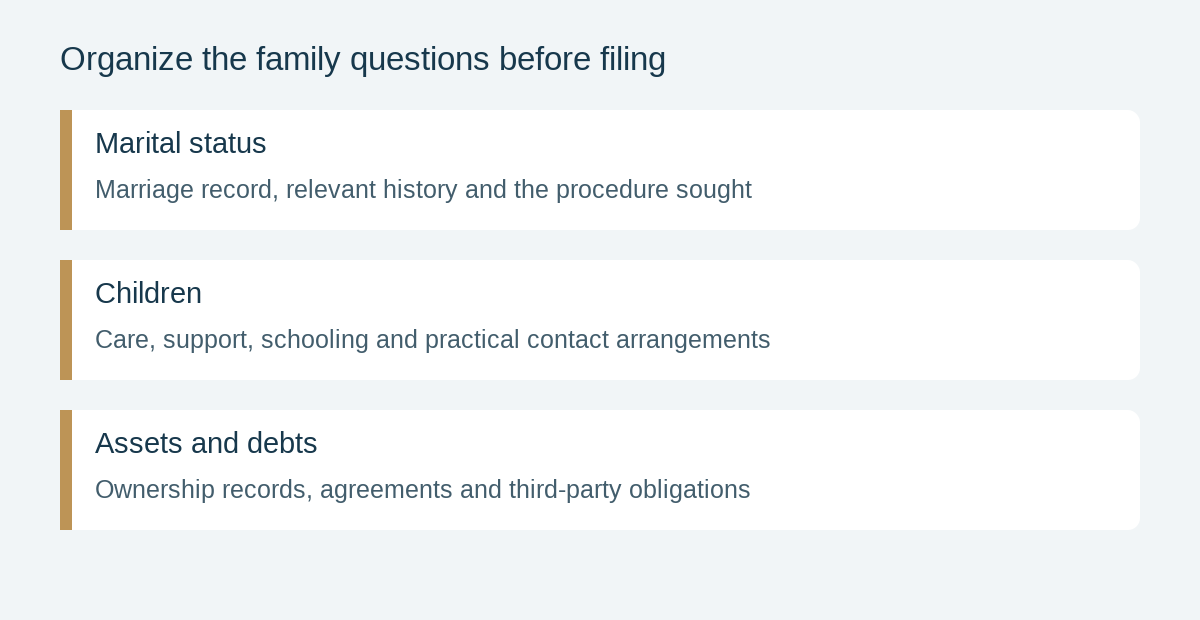
Prepare a short factual account containing each spouse’s nationality, current residence, last shared residence, marriage registration details and the location of their children and relevant assets. Record where the other spouse can actually receive documents. An old address copied from a marriage certificate may no longer be suitable for service.
Separate the outcome sought into marital status, care of children, maintenance, property and obligations to third parties. These subjects affect the evidence required and may raise different legal questions. If an overseas divorce judgment already exists, disclose it at the outset: the appropriate task may involve recognition or civil-status recording rather than another proceeding to dissolve the same marriage.
The international jurisdiction rules must be checked against the spouses’ actual circumstances. Articles 469 and 470 of the Civil Procedure Code address general and exclusive jurisdiction, including specified divorce situations. Do not assume that marrying a Vietnamese citizen means any Vietnamese court can deal with every later request, or that a foreign passport automatically prevents proceedings here.
Once a Vietnamese jurisdictional basis is identified, determine the receiving court under the current domestic rules. The amended Article 35 assigns the listed first-instance categories to regional People’s Courts, subject to the relevant exceptions and division of work. Older instructions sending every foreign-related family case to a provincial court should not be copied into a new filing.
Territorial jurisdiction remains a separate check. The address of a lawyer’s office, the hotel where a spouse is staying and the place where the marriage ceremony took place are not interchangeable grounds for choosing a court. Explain the proposed connection and retain the documents that establish it.
A consensual application requires genuine agreement, not simply two signatures beneath the statement “we agree to divorce.” Article 397 addresses reconciliation and recognition of voluntary divorce, including arrangements concerning children and property that protect the legitimate interests of the wife and children. A proposed agreement should say clearly whether property has been settled or whether division is not requested.
If one spouse does not agree to divorce, or a material issue remains contested, the litigation route must be assessed. A spouse’s refusal to sign does not by itself answer whether the legal grounds for a disputed divorce are met. Conversely, a signed document does not require the court to approve arrangements that fail the applicable conditions.
Consider a fictional couple who both want to end their marriage but propose different countries for their child’s future schooling. Calling the matter “fully consensual” conceals the central dispute. The preparation should identify the competing proposals, the child’s present circumstances and the evidence relevant to care, rather than present an incomplete agreement as settled.
Article 51 of the Law on Marriage and Family limits a husband’s right to request divorce while his wife is pregnant, giving birth or caring for a child under twelve months. This is not a general prohibition on the wife seeking divorce. A disputed application also needs a legal basis under Article 56, rather than treating refusal to sign as the only question. Record the relevant circumstances before choosing the route.
A document file for divorce in Vietnam for foreigners commonly starts with the marriage record, identity documents, information supporting residence and service, and documents connected with the relief sought. Children’s birth records, property documents, loan records and an existing marital-property agreement may also be relevant. The precise file depends on the marriage history and the issues placed before the court.
Where the marriage certificate is unavailable, record why and investigate the appropriate way to obtain an official copy or extract. Do not replace a missing official record with an unexplained photograph and assume it has the same evidential value. If names differ across passports and certificates, explain the difference and collect the documents establishing continuity of identity.
| Question | Material to organize |
|---|---|
| What marriage is to be dissolved? | Registration record, date, authority and any earlier marital-status decisions |
| Where can each spouse receive documents? | Current address, supporting information and known changes of residence |
| What is requested for the children? | Care arrangements, schooling, health needs and maintenance proposal |
| Which assets and debts are disputed? | Ownership, acquisition, funding, loan and third-party records |
| What has already happened abroad? | Filed papers, acceptance notices and judgments where applicable |
Article 478 of the Civil Procedure Code addresses recognition of foreign-issued documents and relevant formal requirements. Translation, certification and consular legalization should be assessed by document category and the applicable exemption. “Every foreign paper must be legalized” is too broad, while assuming an English-language document is automatically usable is equally unreliable.
Identify the issuing authority and the purpose of each document before paying for formalities. Keep a list distinguishing originals, certified copies, translations and documents still being obtained. A legalized document is not a guarantee that the court will accept every factual assertion made about it; authenticity requirements and the weight of evidence are separate issues.
If the marriage was registered overseas, review its recognition and civil-status history under the rules applicable to that record. An old instruction naming a particular administrative office should not be treated as universally current. Explain any missing recording step or unavailable record transparently and obtain advice on the procedure actually required.
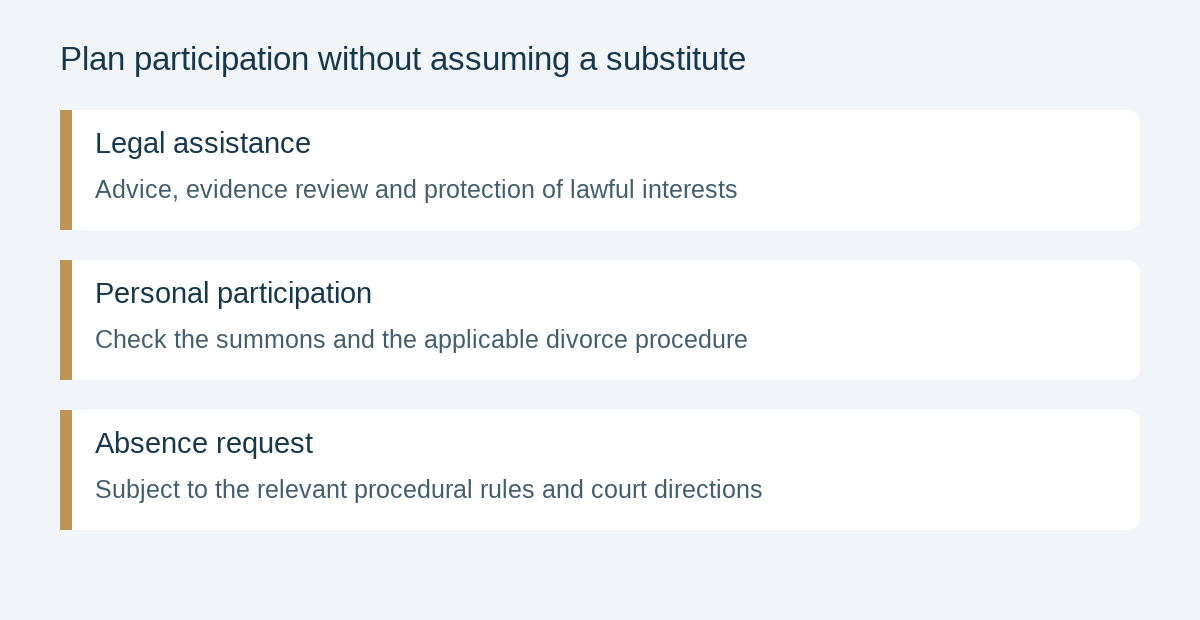
Distance is a practical issue in divorce in Vietnam for foreigners, but it does not create a general right to appoint someone to replace a spouse throughout the case. Article 85 restricts representation by authorization in divorce proceedings. A lawyer’s assistance with advice, evidence and protection of lawful interests should be distinguished from acting as an authorized substitute for the spouse.
An application for proceedings in a person’s absence must be considered under the rules governing the particular stage and type of matter. Articles 367 and 477 address different procedural contexts. A signed absence request should not be marketed as a document that automatically removes every attendance requirement or cures problems with service.
Before making travel plans, discuss the applicable procedure, the court’s directions, the documents needed from abroad and reliable means of receiving notices. Keep copies of submissions and evidence of delivery. If an address changes, communicate the change through the proper channel rather than assume messages sent to the other spouse will update the court file.
A parenting proposal should explain daily care, schooling, health needs, maintenance and practical contact arrangements. Where the parents expect to live in different countries, address travel logistics and communication in concrete terms. A vague promise to allow “reasonable contact” may leave the family with the same disagreement after the marital-status issue is resolved.
The proposal should focus on the child’s situation rather than punishment of either spouse. Keep records relevant to care and support, and distinguish established facts from accusations. Citizenship, passports, immigration permission and relocation can raise additional questions; a divorce order should not be assumed to settle all of them automatically.
Where there are urgent concerns about violence or a child’s safety, raise them at the beginning of the assessment. A routine negotiation timetable may be inappropriate. Identify the evidence and the protective measures that may be available under the applicable procedure without presenting an ordinary settlement clause as a substitute for necessary protection.
Article 81 requires consideration of a child’s wishes from age seven; those wishes are considered within the assessment of the child’s interests. Its rule for children under thirty-six months includes exceptions, so neither parent should be promised an automatic result without examining the circumstances.
Prepare an inventory distinguishing assets claimed as separate property, assets alleged to be common property and disputed obligations. Record acquisition dates, sources of funds, registration details and relevant agreements. A title in one spouse’s name may be an important document, but it is not a complete explanation of every issue in the property dispute.
Article 127 distinguishes applicable law in foreign-related divorce, including the stated common-residence situation involving a Vietnamese spouse abroad. It also directs the treatment of foreign immovable property to the law of its location. Jurisdiction and applicable law therefore need separate analysis.
Cross-border assets require particular care. An order made in Vietnam may need further steps before it has practical effect overseas, and foreign immovable property raises its own legal questions. Do not promise that a single proceeding will automatically transfer an overseas house or bind a foreign registry.
Identify lenders and other persons whose rights may be affected. An agreement between spouses about who will make future payments should not be presented as automatically releasing the other spouse from a bank’s rights. Collect the loan agreement and distinguish allocation between spouses from obligations owed to the creditor.
When budgeting for divorce in Vietnam for foreigners, distinguish court fees or advances, document formalities, translation, service-related expenses and professional fees. Property claims and additional procedural work may change the cost picture. Ask what an engagement covers, which disbursements are estimated and what further work requires a separate agreement.
A statutory preparation period is not a reliable promise of the total time from the first consultation to a final usable result. Overseas service, incomplete addresses, requests for additional evidence, disputed property and later review stages can affect the sequence. A useful plan identifies the next procedural step and its dependencies rather than guaranteeing a fixed completion date.
After a decision, establish its procedural status and obtain the appropriate copies. Consider maintenance compliance, property implementation and any recognition or recording needed in another country. The ability to use a Vietnamese decision abroad depends on the receiving country’s rules and any relevant international arrangements.
Keep the final documents together with proof of required procedural steps. An English explanation prepared for personal understanding should remain distinguishable from an official translation or court-issued record. This reduces confusion when the documents are later presented to another authority.
Begin with the timeline, addresses, marriage record and separate lists of agreed and disputed issues. The guide to drafting a lawsuit petition in Vietnam explains how to organize parties, requests and supporting evidence; a divorce filing must then be adapted to its specific procedural and family-law requirements.
Jurion & Partners can review the family circumstances and proposed scope of assistance before documents are submitted. A careful plan for divorce in Vietnam for foreigners should identify the appropriate procedure, protect the children’s interests and make unresolved questions about service, property and overseas use of the decision visible from the outset.






Subscribe today to get more breaking news from Jurion Partners - Solicitors & Litigators

108 Tran Dinh Xu St., Cau Ong Lanh Ward, Ho Chi Minh City, Vietnam
(+8428) 66.701.709 - (+84) 903.419.479
contact@jurionpartners.com
Follow us
Accept payment





 English
 Tiếng Việt