Plan a consensual divorce around document readiness, acceptance, reconciliation and recognition rather than a guaranteed completion date.
The consensual divorce timeline in Vietnam depends on the condition of the application, the court's procedural steps and whether both spouses maintain a lawful agreement. Agreement to separate can reduce the issues requiring determination, but it does not remove document checks, reconciliation or judicial recognition. Plan around the actual stage of the file rather than a promised completion date measured from the first conversation with an adviser.
Three dates are often confused: the date the spouses finish their paperwork, the date the court receives it and the date the matter is accepted for resolution. A statutory period starting from acceptance should not automatically be counted from the day someone first submits an incomplete application. Keep copies of the court's receipts and notices so that progress can be assessed from evidence.
The law sets periods for particular steps. These do not establish a single universal “average” for every divorce, and they should not be added mechanically without checking how the recognition procedure applies. A case involving missing records or an overseas spouse may have different practical requirements from one involving complete domestic records and readily available applicants.
The useful question is therefore not only “How many months?” Ask which step is pending, what starts the relevant period and whether the court or an applicant is waiting for a specific document or action. That approach produces a more useful plan than relying on a generic advertisement for a quick divorce.
Article 396 of the Civil Procedure Code requires the spouses jointly requesting recognition to sign or fingerprint the application and submit evidence supporting a grounded and lawful agreement. An unsigned draft or a proposal accepted by only one spouse should not be treated as a complete joint request. Confirm the actual consent of both applicants before arranging filing or travel.
Prepare the marriage record, relevant identity and residence material, children's records where applicable and documents supporting any property arrangements submitted for recognition. The precise file depends on the circumstances. If an original record is unavailable, identify how an appropriate extract or replacement can be obtained instead of waiting for the court to discover the gap.
Check names, dates and document numbers across the file. Explain genuine differences rather than quietly changing a copy. Documents issued abroad may require translation and examination of authentication or legalization requirements and any applicable exemption. Identifying those steps early helps avoid making travel plans around a file that is not yet ready.
The parties may agree on dividing or not dividing common property for the recognition procedure. Not requesting the court to divide property is different from declaring that no common property exists or that a final division has already occurred. Use wording that reflects the true position. A rushed, inaccurate statement can create later difficulties even if it appears to simplify the initial file.
Article 363 provides for assignment of a judge within three working days after receipt of the application and accompanying materials. Where the application lacks the required contents, the applicant is asked to amend or supplement it within seven days from receiving that request. A correction notice is therefore a task requiring a response, rather than evidence that the divorce has already reached its final stage.
Where the file meets the acceptance conditions, the provision addresses notification to pay the civil-matter fee within five working days of receiving the payment notice, subject to applicable exemptions or cases where payment is not required. Ordinarily, acceptance follows submission of the fee receipt; the provision separately addresses exempt or non-paying applicants. Record the actual acceptance date from the file.
Distinguish working days from periods expressed simply in days or months. Also identify the relevant trigger: receipt of a notice, acceptance of the matter or preparation of minutes. A calendar prepared without those distinctions may appear precise while using the wrong starting point.
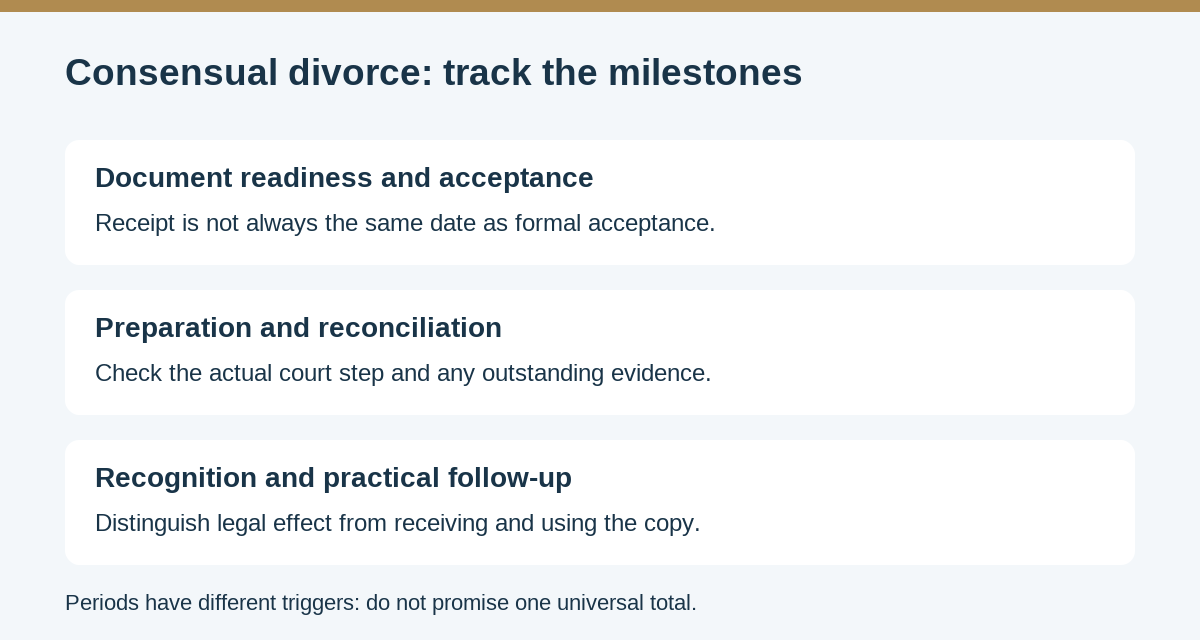
Article 366 generally sets a one-month preparation period from acceptance unless the Code provides otherwise. During preparation, the court may require additional evidence or obtain material needed for resolution. The provision includes an extension of no more than one month where specified expert examination or asset-valuation results remain outstanding. That particular rule should not be advertised as an unrestricted extension for every vaguely “complicated” file.
Article 366 also contains general provisions concerning a decision to open a meeting and the period for holding it. Consensual divorce recognition has the specific framework in Article 397, including reconciliation and recognition by reference to Article 212. A reliable explanation must read those rules together rather than automatically adding every general period to every recognition matter.
These statutory checkpoints help identify what to ask about, but do not justify a guaranteed overall completion date. If an adviser provides an estimate, ask which assumptions it uses: complete documents, proper jurisdiction, workable participation and continued agreement. Revisit the estimate if any assumption changes.
Article 397 requires the judge to undertake reconciliation aimed at reunion and explain the relevant family responsibilities. Recognition depends on genuine willingness to divorce and appropriate arrangements concerning property and children that protect the legitimate interests specified by law. A joint signature does not oblige the court to recognize terms that fail those requirements.
Where recognition proceeds by reference to Article 212, that article provides a seven-day period from successful agreement minutes without a party changing their position before the decision is issued. It is not a seven-day ordinary appeal period beginning after an effective recognition decision. Confirm which document was prepared and the stage actually reached.
If the spouses reunite or a required agreement cannot be maintained, the procedure may change under Article 397. In the specified disagreement situation, the recognition matter is discontinued and a case is accepted for ordinary resolution. The original estimate for a genuinely agreed request should then be reassessed, rather than presented as a binding deadline for the new situation.
An overseas spouse may need time to obtain records, arrange translations, provide usable address information and clarify how they can participate lawfully. The relevant court and any service requirements must be assessed from the circumstances. Do not assume that all foreign-related matters take one standard number of months or that every overseas applicant can follow an identical document route.
Before booking a short visit, confirm the file requirements and obtain advice on likely participation needs. A flight reservation does not require the court to finish within the visit. Equally, the presence of a foreign element should not be used to invent unnecessary steps without examining the particular documents and applicable rules.
Article 85 restricts representation by authorization in divorce proceedings. Legal assistance can improve preparation and protect legitimate interests within the permitted scope, but a blanket promise that a lawyer will replace a spouse for all court participation is misleading. Discuss availability, language needs and any proposed absence request early, without assuming it will automatically be accepted.
Preparation of the consensual divorce timeline in Vietnam should include responsibilities for both applicants. One spouse may hold the marriage record while the other holds a child's birth record or an overseas document. Assign who will obtain each item and when, then check that the completed versions are consistent before submission.
Required applicant contact details are part of a workable application; they should not be confused with promotional telephone numbers in a public article. Supply the information the procedure requires while keeping unrelated advertising out of the case documents. The objective is an accurate file that can be processed, rather than simply a shorter-looking document.
A useful update identifies the last completed event, the next required action and the person responsible for it. For example, “application received, correction requested, revised marriage extract being obtained” explains the current position more clearly than “the divorce is processing.” It also distinguishes an applicant's outstanding task from a court step.
In a fictional example, both spouses agree from the outset but one identity document contains an unresolved name difference. Their initial agreement does not remove the need to explain the record. Time spent obtaining the necessary material should be visible in the plan instead of being hidden behind an inaccurate claim that a statutory period began when they first agreed to divorce.
In another example, the documents are ready but one spouse subsequently disputes the proposed child-care arrangement. The issue is no longer merely scheduling. The parties need advice on the effect of the disagreement and the procedure now applicable. Repeatedly asking for a faster appointment will not resolve the missing substantive agreement.
Article 213 provides immediate legal effect for a decision recognizing the parties' agreement and excludes ordinary appellate appeal or protest. A person should not be told to wait a routine appeal period as though every recognition decision were an ordinary first-instance divorce judgment. Review the actual document to confirm its nature and effect.
Receiving the issued copy and completing any subsequent administrative or property steps are practical matters that should also be planned. Those actions should not be confused with the date the marital relationship legally ends. Keep an appropriate copy securely and identify any further step relevant to the parties' particular circumstances.
The guide to drafting a lawsuit petition in Vietnam explains how to organize parties, requests and evidence for court work. Confirm which type of application is appropriate before selecting a form, and use a clear document checklist to support the agreed route.
>>> Read more: Is it possible to change the agreement in consensual divorce?
>>> Read more: The fastest divorce procedure in Vietnam
Jurion & Partners can review document readiness, participation requirements and the next procedural milestone. A useful consensual divorce timeline in Vietnam states its assumptions, tracks the events that start each period and is updated when the file changes, giving the spouses a realistic basis for arranging work, travel and family responsibilities.






Subscribe today to get more breaking news from Jurion Partners - Solicitors & Litigators

108 Tran Dinh Xu St., Cau Ong Lanh Ward, Ho Chi Minh City, Vietnam
(+8428) 66.701.709 - (+84) 903.419.479
contact@jurionpartners.com
Follow us
Accept payment





 English
 Tiếng Việt