Understand property claims after unregistered cohabitation, including agreements, financial and household contributions, third-party interests and children’s rights.
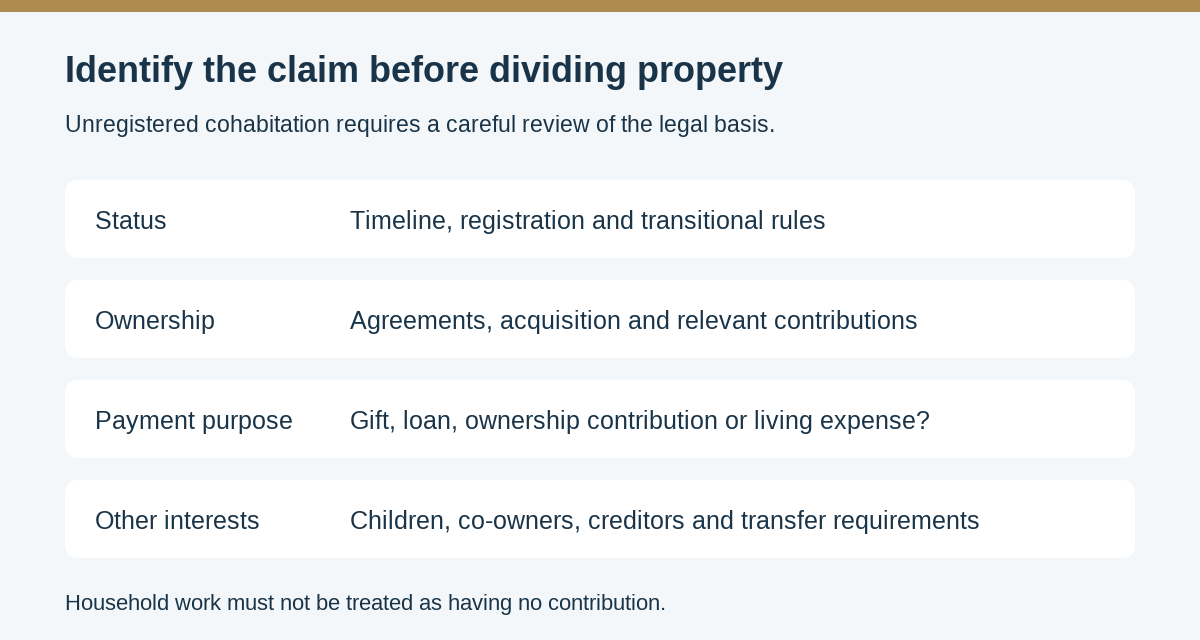
Cohabitation as husband and wife can involve a shared home, years of household work, children and substantial purchases without a marriage registration. When the relationship ends, those facts still require legal attention. The absence of a registered marriage does not mean that either person loses every property claim, or that the children have fewer rights. The first task is to identify the relationship’s legal status and the basis of each requested financial outcome.
Articles 14 to 16 of the Law on Marriage and Family address eligible men and women living together without registering their marriage. Under this framework, cohabitation does not create the rights and obligations of spouses. Property, obligations and contracts are addressed through the parties’ agreement or, without agreement, the Civil Code and other relevant law.
That is different from saying that the relationship and its consequences receive no legal protection. Article 16 expressly addresses lawful interests of women and children and recognizes household work and other work maintaining the common life as income-generating work. A review should consider these protections alongside ownership, agreements and the evidence of contributions.
Do not automatically import the statutory marital-property division framework into an unregistered relationship. Equally, avoid replacing it with a simplistic rule that the person with the larger salary receives everything. The legal basis and actual facts must be assessed together.
Longstanding relationships require a separate status check. Transitional provisions and the historical rules associated with Resolution 35/2000/QH10 can affect recognition, particularly for relationships established before 3 January 1987. Article 131 also addresses transitional application. A statement that every unregistered relationship is unrecognized, regardless of when and how it began, is therefore too broad.
Record when the parties began living together, their marital status at the time, any later registration and earlier court decisions. This article focuses on property consequences where the relationship is assessed as unregistered cohabitation under the relevant framework. A wedding ceremony, family acknowledgment or shared address should be disclosed as evidence of circumstances, but should not be assumed to settle legal status by itself.
Where Article 53 applies to a divorce request involving an unregistered relationship, the court declares non-recognition of the spousal relationship and addresses requested child and property matters under Articles 15 and 16. This is not simply a divorce between legally recognized spouses with the same property calculation copied across.
Identify the actual outcome sought: recognition of an ownership interest, division of jointly owned property, repayment of a loan, or resolution of another obligation. These claims may depend on different facts. Describing every payment made during the relationship as a contribution to common property can conceal important distinctions.
If the parties later registered a marriage, distinguish the period before registration from the period after it. Article 14 addresses the establishment of the marital relationship upon subsequent lawful registration within its framework. The date and legal basis of a particular asset’s acquisition remain important; registration should not be assumed to transform every earlier transaction automatically.

Gather any agreement concerning purchases, ownership shares, loans or shared expenses. A written agreement can be important, but its validity, scope and any required form still need review. A message saying “our house” may provide context without necessarily proving every term of an ownership agreement or completing a legally required transfer.
For each significant asset, record the purchase date, purchase price, source of funds, registered holder and current possession. Identify later improvements, refinancing or transfers separately. This makes it easier to see whether the disagreement concerns ownership, the amount contributed, a repayment obligation or the method of division.
Where there is no clear agreement, explain what each party actually did and the legal basis relied upon. A proposed percentage should have a factual foundation. Avoid choosing a number merely because it resembles a married couple’s starting point or matches the number of years spent together.
A transfer of money can have different purposes. It may be a gift, a loan, a contribution towards acquiring an interest, or payment of ordinary living expenses. The bank transfer alone may not explain which. Review accompanying communications, payment references, purchase documents and subsequent conduct.
For a fictional example, one partner transfers money shortly before a vehicle is purchased in the other’s name. The first partner says it bought a shared interest; the other says it was a temporary loan already repaid. The useful inquiry concerns the arrangement and supporting records, rather than an assumption that every transfer between partners creates equal ownership.
Preserve evidence of deposits, instalments, construction payments and other relevant expenditure. Identify who made the payment and whether the money came from that person, a relative or another source. Where a family member provided funds, establish whether they claim a loan, gift or ownership interest. Their position should not be guessed or silently absorbed into one partner’s claim.
Household work and other work maintaining the common life should also be described under Article 16. Explain the responsibilities undertaken, their duration and their relationship to the shared arrangements. The absence of a wage slip does not justify treating that work as nonexistent.
At the same time, there is no universal formula converting every year of housework into a fixed ownership percentage. The assessment depends on the agreement, applicable law and evidence. A careful account of care, domestic responsibilities and support for the household is more useful than an invented hourly calculation presented as a statutory entitlement.
Registration records are important, but they need to be read with the underlying transactions and relevant legal requirements. If an asset is held in one person’s name, identify the basis on which the other claims an interest. If it belongs to a parent, sibling or company, the couple cannot simply divide it between themselves without addressing the actual owner’s rights.
Land-use rights and housing may involve additional conditions concerning lawful ownership, registration and transfer. A proposal to divide a physical parcel requires more than agreement about percentages. Check the type of interest, applicable restrictions and whether the proposed transfer or subdivision can be carried out lawfully.
Where a foreign national is involved, assess the specific acquisition and holding rules. Do not promise that a private cohabitation agreement overrides legal restrictions on a property interest. The practical remedy available may differ from the arrangement the parties originally expected.
Record each relevant loan or contract, the parties who entered it, its purpose and the amount outstanding. An unregistered relationship does not automatically make one partner liable for every debt incurred by the other. Nor does separation necessarily end an obligation that both lawfully undertook.
If the partners agree that one will make future payments, check the creditor’s rights under the original arrangement. Their private allocation does not necessarily release an existing borrower or guarantor. Any proposed release, refinancing or substitution should be addressed with the person whose rights are affected.
Keep claims involving borrowed money distinct from the asset’s gross value. An apparently valuable home may be subject to security or a disputed family loan. A settlement based only on its headline price can leave both parties with a misleading picture of their positions.
Article 15 applies the law’s parent-child rights and obligations to this situation. A lack of marriage registration does not by itself remove parental duties or the child’s entitlement to lawful protection. Where parentage is disputed or has not been established, identify that issue and the appropriate procedure rather than assuming it can be resolved by a property agreement.
Care and support arrangements should address the child’s needs. Do not make support conditional on an adult abandoning an ownership claim, or treat handing over an asset as automatically resolving every future parental obligation. Any proposed financial arrangement involving the child requires its own legal assessment.
When reviewing cohabitation as husband and wife, keep separate schedules for property and child-related issues. Some evidence may be relevant to both, but separate schedules help prevent a disagreement about an asset from obscuring an immediate care or support need.
A negotiated property resolution should identify the asset or obligation, the legal interests being addressed, agreed values and practical performance steps. State what remains disputed. Check required form, registration and third-party participation before assuming that signatures alone complete the arrangement.
If court determination is required, organize the request around the actual legal claim and evidence. Preserve original records, provide an accurate chronology and explain documents that cannot lawfully be obtained without procedural assistance. Do not conceal property or create retrospective agreements to defeat another person’s legitimate rights.
Include an implementation check: who must pay, transfer possession, supply documents or obtain consent, and whether those steps are realistic. A settlement that allocates an asset without addressing an existing security interest or required formalities may create a new dispute rather than close the old one.
>>> Read more: Resolving the common property in divorce
>>> Read more: Get custody of children in case of divorce
Before a discussion with Jurion & Partners, prepare the relationship timeline, asset records and a list of agreements, payments and third-party interests. Identify the outcome sought for each item and the facts the other person disputes. This gives the review a clear purpose without assuming that either person automatically receives a particular share.
The guide to drafting a lawsuit petition in Vietnam helps organize a written request where proceedings are needed. A sound approach to property arising from cohabitation as husband and wife begins with the correct status assessment, recognizes relevant contributions and produces a resolution that respects children and other lawful interests.






Subscribe today to get more breaking news from Jurion Partners - Solicitors & Litigators

108 Tran Dinh Xu St., Cau Ong Lanh Ward, Ho Chi Minh City, Vietnam
(+8428) 66.701.709 - (+84) 903.419.479
contact@jurionpartners.com
Follow us
Accept payment





 English
 Tiếng Việt