Prepare marital-property division in Vietnam: identify the property regime, trace ownership and funding, assess shares, debts, valuation and practical allocation.
Division of joint property on divorce begins with identifying what belongs to the spouses, what is claimed as separate property and which rights of other people may be affected. A list of valuable items is only the starting point. The applicable property regime, acquisition history, funding records and proposed method of allocation all matter. Preparing those materials early helps turn a broad disagreement about fairness into specific questions that can be negotiated or presented to the court.
The Law on Marriage and Family distinguishes the statutory regime from an agreed marital-property regime. An agreement should be examined for its form, timing, content, amendments and validity. Do not assume that every document signed by spouses has the same legal function. A premarital property agreement, an agreement dividing assets during marriage and a proposed divorce settlement raise different questions.
Where an agreed regime applies, Article 59 directs attention to that agreement and the applicable statutory provisions where its terms are incomplete or unclear. A dispute about validity needs its own analysis. The practical first step is to collect the complete signed document and any later amendments, rather than rely on a summary prepared by one spouse.
If no applicable agreed regime has been established, examine the statutory rules against each asset and obligation. Keep the classification exercise separate from the later question of who should receive a particular item. A proposal to keep the family home does not by itself prove that the home is separate property.
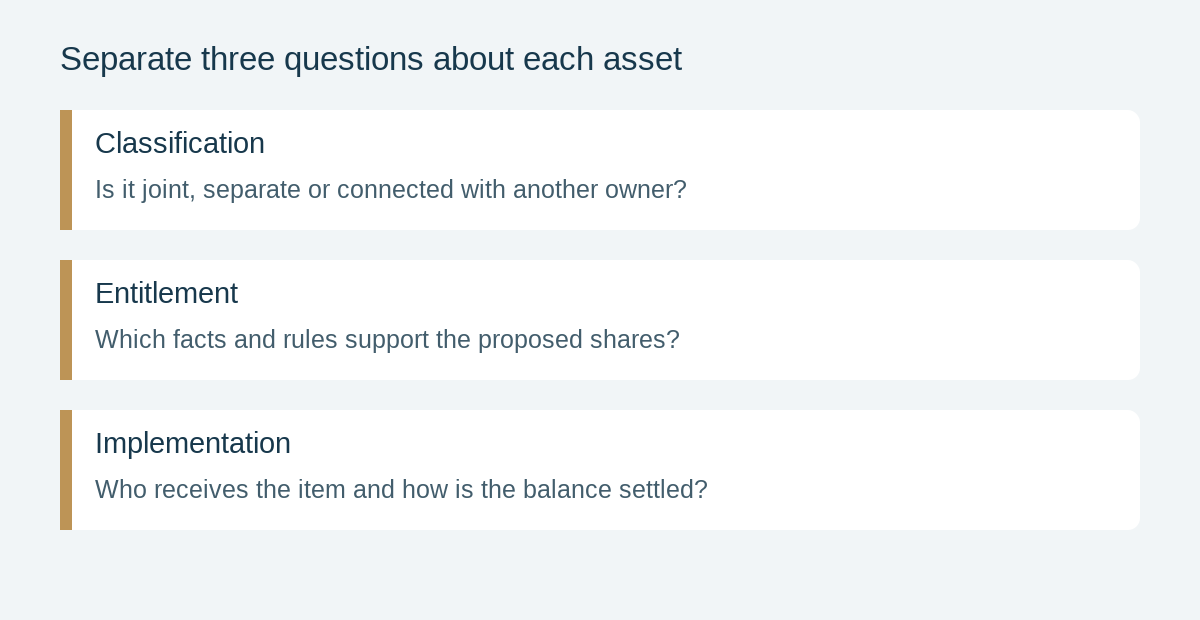
List assets individually, including homes, land-use rights, bank funds, vehicles, investments and relevant business interests. Record the registered holder, acquisition date, purchase price, current location and the documents available. Also identify assets said to be held jointly with relatives or other persons. These details help avoid treating another person's property as part of the spouses' divisible pool.
| Field | Information to collect |
|---|---|
| Identification | Address, account, registration or other reliable reference |
| History | Acquisition date, transaction and relevant family events |
| Funding | Payments, loan proceeds, gifts, inheritance or sale proceeds relied upon |
| Legal status | Ownership, security, co-ownership and existing agreements |
| Value and proposal | Valuation basis and the allocation or sale sought |
An inventory should distinguish verified facts from information still being checked. If an account is believed to exist but its balance is unknown, identify the source of that belief. Avoid presenting a guessed value as an established figure. The same discipline should be applied to liabilities and alleged contributions.
Articles 33 and 34 address joint property and registration. A record in only one spouse's name does not automatically resolve a dispute over whether the asset is joint or separate. Its acquisition and source must be examined. Equally, marriage does not mean every asset held by either spouse automatically belongs to both.
Article 33 includes a rule treating disputed property as joint where there is no basis to establish it as a spouse's separate property. Someone relying on a separate-property claim should therefore organize the evidence supporting it. That may include earlier ownership records, inheritance documents or a documented chain of funding, depending on the asserted basis.
For example, saying that an apartment was bought with proceeds of a pre-existing asset is a claim that requires tracing. Collect the earlier sale, movement of funds and later purchase records. If funding was mixed, explain which amounts are alleged to have come from each source rather than assume the entire purchase follows one label.
Article 59 establishes division in half while taking account of the listed factors, including family circumstances, contributions, legitimate production or occupational interests and fault in violating marital rights and obligations. Household work is recognized in assessing contributions. These factors need to be connected to facts rather than used as general accusations.
A spouse who undertook unpaid care should not be dismissed as having contributed nothing simply because income arrived in the other spouse's account. Conversely, a claim to a larger share should explain its factual and legal basis. Neither a high salary nor an allegation of misconduct automatically establishes a fixed percentage.
The protections for the wife and the children identified in Article 59 also require attention. Property allocation and arrangements for children should be considered coherently, but a dispute over care should not be treated as an automatic transfer of every asset to one parent. Each request needs an appropriate basis.
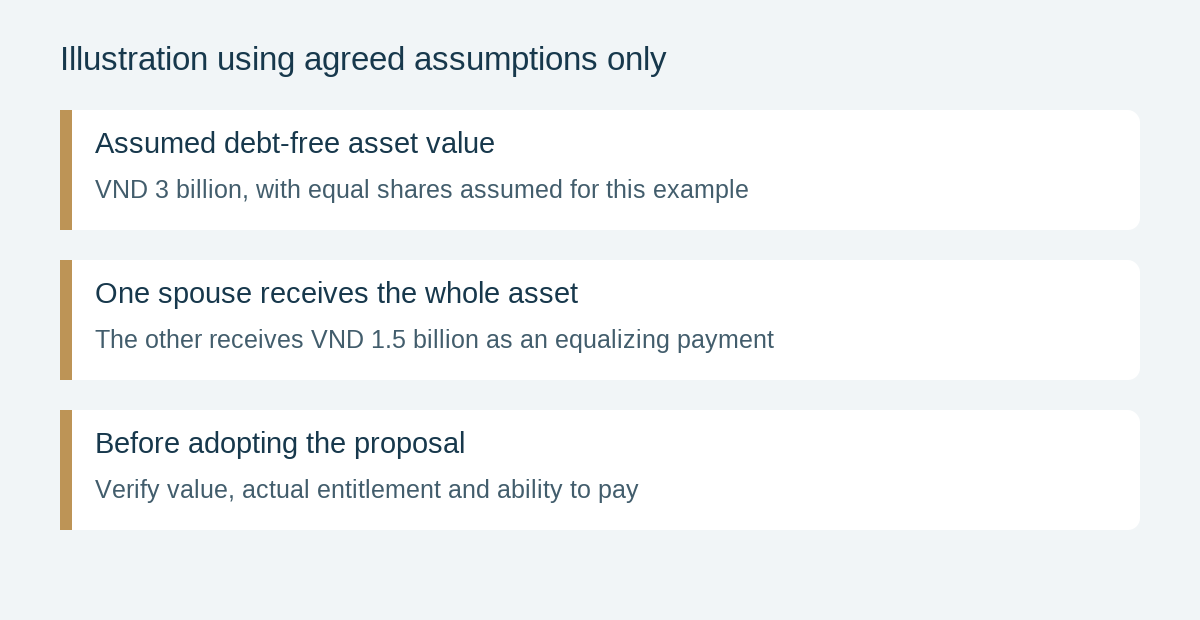
Division of joint property may involve allocating an item to one spouse and requiring an equalizing payment, rather than physically splitting every asset. Article 59 addresses division in kind and by value. The proposed method should identify what each person receives and how any difference will be paid.
For a fictional example, assume the parties have agreed, for illustration only, that a debt-free asset worth VND 3 billion will be allocated equally by value. If one spouse receives the whole asset, a VND 1.5 billion payment would balance those assumed shares. This arithmetic does not establish the legally appropriate shares, the asset's actual value or either person's ability to pay.
A settlement should deal with payment dates, delivery of documents, possession and the formal steps needed for registration. An attractive allocation on paper may be impractical if the recipient cannot make the promised payment. Consider that implementation problem before treating the negotiation as complete.
Article 60 addresses property rights and obligations involving third parties after divorce. Identify creditors, security interests and any relevant agreements. Do not assume that the spouses can release one another from a bank's rights simply by writing that only one person will pay the remaining loan.
Distinguish allocation of an obligation between spouses from the creditor's entitlement under the relevant transaction. Obtain the loan agreement, disbursement records, repayment history and security documents. If a debt is disputed, record why, who signed, the alleged purpose and how the money was used.
For a mortgaged home, a proposal should show both the asset and the liability rather than divide the gross value while ignoring the loan. The required treatment depends on the legal status of the debt and creditor rights. A simple subtraction is a negotiation tool, not a replacement for that analysis.
Article 61 deals with specified situations where spouses live with their family and their property is connected with the wider family's property. Living in a relative's house does not by itself prove ownership of that house. Clarify whether the spouses claim an identifiable share, a contribution or another entitlement, and identify the other persons concerned.
Business-related property also needs attention to the ownership structure. A company is not necessarily identical to its shareholder. Identify whether the relevant asset is a shareholding, a contribution, property owned personally or something belonging to a separate legal entity. A spouse should not list every company asset as personally owned marital property without examining that distinction.
Article 64 addresses joint property used in business and includes a qualification concerning other business legislation. Operational continuity and the other spouse's value entitlement need to be considered together. Supporting records may include contribution documents, ownership registers and reliable valuation materials.
Article 62 contains specific rules for land-use rights. Identify the type of land, the parties' rights and any co-ownership or other relevant interest before proposing a division. Physical subdivision, transfer formalities and registration require checking under the applicable land rules; a divorce settlement should not promise a registrable split merely because both spouses prefer it.
Where property is overseas, distinguish the Vietnamese proceeding from the ability to implement an outcome abroad. Article 127 addresses the law applicable to foreign immovable property. The foreign registration system and any recognition requirements may require additional steps. Avoid assuming that one Vietnamese decision automatically changes an overseas title.
Collect records lawfully and retain their context. Keep complete bank entries, transaction documents and correspondence rather than selected screenshots that conceal dates or parties. If records are controlled by another person, identify what is needed and consider the proper means of obtaining them. Unauthorized access is not a sound evidence strategy.
A useful chronology connects the marriage, major purchases, gifts, inheritance, borrowing and significant agreements. Next to each event, note the supporting record and the point still disputed. This helps a lawyer identify whether the central problem is classification, proof, value, allocation or enforcement.
A focused proposal for division of joint property should state what is agreed and what remains contested. For each item, identify the value relied upon, who would receive it and any payment or formal step required. Keep offers separate from admissions where appropriate and obtain advice before signing wording that settles more than intended.
Do not use a broad statement that “all property has been resolved” if important assets or debts remain unexamined. If the parties intentionally leave an issue for later resolution, the document should accurately reflect that decision and its procedural implications. Clear drafting is particularly important when the marital-status question and property issues follow different paths.
The court needs identifiable requests and supporting materials, not only an account of the relationship's breakdown. The guide to drafting a lawsuit petition in Vietnam explains how to organize parties, relief and evidence. A marital-property claim must then be adapted to the family circumstances, applicable procedure and relevant third parties.
Jurion & Partners can review the inventory, funding history and proposed allocation within an agreed scope. Before pursuing division of joint property, assemble the documents that identify the divisible pool, the disputed shares and the practical steps needed to make an agreement or decision usable.






Subscribe today to get more breaking news from Jurion Partners - Solicitors & Litigators

108 Tran Dinh Xu St., Cau Ong Lanh Ward, Ho Chi Minh City, Vietnam
(+8428) 66.701.709 - (+84) 903.419.479
contact@jurionpartners.com
Follow us
Accept payment





 English
 Tiếng Việt