Mergers and acquisitions (M&A) have become an increasingly common strategy for businesses seeking to expand, restructure, or enter new markets.
Contractual aspects in M&A determine how the parties describe the acquisition, exchange value, allocate identified risks and respond when the transaction does not proceed as planned. A carefully negotiated agreement can make those choices clearer, but it cannot replace a regulatory approval, bind an absent third party or guarantee that a financially weak seller will meet a future claim. Understanding both the advantages and limits of contractual protection is essential before agreeing the final wording.
Before comparing clauses, establish exactly what is changing hands. A share purchase transfers an ownership interest in a company; an asset transaction concerns specified assets and related arrangements. New capital subscribed into a company raises another set of questions about investment proceeds, dilution and future governance. Calling every transaction an SPA can obscure these differences. The agreement should match the actual structure and identify the parties who have the rights and authority needed to implement it.
The contractual package may extend beyond the principal acquisition agreement. Confidentiality arrangements, disclosure schedules, shareholder agreements, transitional services and documents implementing particular transfers may all matter. They should operate together. An acquisition agreement promising access to essential technology is incomplete in practical terms if the separate licence describes a narrower use than the buyer needs. Reviewing each document in isolation can miss that inconsistency.
In Vietnam, the validity and implementation of an agreement depend on the applicable legal framework, including the parties' capacity, authority and voluntary consent, the transaction's purpose and content, and any required form. Corporate, investment, competition and sector rules may add requirements specific to the deal. Clear drafting helps organise compliance work; it does not establish that the work has been done or that an approval will be granted.
A clause allocating responsibility for an application should therefore identify the responsible party, required cooperation, relevant evidence and consequences of an unsuccessful or delayed process. Avoid a blanket assertion that signing a compliant contract ensures competition clearance. The authority's decision is separate from the bargain between the parties, and the transaction timetable should recognise that distinction.
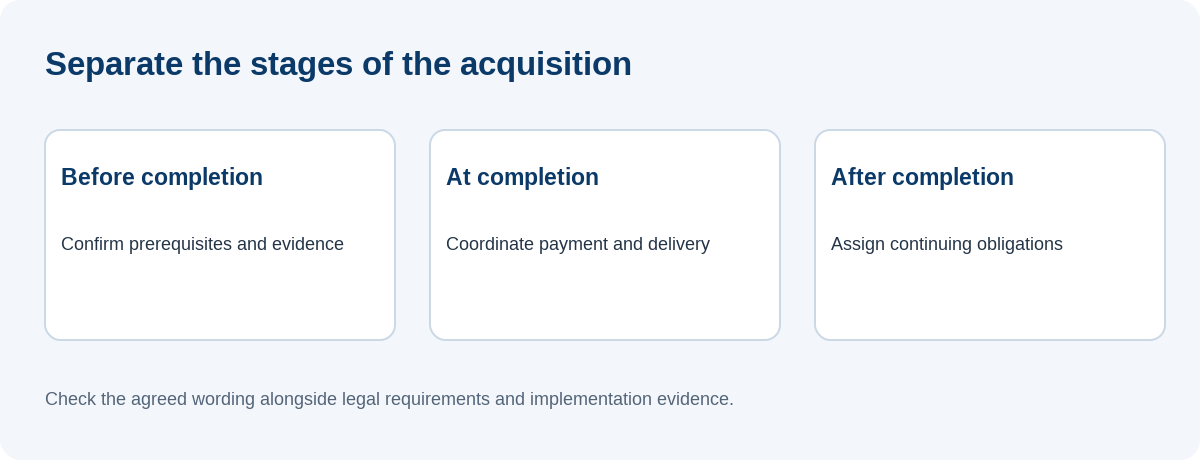
Contractual aspects in M&A have immediate practical value when they explain who delivers what, when payment is released and which evidence shows completion. A headline price alone leaves questions about adjustments, payment recipients, currency, fees and outstanding obligations. A completion list should connect documents and actions with the release of funds rather than assuming that every party will interpret “completion” in the same way.
The sequence matters when several steps depend on one another. A transfer document may need to be signed, a lender may need to release security and a particular registration may need to be completed or initiated. The appropriate order depends on the structure and applicable requirements. The agreement should identify which events are prerequisites, which occur together and which remain obligations after completion. Practical coordination can be as important as the legal wording of each obligation.
A review may identify a historical claim, an unresolved contractual commitment or a missing document. The parties can negotiate how those matters affect price, conditions, undertakings and potential remedies. This creates a more precise discussion than asking one side to accept “all risks”. Each proposed protection should be connected to an identifiable exposure and examined alongside the information already disclosed to the buyer.
For example, a known customer dispute may warrant a defined arrangement about its conduct and economic consequences. A general statement that all contracts are in good standing may not address who controls negotiations with that customer or who receives the benefit of a later settlement. The useful outcome is a workable allocation supported by clear evidence, rather than an impressive list of overlapping clauses.
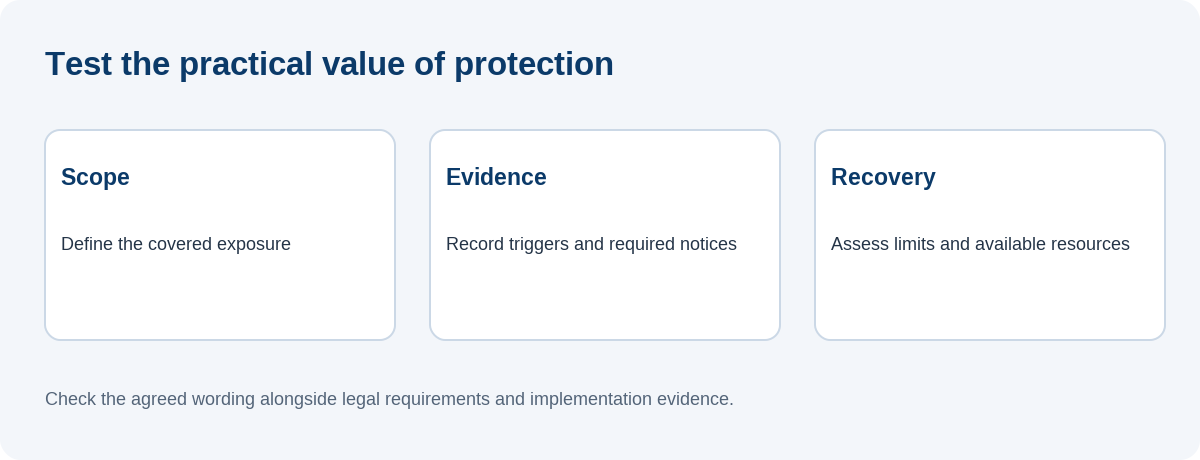
A warranty or indemnity is only as useful as its agreed scope and the ability to enforce it. Examine what triggers a claim, who can bring it, the notice requirements, applicable limits and the resources available to meet a successful demand. A buyer who negotiates broad wording against a seller that will distribute all sale proceeds may still face a difficult recovery exercise. Any proposed security or retention mechanism requires its own assessment and agreement.
Commercial labels imported from another transaction should not be assumed to carry identical effects under every governing law. Parties need to understand the intended operation of the actual provision. What loss is covered? Is the same matter addressed elsewhere? Does disclosure change the claim? Could the provision conflict with a mandatory rule? These questions are more useful than treating an English heading as a complete legal explanation.
Contractual aspects in M&A can become costly when teams add provisions without resolving commercial choices. Multiple drafts may contain inconsistent definitions, old references or competing payment calculations. A long agreement can still leave a crucial obligation unclear. Negotiating every theoretical scenario also consumes time that may be better spent obtaining a missing consent or establishing the basis of an important asset right.
A disciplined issues list records the decision needed, the person authorised to make it and the consequences of each option. Once a decision is reached, the drafting should reflect it consistently throughout the documents. This does not mean shortening a complex agreement at any cost. It means ensuring that complexity answers a real transaction need and that decision-makers can understand the obligations they are accepting.
Assume an acquisition depends on continued business from a major customer. The customer agreement requires consent to the proposed change of control. The seller offers to warrant that the relationship will continue, and the buyer initially considers that sufficient protection. The problem is that the customer is not a party to the acquisition agreement. A promise between buyer and seller cannot itself constitute that customer's consent.
The parties should examine the clause, the actual transaction trigger and the consequences of proceeding without consent. Depending on the facts, they might obtain written consent before completion, reconsider timing or revise the commercial assumptions. If they decide to accept residual exposure, they should understand both the contractual remedy and its practical limits. A later damages claim may not recreate the lost customer relationship.
This illustrates why contractual aspects in M&A should be reviewed alongside third-party rights and implementation evidence. The negotiators must distinguish a promise to seek a result, an obligation to deliver it and proof that it has occurred. Confusing those categories can make an unresolved dependency look settled on paper.
Where the buyer will remain alongside other shareholders, the acquisition terms and future governance arrangements need a joint review. Board representation, reserved decisions, information rights, funding commitments and exit arrangements should reflect the agreed ownership structure. A shareholder agreement should also be considered with the company's charter and applicable corporate rules. A contractual voting arrangement should not be described as automatically overriding every corporate requirement.
Disclosure deserves the same care. Define how the disclosure materials relate to the negotiated protections and keep a reliable record of the agreed version. An evolving data room with no clear cut-off can create uncertainty about what the buyer received and what a reference to “disclosed information” means. The legal effect depends on the agreed wording and applicable law, so neither side should rely on an unexamined assumption about the effect of uploading a document.
Operating continuity may require specific arrangements for systems, records, premises, employees or group services. These should reflect the structure: acquiring shares does not by itself mean that every employee moves to a different employer. Where the transaction does change employment or operating arrangements, assess the relevant obligations separately. A broad undertaking to “transfer the business smoothly” rarely provides enough detail for the people implementing the handover.
Contractual aspects in M&A include planning how disagreements will be handled. Governing law, the dispute forum, language and service arrangements should be reviewed together. If arbitration is selected, the agreement needs an effective arbitration arrangement appropriate to the dispute and parties. Vietnamese arbitration legislation recognises the significance of the arbitration agreement; a generic reference to arbitration should not be treated as a substitute for checking its validity and workability.
Related documents may involve different parties or dispute provisions. Examine whether that could fragment a dispute about the same completion or payment event. Also consider where relevant assets and evidence are located. Choosing a forum is only part of the analysis; an eventual decision may need recognition or enforcement in another jurisdiction. No clause can guarantee a quick or successful recovery in every location.
The broader service for drafting and reviewing contracts explains how legal review supports a coherent agreement. For a proposed acquisition, the most useful instruction includes the agreed commercial terms, outstanding diligence findings and a list of decisions the parties have not yet resolved.
A focused review with Jurion & Partners can use those materials to examine the draft against the actual transaction. Ask for an explanation of the material choices and implementation requirements, rather than a general assurance that the document offers complete protection. That approach helps the authorised decision-makers understand what they are agreeing to deliver and which risks remain with them.
>>> Read more: Foreigners Divorce in Vietnam
>>> Read more: Custody of children in divorce disputes
Contractual aspects in M&A deserve attention because the agreement translates an investment decision into enforceable commitments and an implementation plan. Before signature, resolve the material choices, test the sequence against the available evidence and identify the limits of each protection. The goal is a bargain the parties can understand and carry out, with outstanding dependencies made visible rather than concealed by confident wording.





Subscribe today to get more breaking news from Jurion Partners - Solicitors & Litigators

108 Tran Dinh Xu St., Cau Ong Lanh Ward, Ho Chi Minh City, Vietnam
(+8428) 66.701.709 - (+84) 903.419.479
contact@jurionpartners.com
Follow us
Accept payment





 English
 Tiếng Việt