Understand how to use legal articles responsibly, distinguish general information from individual advice and check dates, sources and circumstances.
This disclaimer statement explains the purpose and limits of the legal information published on this website. Articles can help readers understand a subject, organise questions and recognise issues that need further investigation. They cannot determine the answer to an individual matter without the relevant facts, documents and applicable law. Read the following guidance alongside the particular article before relying on its contents for a decision.
The website contains general explanations of legal topics, procedures and services. An article may describe a typical situation or outline a process, while leaving out exceptions that do not fit its subject. Its purpose is to make the topic understandable. It should not be read as a complete assessment of every possible transaction, dispute or personal circumstance connected with that topic.
For example, an explanation of inheritance rules may assume that ownership of the property is established. A reader whose family disputes that ownership needs an additional analysis before applying the distribution example. Similarly, a guide to an investment procedure does not establish that a particular investor qualifies for a regulated activity. Identify the assumptions before transferring a general explanation to your own circumstances.
Reading an article does not, by itself, establish a professional engagement or a commitment to act in a particular matter. An individual assignment requires clarification of the people involved, the work requested and the arrangements under which it would be undertaken. Do not assume that publication of a service description means that your documents have been reviewed or that a filing will be made on your behalf.
A useful request for advice identifies the decision you need to make, the relevant dates and the records available. Explain what is uncertain rather than presenting an assumption as an established fact. An adviser may need to examine an agreement, an official decision or earlier correspondence before giving a meaningful answer. The distinction matters because a small factual difference can change the available options.
This disclaimer statement does not replace the terms of a separately agreed legal assignment. If you have an existing engagement, refer to its agreed scope and clarify whether a new question falls within it. Work on one transaction should not be taken as confirmation that unrelated disputes, filings or deadlines are also being managed.
Legal rules and administrative arrangements can change. An article's publication date, an amendment mentioned in its text and the effective date of a legal instrument answer different questions. A newly published instrument may apply only from a later date. Conversely, an older transaction may require attention to transitional provisions even when a newer rule governs transactions made today.
Before taking action, check the current official text and the provisions governing the event in question. Record the date of the transaction, death, application, decision or alleged breach where relevant. These dates can determine which rules need to be considered. A search result that displays a recent date is not sufficient evidence that every statement in the underlying article has been updated.
Much of the website concerns Vietnamese law. A cross-border matter may also involve another jurisdiction, a treaty, foreign-issued documents or a contractual choice of law. Do not assume that the location of a website determines all the rules applicable to your arrangement. Identify where the parties, property and relevant activities are located before drawing a conclusion.
English explanations are intended to assist understanding. They do not turn an editorial translation into an official translation of legislation. When wording is material, compare it with the authoritative legal text and obtain appropriate assistance with any ambiguity. A familiar English legal expression may not have precisely the same scope as the Vietnamese legal concept being described.
Examples isolate selected facts to explain a principle. They do not establish that all readers with a superficially similar problem will receive the same result. If an example calculates a share of an estate after deducting obligations, a reader must first establish the actual estate and obligations. Copying the final number without those steps defeats the purpose of the example.
Likewise, a checklist is a preparation aid rather than evidence that a dossier is complete. The correct supporting documents can depend on the applicant, transaction and receiving authority. Check the current procedure and explain any inconsistency between records. A missing signature, an expired authorisation or a different legal name may require attention even if every item on a general list appears to be present.
Processing periods should be read with their conditions. A stated period may run from acceptance of a complete and valid dossier, rather than from the first enquiry or initial upload. Time spent collecting documents or answering a request for supplementation may need separate planning. Neither a procedural summary nor an illustrative timeline guarantees an authority's decision or the result of a dispute.
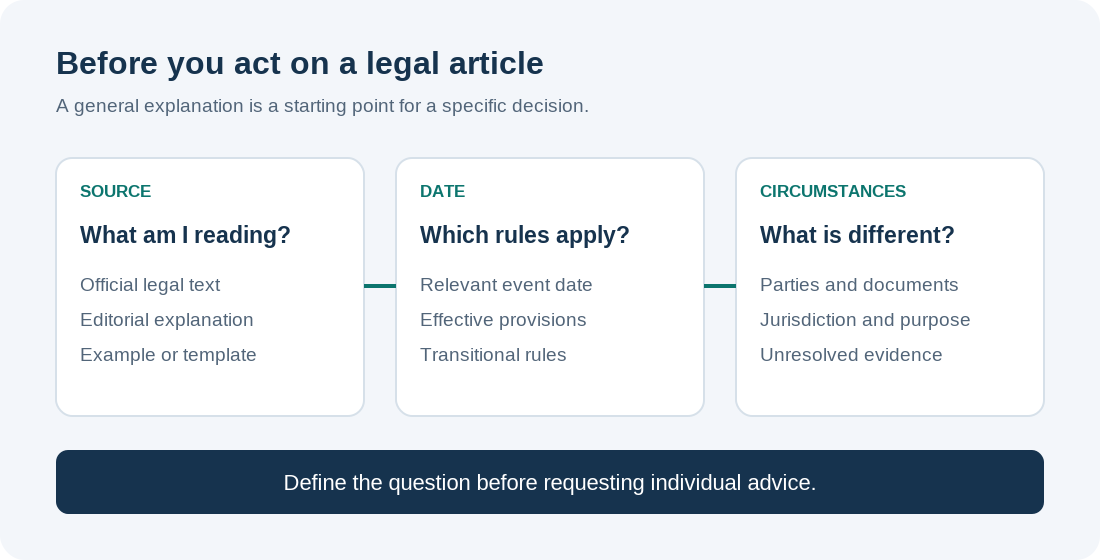
A sample clause or document can show a structure, but it may omit provisions required for a different transaction. Replacing names and amounts does not establish that the document is suitable. Consider signing authority, mandatory form requirements, the agreed obligations and any sector-specific rules. Check that the final text describes what the parties actually intend to do.
For a proposed agreement, a focused contract drafting and review process can connect the commercial brief with the clauses that need attention. That assessment is distinct from reading a sample on a website. Preserve the negotiation record and identify unresolved terms before treating a document as ready for signature.
A link may help a reader locate an official source, a related explanation or information about another organisation. Follow it with attention to the destination and the date of the material. Third-party pages can change, move or become unavailable. The fact that a page is linked does not establish that every statement or service offered there has been independently verified.
Check whether a document is the enacted text, a draft, an unofficial reproduction or an explanatory article. If the issue depends on a precise legal provision, obtain the authoritative version rather than relying only on a summary. Treat payment requests, downloadable files and requests for personal information according to the actual destination's circumstances; a reference in an article is not a guarantee of their suitability.
This disclaimer statement does not claim exclusive ownership of every fact, legal provision or document referred to on the website. Vietnamese intellectual-property law distinguishes protected expression from material outside copyright protection. Article 15 excludes, among other categories, legislative, administrative and judicial documents and their official translations. An editorial explanation or original illustration must be considered separately from the legal text it discusses.
Before reproducing material, distinguish a short attributed quotation, a permitted use and a proposed republication of a complete article or image. The applicable rights and exceptions depend on the material and the manner of use. Giving credit does not automatically authorise every reproduction. Equally, a general copyright notice should not be read as removing uses or access that the law permits.
Maintain the context of any quotation. An extract that removes a qualification can give the opposite impression from the original explanation. Do not attribute your additions to the original author or present an edited checklist as an official form. Where permission is needed for the intended use, resolve that issue before publication rather than assuming that public availability means unrestricted reuse.
The practical limitation explained here is that general website information cannot account for an unidentified reader's complete circumstances. It is not a promise of uninterrupted availability, a verified result or suitability for every purpose. Readers should obtain an assessment proportionate to the decision, especially before signing, transferring assets, starting proceedings or allowing a deadline to pass.
Nothing in this disclaimer statement should be understood as excluding liability, restricting a remedy or removing a right where applicable law does not permit that result. Vietnamese civil-law rules address the treatment of certain exemption and rights-restriction provisions in standard-form contracts and general transaction conditions. Whether a particular provision applies or is enforceable requires consideration of the legal relationship and its circumstances.
The page therefore does not declare that a reader loses every right to raise a complaint or claim by using the website. Nor does it decide in advance the outcome of any disagreement. A website notice cannot replace the analysis of duties, facts, causation and other requirements relevant to a particular allegation.
When approaching Jurion & Partners about a matter, prepare a concise chronology, identify the parties and state the decision for which you need assistance. Keep original records and distinguish confirmed facts from recollections. Clarify the proposed scope and any urgent dates rather than assuming that a general enquiry has arranged representation or preserved a deadline.
Use this disclaimer statement as a guide to reading the website with appropriate care: understand the article's purpose, check its sources and timing, and identify the facts that remain unresolved. Where a decision depends on individual circumstances, turn that preparation into a specific request for advice before taking action.





Subscribe today to get more breaking news from Jurion Partners - Solicitors & Litigators

108 Tran Dinh Xu St., Cau Ong Lanh Ward, Ho Chi Minh City, Vietnam
(+8428) 66.701.709 - (+84) 903.419.479
contact@jurionpartners.com
Follow us
Accept payment





 English
 Tiếng Việt