A practical readiness guide to divorce in Vietnam: identify genuine agreement, resolve document gaps and plan lawful participation without promises of guaranteed speed.
Finding an efficient divorce procedure in Vietnam starts with choosing a legally suitable route and preparing an accurate file. No single process is the fastest for every couple. Genuine agreement can reduce disputed issues, while an unsuitable joint application, missing evidence or an incorrect court can create avoidable work. The practical objective is a valid, workable resolution rather than a promise to bypass required safeguards.
First establish whether both spouses genuinely want to end the marriage and what they have agreed about children and property. One person's wish to use a consensual procedure is not enough. A draft signed under pressure, or an arrangement the other spouse has already rejected, is a poor foundation for a joint request.
Article 55 of the Law on Marriage and Family and Article 397 of the Civil Procedure Code provide the relevant recognition framework. Where the required consent or arrangements are missing, a one-spouse request may need assessment instead. The grounds for that request must be examined under the applicable law; choosing a different label does not remove the need to establish them.
A foreign element is not a third alternative to consensual and one-spouse divorce. It is a feature that may affect jurisdiction, applicable law, documents and service within the relevant route. Two spouses may genuinely agree while one lives abroad. Conversely, the involvement of a foreign national does not make a disputed divorce consensual.
Ask what is actually preventing progress. The obstacle might be an unavailable marriage record, uncertain address information, an unresolved child-care issue or the need to examine documents issued abroad. Each requires a different response. Paying for a general promise of speed will not itself resolve an evidential or legal problem.
Make a short issue list recording the problem, the person responsible for the next action and the document or decision needed. If the original marriage certificate is missing, investigate an appropriate extract or replacement. If a spouse disputes a property term, record that disagreement and assess the route rather than repeatedly sending the same rejected draft.
Keep urgent personal safety concerns separate from ordinary scheduling. Where threats or violence are involved, negotiation may need additional safeguards and appropriate protective action. A person should not be urged to accept unsafe contact or waive legitimate rights merely to keep a proposed completion date.
A useful agreement explains what the parties will actually do. For children, identify direct care, maintenance and workable arrangements consistent with their interests. For property submitted for resolution, identify the assets, ownership questions and any balancing payments. Avoid vague wording that leaves the central disagreement to emerge only when the court examines the file.
Article 397 allows agreement on dividing or not dividing common property. Not asking the court to divide property in the present matter is different from declaring there is no property or that every asset has already been finally divided. Accurate wording can keep the scope manageable without misrepresenting the facts.
Consider third-party rights. A settlement between spouses should not purport to cancel a mortgage or release one person from a creditor's claim without a proper legal basis. An apparently quick agreement can become difficult to implement if it assumes cooperation from someone who was never consulted and whose rights remain protected.
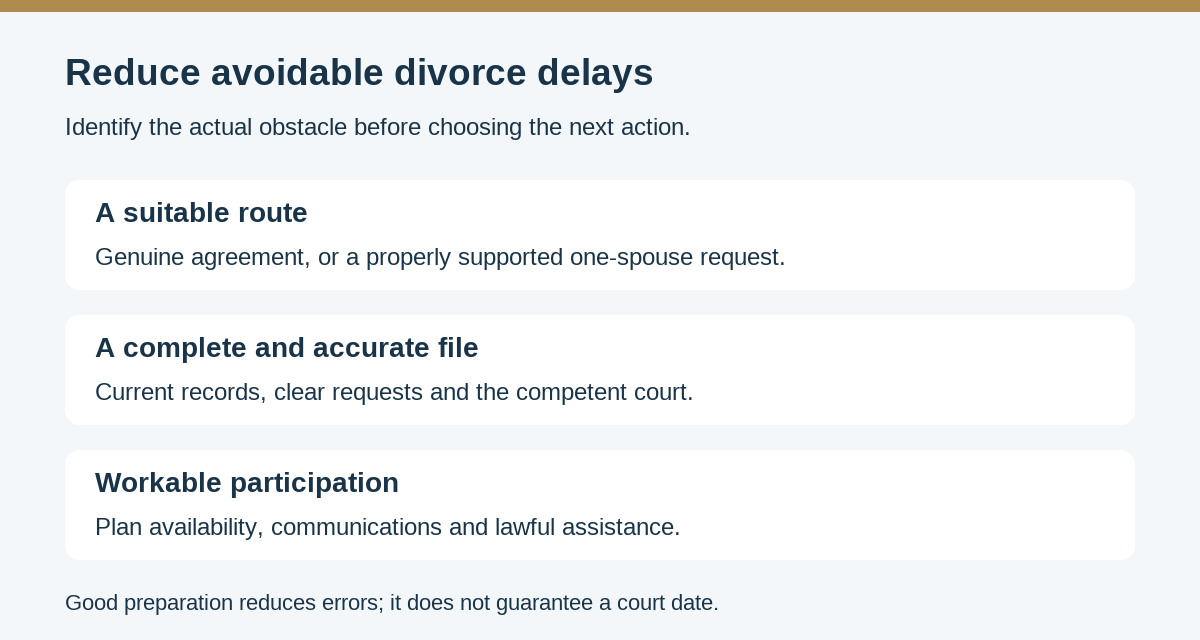
Start with the marriage record, appropriate identification and residence information, children's records where relevant and supporting material for the relief requested. A joint recognition request requires both spouses' signatures or fingerprints under Article 396. A one-spouse claim requires preparation appropriate to that claim rather than an assumption that the absent signature makes filing impossible.
The former paper household registration book should not be presented as a universally current compulsory document: those books ceased to have legal validity after 31 December 2022. Residence information still matters, particularly for jurisdiction and communication. Check the current method of providing or verifying it for the actual file rather than demanding an obsolete booklet.
Compare names, dates and identity numbers across records. Explain genuine differences with appropriate evidence. For foreign-issued material, assess translations, authentication or legalization requirements and any applicable exemption. Obtain advice before ordering unnecessary certifications, but do not assume a foreign document becomes sufficient merely because a translation has been attached.
A simple register can show the item, who holds it, whether an original or suitable copy is available and what remains to be obtained. This is particularly helpful when spouses live apart. It prevents both paying to obtain the same document while another essential record is overlooked.
The correct court depends on the type of matter and relevant connections, not solely on the applicants' preferred location. Current first-instance jurisdiction under the Civil Procedure Code includes regional People's Courts for the relevant family matters. Use the current court name and responsibility for the locality rather than copying an old district-court address.
International jurisdiction requires additional examination where foreign elements are involved. Nationality alone does not answer every question about whether a Vietnamese court may deal with the matter. Describe residence, addresses, the marriage and any relevant foreign proceedings before deciding where the request belongs.
Do not invent a convenient address to obtain a preferred forum or avoid service. If the other spouse's location is genuinely uncertain, explain what is known and what enquiries have been made. An unknown address and a judicial declaration that a person is missing are different situations, with different legal implications.
Article 85 restricts authorization for someone else to participate in divorce proceedings in place of the spouse. A lawyer can advise, prepare documents and protect legitimate interests within the permitted scope, but should not promise to replace the client in every aspect of the divorce. Any special legal situation requires its own assessment.
If a spouse lives abroad, has language needs or expects difficulty attending, discuss that before setting a travel schedule. An absence request and the court's assessment of it are not the same as a guaranteed exemption from participation. A short visit does not oblige the court to conclude the matter before a return flight.
Provide accurate contact details for procedural communication and monitor notices. A missed request for supplementation or an overlooked summons can disrupt an otherwise well-prepared file. Keep the case reference, received documents and response deadlines together so both the client and adviser can identify the next action.
Good preparation for an efficient divorce procedure in Vietnam reduces errors, repeated amendments and misunderstanding of the request. It does not allow an adviser to guarantee the court's outcome or eliminate required reconciliation and scrutiny. A service proposal should distinguish work controlled by the adviser from decisions and scheduling controlled by the court.
Ask for a defined scope: document review, explanation of the available route, preparation of the appropriate application, assistance with lawful submissions and updates on developments. Agree how additional issues or a change from consensual recognition to a contested case will be handled. A clear scope is more useful than an undefined premium for being “the fastest.”
Separate court fees, professional fees and possible document or translation expenses. An estimate should state its assumptions and identify what could require additional work. Avoid treating a higher professional fee as evidence that a particular completion date has been officially secured.
In a fictional example, spouses intend not to request property division now, but their draft says they have no common assets. Correcting that wording before filing can prevent a misleading record. It does not require pretending to settle every asset merely to make the application appear simpler.
In another example, the spouses agree to divorce but disagree about direct care. Repeatedly calling the request consensual does not resolve that disagreement. The adviser should assess the legal route and evidence needed, while keeping the child's interests central to any renewed discussions.
In a third example, a foreign-issued marriage record uses a name different from the current passport. A focused explanation and appropriate supporting record may be needed. Identifying the issue before travel is more useful than arranging a rushed visit and discovering that the document set requires further work.
A first-instance contested divorce judgment and a decision recognizing agreement do not have identical rules on legal effect and appeal. Article 213 addresses the immediate effect of an agreement-recognition decision, while ordinary judgments require examination of the applicable appeal and finality rules. Verify the actual document instead of announcing that every marriage ends on the date of the first hearing.
Read the operative terms and identify practical follow-up, including any payment, transfer or administrative step relevant to the case. Obtain an appropriate copy and keep it safely. A resolution that cannot be implemented because the parties overlooked the details is not a successful outcome merely because filing happened quickly.
The guide to drafting a lawsuit petition in Vietnam explains how to organize parties, requested decisions and evidence. Use the appropriate application for the chosen route and make the requested relief clear before submission.
>>> Read more: Is it possible to change the agreement in consensual divorce?
>>> Read more: How to divorce with the person who is missing in Vietnam?
Jurion & Partners can assess agreement, documents, jurisdiction and participation needs before setting out the proposed work. An efficient divorce procedure in Vietnam is built on an honest assessment of those issues, prompt attention to real obstacles and clear expectations about the steps that remain.






Subscribe today to get more breaking news from Jurion Partners - Solicitors & Litigators

108 Tran Dinh Xu St., Cau Ong Lanh Ward, Ho Chi Minh City, Vietnam
(+8428) 66.701.709 - (+84) 903.419.479
contact@jurionpartners.com
Follow us
Accept payment





 English
 Tiếng Việt