Mergers and acquisitions (M&A) are major business decisions that can reshape the future of a company.
Due diligence in M&A helps a buyer understand what it is acquiring, which legal problems may affect the investment and what must happen before money changes hands. Its value lies in better decisions, rather than a promise that every liability will be discovered. In Vietnam, an effective review connects the proposed transaction with the target's ownership, actual operations, contractual commitments and regulatory position. The benefits must be weighed against cost, disruption, confidentiality concerns and the limits of the available evidence.
A legal review tests rights, obligations and legal exposure. Financial advisers assess earnings and accounting assumptions; tax specialists examine tax treatment and potential assessments; technical advisers investigate matters such as equipment condition or environmental measurements. These assignments overlap, but they should not be treated as interchangeable. A lawyer can identify a missing operating permission without confirming that a factory meets every engineering requirement. Clear responsibility prevents important questions from falling between advisers.
The agreed transaction also determines the review. Buying shares leaves the target company in place, together with its contractual and historical position. Buying selected assets raises different questions about transferable rights, approvals, employees and continuity. Neither structure automatically eliminates all liabilities. Reviewers need a sufficiently clear proposal to investigate the consequences, while leaving room to recommend changes when the evidence reveals an unsuitable structure.
A useful brief identifies the businesses, entities and sites included, the proposed interest being purchased and the buyer's intended use. It also records what would make the investment unacceptable. For example, a buyer acquiring a manufacturing business for its location should prioritise the legal basis for occupying and using that site. A buyer seeking proprietary software needs a convincing chain of rights from its creators. The same document checklist will not answer both questions adequately.
Due diligence in M&A can uncover a gap between the seller's account and the documents supporting ownership or authority. Corporate records, capital contribution evidence, transfer history and relevant approvals should be examined together. A signature on a proposed agreement does not establish that the signatory owns the interest or can bind every necessary party. A discrepancy may require additional evidence, a corrective step or a different party at the negotiating table.
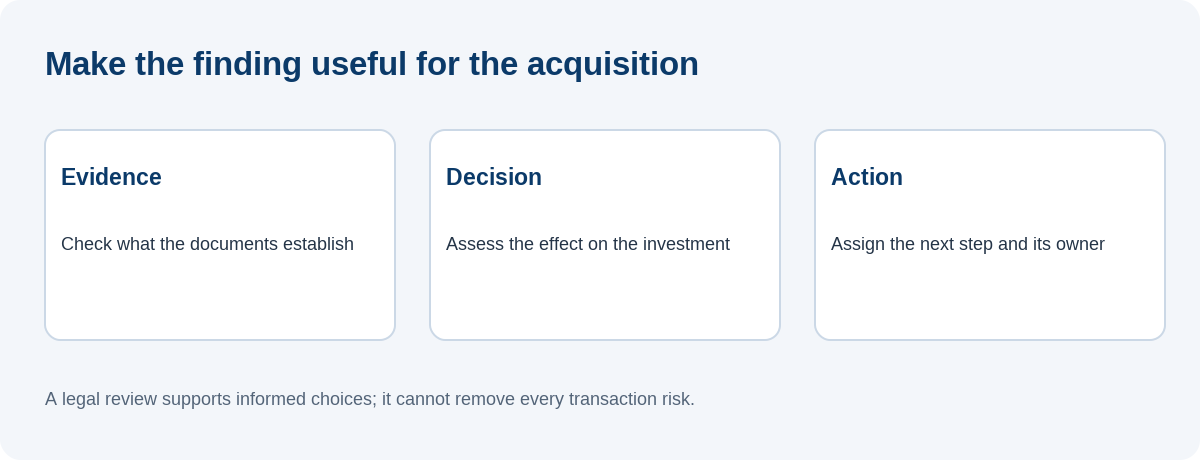
The benefit is strongest when the finding changes an action. An unresolved transfer restriction may become a condition requiring consent. An unexplained ownership history may justify further investigation before a binding commitment. A material defect that cannot be resolved within the available timetable may cause the buyer to reconsider. Listing the defect without explaining these choices leaves the commercial team with an observation but no usable decision.
Important revenue may depend on a customer agreement with a change of control clause. A premises arrangement may expire soon after the intended completion date. An operational permission may relate to a particular entity, activity or location. The review should compare the documents with the actual business and proposed changes. Having a registration document somewhere in the data room does not prove that every activity, site or transaction is covered.
Contractual findings can also challenge valuation assumptions. If a major customer can terminate after a transaction, the projected revenue needs a commercial response. Lawyers should identify the relevant right and its trigger, while financial advisers assess the effect on forecasts. The buyer then decides whether to seek consent, revise the business plan, renegotiate the price or accept a defined risk. Legal analysis contributes to valuation without replacing financial judgement.
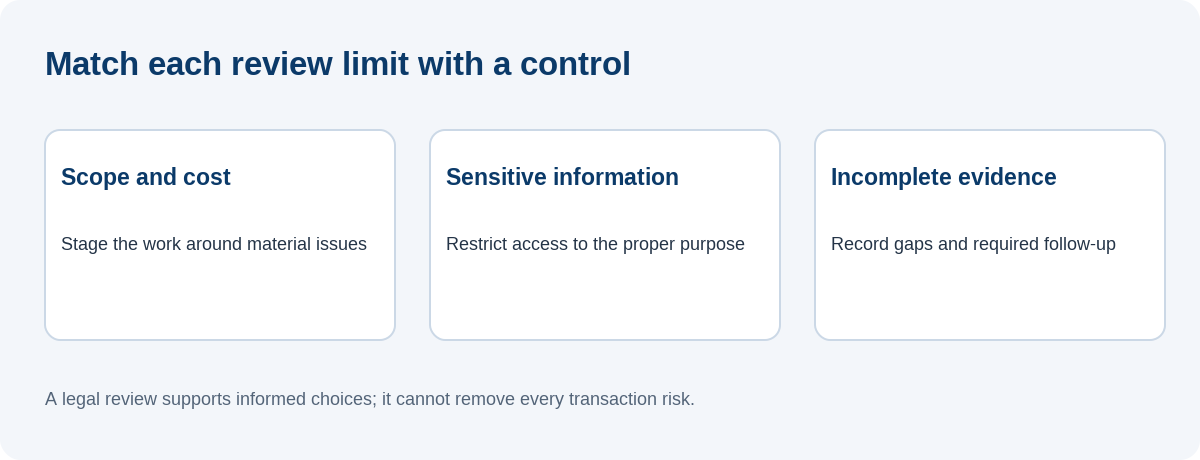
A large request list creates work for the seller and its management team. Locating historical records, checking translations and answering overlapping questions can divert attention from daily operations. Buyers also incur adviser fees and internal management costs. More documents do not necessarily produce more insight. An extensive review becomes inefficient when teams repeatedly request information without identifying the issue they are trying to resolve.
A staged approach helps control this problem. Begin with matters capable of preventing the transaction or materially changing its economics. Then investigate the areas required to resolve identified concerns and negotiate the documents. Agree who consolidates questions, when responses are expected and how additional work is authorised. This supports a reasoned budget without hiding the fact that an unexpected finding may require more investigation.
A seller may need to disclose sensitive customer terms, pricing methods, employee records or technical information before knowing whether the deal will complete. That exposure is particularly important where the potential buyer competes with the business. A confidentiality agreement is useful, but the information-sharing process also needs practical controls. Access should reflect the legitimate purpose and sensitivity of the material, rather than giving every participant unrestricted downloads.
Possible arrangements include staged disclosure, redacted documents, restricted adviser access and a defined process for especially sensitive information. Applicable confidentiality, personal data and competition obligations still need separate consideration. An NDA does not itself authorise every disclosure. The parties should also address how information will be returned, retained or deleted if negotiations stop, recognising that some professional or legal retention obligations may apply.
The review is constrained by what can lawfully be obtained and reliably checked. A missing document may reflect poor administration, an unresolved problem or a request that was misunderstood. It should not automatically be presented as proven misconduct. Equally, silence from management is not evidence that no problem exists. Reports should distinguish verified facts, explanations requiring support and questions that remain unanswered.
A search or document review is also a snapshot. Business activity continues while negotiations proceed, and a later event can change the position. A clear cut-off date, an updated disclosure process and selected checks before completion help manage that gap. None provides an unlimited guarantee. Buyers should understand which findings remain current and which assumptions require confirmation when the final decision is made.
Suppose a buyer intends to acquire a company because it operates from a strategically important warehouse. The data room contains an executed occupancy agreement, and management says the location is secure. Further review shows that the agreement expires shortly after the planned acquisition and renewal depends on the counterparty's agreement. The document is genuine, but it does not establish the long-term continuity assumed in the buyer's plan.
The appropriate response depends on the investment rationale. The parties might obtain an acceptable extension before completion, assess relocation costs or adjust the transaction terms. A contractual promise by the seller may offer some protection, but it cannot compel an unrelated property counterparty to renew. This example illustrates both the advantage of early investigation and the limit of allocating risk solely through the purchase agreement.
For this reason, due diligence in M&A should record the significance of a finding, the available responses and the evidence needed to close the issue. It should also identify the person responsible for the next step. A report marked “completed” is not equivalent to confirmation that every remediation action has actually been performed.
Different findings call for different treatments. A missing prerequisite may need to be satisfied before completion. A defined historical exposure may require discussion of contractual allocation and available recovery. An administrative task with limited immediate effect may be suitable for a post-completion plan. These choices should consider enforceability, timing, financial resources and the practical ability of each party to deliver the promised action.
Due diligence in M&A also informs disclosure. Buyers should understand how the agreement treats disclosed matters and how that treatment interacts with warranties, indemnities and other negotiated provisions. Broad labels such as “full protection” conceal important differences. A contractual right may be limited by its wording, deadlines, exclusions, evidential requirements and the resources of the person against whom it must be enforced.
Regulatory approval is a separate workstream. Identifying a potential filing does not mean that an authority has cleared the transaction. The team should check the rules applicable to the actual structure, parties and timing, gather the required information and reflect the necessary steps in the transaction timetable. Internal investigation, submission of an application and receipt of an approval are different events and should be recorded separately.
The broader legal due diligence process explains how scope, document review and reporting fit together. This article focuses on the trade-offs when deciding how much investigation is useful and how its results should affect a proposed acquisition.
Where legal support is needed, a focused brief to Jurion & Partners can set out the acquisition rationale, proposed structure, information already available and unresolved decision points. This provides a more useful starting point than requesting a general assurance that the target is safe to buy. The next discussion can then address a suitable scope and the outputs needed by the decision-makers.
>>> Read more: Competence of Vietnam courts over civil cases with foreign elements
Due diligence in M&A is most useful when its cost and depth are matched to the investment, its limitations are explicit and its findings lead to deliberate actions. Before approving the deal, confirm what has been verified, what remains uncertain and who will carry each outstanding task forward. That discipline supports an informed acquisition decision while keeping the remaining commercial and legal risks visible.






Subscribe today to get more breaking news from Jurion Partners - Solicitors & Litigators

108 Tran Dinh Xu St., Cau Ong Lanh Ward, Ho Chi Minh City, Vietnam
(+8428) 66.701.709 - (+84) 903.419.479
contact@jurionpartners.com
Follow us
Accept payment





 English
 Tiếng Việt