Understand why IRC complexity depends on the activities, investor and project conditions, rather than the foreign ownership percentage alone.
An IRC for a wholly foreign-owned enterprise in Vietnam is neither automatically difficult nor automatically straightforward. The proposed activities, investor status, location and applicable market-access conditions matter more than the ownership percentage alone. A project may permit full foreign ownership but still require suitable premises, adequate financial evidence and other approvals. The practical starting point is to establish whether the intended business model is legally available and then prepare the project and company records around that conclusion.
“Wholly foreign-owned” describes the ownership position; it is not a separate type of Investment Registration Certificate. Identify the foreign investor or investors and the economic organisation that will implement the project. A new company, an additional project of an existing company and an acquisition of an existing business require different analysis. Do not use a new-project IRC checklist for every transaction simply because all capital will be foreign-owned.
The Law on Investment 143/2025/QH15 distinguishes projects requiring investment registration from other investment forms. The company and project must be classified under that framework. In particular, the treatment of capital contributions and share purchases is not identical to establishing a new project company. An acquisition can involve market-access and registration questions without automatically requiring a new IRC as though no company existed.
Article 8 of the Investment Law provides the framework for foreign-investor market access. Its conditions can concern the foreign ownership percentage, investment form, scope of activities, investor capacity, participating partners and other legally prescribed matters. A favourable answer on the ownership percentage does not establish that the investor can conduct every proposed activity without further conditions.
Decree 96/2026/ND-CP distinguishes sectors not open to foreign investors, sectors subject to conditions and the treatment of activities outside the restricted market-access list. The assessment should identify the specific activities and the applicable legal basis. A broad description such as “commercial services” can conceal several functions with different conditions and should be clarified before the structure is finalised.
A sector can have conditions for doing business that also apply to domestic investors. Foreign-investor market-access conditions address a different question. The proposed company may need to satisfy both sets of requirements. An IRC should not be presented as replacing an operating licence, professional qualification or premises condition merely because full foreign ownership is permitted.
Equally, an activity being conditional does not by itself prove that a Vietnamese shareholder is mandatory. Examine the applicable condition and what it requires. A genuine local partnership can serve a commercial purpose, but adding a nominal participant is not a substitute for resolving a legal restriction. The structure and application should reflect the actual arrangement.
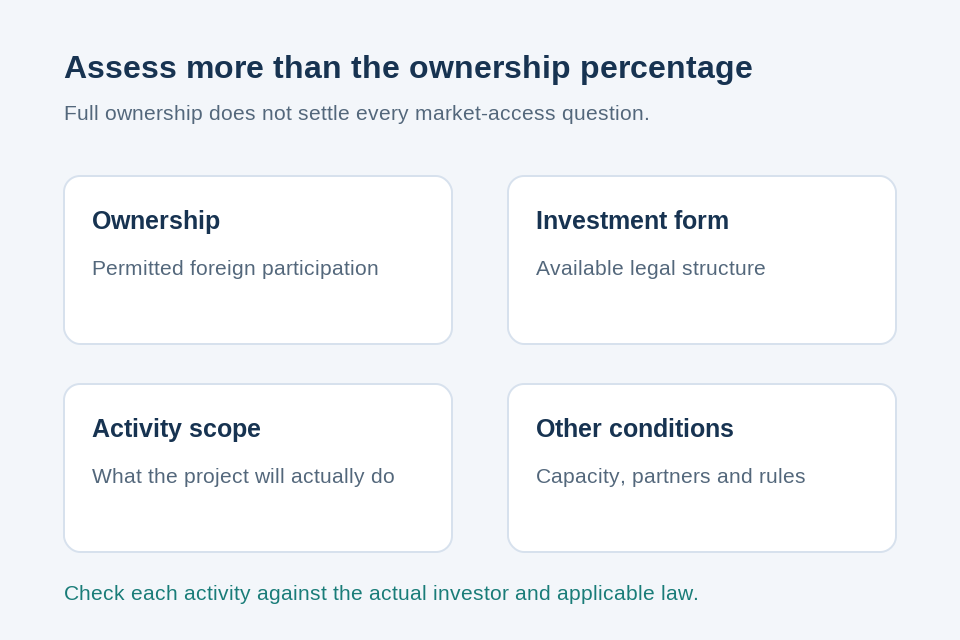
For an IRC for a wholly foreign-owned enterprise, a mixed activity list deserves early attention. Decree 96 requires compliance with the applicable market-access conditions across the relevant activities. Where treaty ownership restrictions differ between activities, the decree addresses the interaction of those limits. Do not assume that the main activity's ownership position determines the answer for everything else.
For example, an investor may initially plan a narrowly defined technology service and later add trading, installation or another service for customers. The additional function should be assessed separately. The application needs an accurate description of what the business will do, not an expansive activity list selected only to reserve options for an uncertain future.
Prepare an activity matrix identifying each proposed revenue-generating function, its customers, the services or goods involved and any connected operational requirement. Record the ownership conclusion and legal conditions for each function. If management decides to defer an activity, distinguish a genuine future plan from an activity it actually intends to start immediately.
Investor nationality and legal status may be relevant to applicable international commitments. Decree 96 includes rules on treaty treatment, non-WTO investors and the choice between applicable investment treaties. These provisions do not justify selecting isolated favourable terms from different instruments without considering the governing rules and the investor's entitlement.
Identify the actual investing entity, its jurisdiction and the evidence of its legal existence. A well-known group brand does not identify which company is the investor or establish that it qualifies for the treatment claimed. An ownership chart should match the corporate records and the intended capital contribution. Changes to the investing entity should trigger reassessment where they affect the legal basis of the structure.
A written assessment should identify its assumptions and date. Market-access rules and sector legislation can change. A previous approval obtained by another investor can be useful background but is not a complete legal basis for the new project. Review the proposed structure against the applicable rules rather than relying solely on a competitor's registration.
It is inaccurate to say that establishing every wholly foreign-owned company must begin with obtaining the IRC. The current framework recognises establishment before completion of the investment registration procedure, as well as the IRC-first route. Foreign-investor market-access conditions still apply when using the company-first route; incorporation does not postpone that assessment until later.
Article 72 of Decree 96 attaches specific obligations to the company-first arrangement. These include the market-access undertaking, completion of the project IRC procedure within 12 months and the restriction on adding other business lines before the IRC is issued. The company may implement the project only after completing the required investment registration procedure. The period is not a general operating grace period.
When planning an IRC for a wholly foreign-owned enterprise, compare the sequences against the available project information, internal approvals and practical dependencies. An ERC establishes the enterprise under the relevant company-registration framework; an IRC records the investment project. Treating either document as answering every question about lawful operations creates an avoidable gap.
Even where full ownership is available, the proposal must describe a project that can be assessed. Explain the objectives, scale, location, capital and implementation plan. The applicant should have appropriate legal-status and financial-capacity evidence, together with the location and other documents required for the particular route. A simple shareholder structure does not compensate for an unsupported project description.
There is no sound basis for presenting one minimum capital figure as applying to every wholly foreign-owned business. Check any sector-specific or other relevant capital condition and prepare an achievable budget. Distinguish charter capital from total project investment and explain other proposed financing. Decree 96 expressly recognises that these capital figures need not be equal.
Evidence should support the investor's actual capacity and proposed funding. The dossier rules recognise alternatives including relevant financial statements, support commitments, guarantees and other material. Where the funding comes from a parent or another source, explain the relationship and the commitment relied on. Do not describe an unapproved group intention as a completed contribution.
Check the proposed location against the activities, property records and applicable planning or other requirements. Full ownership of the company does not automatically confer land rights or make any premises suitable. Identify the area to be used and the documentary basis for using it. A lease or preliminary agreement should be reviewed in the context of the project rather than treated as an interchangeable address attachment.
Additional complexity may arise from several activities, specialised conditions, a sensitive location, a project requiring policy approval or uncertainty about the investor's eligibility. These are substantive issues. Document inconsistencies, missing signatures and unresolved budgets are a different source of delay. A useful adviser should identify which category of issue is present and what can realistically resolve it.
For the ordinary IRC route outside investment policy approval, Article 39 of Decree 96 provides a 10-working-day consideration period from a valid dossier, subject to the applicable conditions. Other defined routes have different rules. Preparation, earlier approvals and the applicant's supplementation time should not be confused with that formal period. A promise of approval within a fixed total number of days can obscure those differences.
Once issued, an IRC for a wholly foreign-owned enterprise should be checked against the accepted project record. Identify the recorded activities, location, capital and schedule, and assess any discrepancy promptly. Ownership changes, additional activities or a new location may require further legal assessment and procedures. The original ownership conclusion should not be treated as permanently covering every expansion.
The broader guide to procedures for foreign investment in Vietnam connects market access with company establishment, investment records and operational preparation. Use it to allocate remaining licensing, tax, employment and other responsibilities. An IRC does not automatically award incentives or certify that every condition for starting the business has been satisfied.
A discussion with Jurion & Partners can start with the proposed ownership chart and a precise description of the activities. Add the investor's jurisdiction, proposed site and project budget. Ask for the applicable ownership position, conditions, evidence gaps and procedures, together with the assumptions on which the assessment depends.
The difficulty of obtaining an IRC for a wholly foreign-owned enterprise depends on that factual and legal analysis. Where the structure is available and the project is well supported, the application is more manageable. Where a restriction or material uncertainty remains, address it before filing rather than relying on the ownership label, an outdated registration sequence or an unsupported assurance that approval is easy.






Subscribe today to get more breaking news from Jurion Partners - Solicitors & Litigators

108 Tran Dinh Xu St., Cau Ong Lanh Ward, Ho Chi Minh City, Vietnam
(+8428) 66.701.709 - (+84) 903.419.479
contact@jurionpartners.com
Follow us
Accept payment





 English
 Tiếng Việt