Mergers and acquisitions (M&A) are complex transactions involving not only valuation and negotiation but also clearly defined liabilities for both buyers and sellers.
Buyer and seller liabilities in M&A should be analysed separately from the debts of the business being acquired. A purchase agreement can allocate economic exposure between its parties, but that allocation does not automatically change the person who owes an obligation to a supplier, employee, lender or authority. Before negotiating protection, identify the transaction structure, the actual obligor and the legal basis of each proposed claim. This prevents a broad promise about “all historical liabilities” from concealing several different questions.
Start with three columns. The first records the obligation owed to an outside party and the person responsible for it. The second records the allocation proposed between buyer and seller. The third explains how that allocation would be enforced in practice. A target company may remain responsible for a debt while the seller agrees to reimburse a defined economic cost. Those statements can coexist; they do not describe a transfer of the supplier's rights against its debtor.
Use the actual documents to populate the map. Identify the contracting entity, any guarantor, relevant security and the basis of a statutory obligation. Group names and trading brands can obscure the legal position. A payment made by one group company does not necessarily establish that it was the debtor. Likewise, a seller's involvement in management should not be treated as proof of personal liability for every company obligation.
When shares in a company change hands, the company generally continues to exist. Its contractual position must be examined in that context. Limited liability also requires attention to the company form and relevant exceptions, rather than an unconditional statement that shareholders can never be exposed. Separate personal guarantees, contribution issues or other legal grounds may require their own review.
A statutory merger involves a different succession framework. An asset acquisition raises questions about the assets and obligations included and the steps required to implement the intended transfers. Do not use the general expression “M&A” as if all structures have identical consequences. An agreement allocating responsibility may operate alongside statutory rules and third-party rights, and the documents should reflect that relationship.
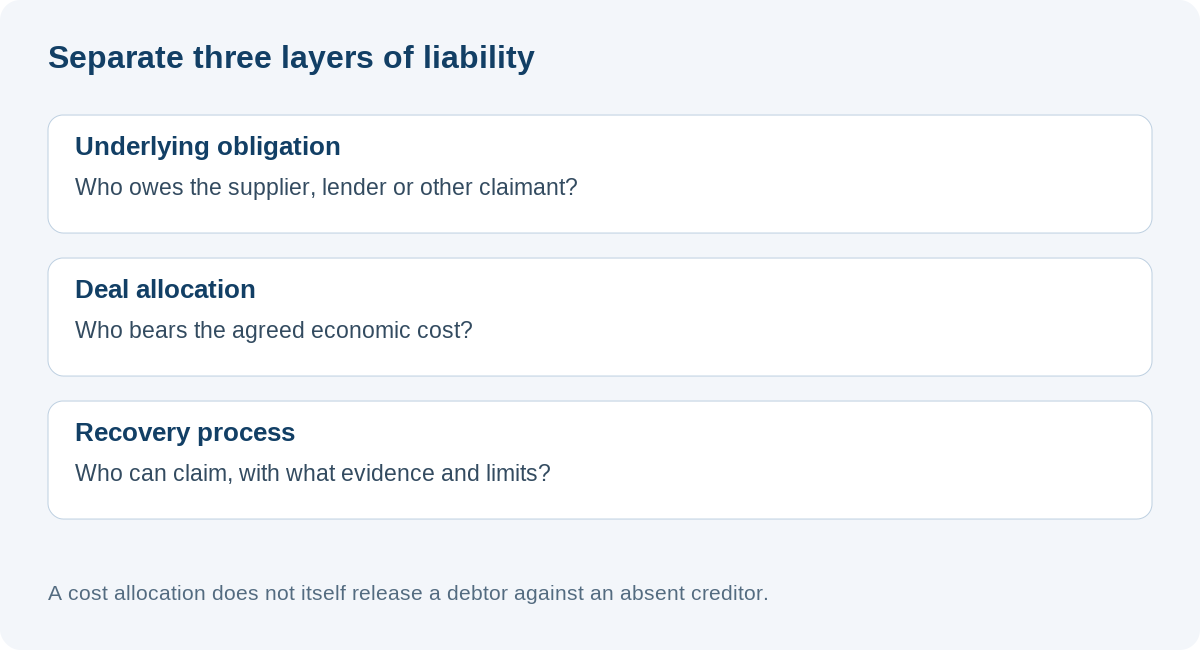
Suppose a buyer acquires all shares in a company that owes money to a supplier. The buyer and seller agree that the seller will bear specified pre-completion trading costs. The supplier was not a party to that agreement. The starting point remains the supplier's rights under its arrangement with the company; the allocation between buyer and seller is a separate matter that needs to be implemented according to its terms.
If the company pays the invoice, the next question is who may claim reimbursement and under which provision. The agreement should identify the claimant, the covered cost, the required evidence and any conditions. A clause that only says “seller responsible” may leave uncertainty about whether the buyer, company or another person can enforce it. Avoid assuming that the party experiencing the economic effect automatically holds the contractual claim.
This example shows why buyer and seller liabilities in M&A need both a legal and an implementation map. If the parties instead intend to replace a debtor or release an existing obligor, they must examine the applicable transfer rules and required participation or consent. A private allocation of cost should not be described as a universal release binding an absent creditor.
The seller's transaction obligations may include delivering the interest or assets being sold, obtaining relevant cooperation and making agreed statements about the business. Examine who gives each statement and what it covers. A statement about ownership differs from a statement about the target's accounting records or pending claims. The parties should understand the factual basis, relevant period and qualifications, rather than rely on a general assurance that everything is compliant.
Disclosure should be coordinated with those commitments. Define the agreed disclosure materials, preserve the version used and explain their intended contractual effect. Uploading a document does not answer every question about whether a matter was adequately disclosed under the actual agreement. The buyer should also distinguish information verified independently from management explanations that remain unsupported.
Buyer and seller liabilities in M&A often involve a known matter that requires specific treatment, such as an unresolved customer dispute. The agreement can address the economic allocation and conduct of that matter. Decide who receives correspondence, who controls discussions and whether the other party's approval is needed for a settlement. A reimbursement promise alone may not prevent one party from taking steps that increase the exposure.
Tax, employment and regulatory obligations require specialist attention where relevant. The acquisition agreement should not suggest that allocating a cost eliminates statutory duties or binds an authority. Identify the responsible entity, the periods and matters covered, and the interaction with the negotiated provisions. Financial and tax advisers may need to assess amounts and treatment separately from the legal drafting.
The buyer's payment commitment needs a defined amount or calculation, recipient, timing and conditions. Price adjustments, retentions and disputed calculations should be coordinated rather than left in competing provisions. Payment delay does not automatically produce every remedy appearing in another transaction. Assess the applicable law and the agreed consequences, including any conditions or limits on a particular claim.
The buyer may also owe cooperation, information or implementation duties. For example, a post-completion claim relating to a historical matter may require access to records now controlled by the buyer or target. If the seller is expected to respond, the process should make the necessary documents available on appropriate terms. The buyer should understand those continuing commitments before assuming completion ends every interaction.
Responsibility for pursuing a regulatory process should identify the work, cooperation and evidence required. A contractual allocation does not itself constitute an approval. Similarly, proposed changes to employment, premises or licences need the relevant legal analysis. A share purchase does not by itself mean that every employee changes employer or that every business contract is assigned to the buyer.
Buyer and seller liabilities in M&A are affected by the wording governing claims. Review the event that triggers liability, the person entitled to claim, the evidence required and the process for giving notice. Time limits, monetary limits and exclusions should be understood together. Labels such as warranty or indemnity do not guarantee an identical outcome under every governing law or formulation.
Consider how the provisions interact. Could the same matter fall within several clauses? How is an amount already reflected in the price treated? Are insurance proceeds or third-party payments relevant? These questions should be resolved through deliberate drafting. The objective is a coherent allocation, rather than overlapping statements that each appear protective but leave the parties arguing about which provision controls.
A successful demand is only useful if it can be satisfied. The parties may discuss a retention, escrow, guarantee or another arrangement, subject to its suitability and legal requirements. Each has its own terms and practical limits. Identify who holds the funds, when release is permitted, how a disputed claim affects release and what happens when the relevant period ends.
Do not treat a holdback as proof that every loss is recoverable. The amount may be insufficient, the claim may fall outside the agreed scope or the release conditions may not support the intended protection. Equally, a seller should understand when money can be retained and how an unsupported demand is addressed. Both sides benefit from a process that can be administered without inventing new rules after completion.
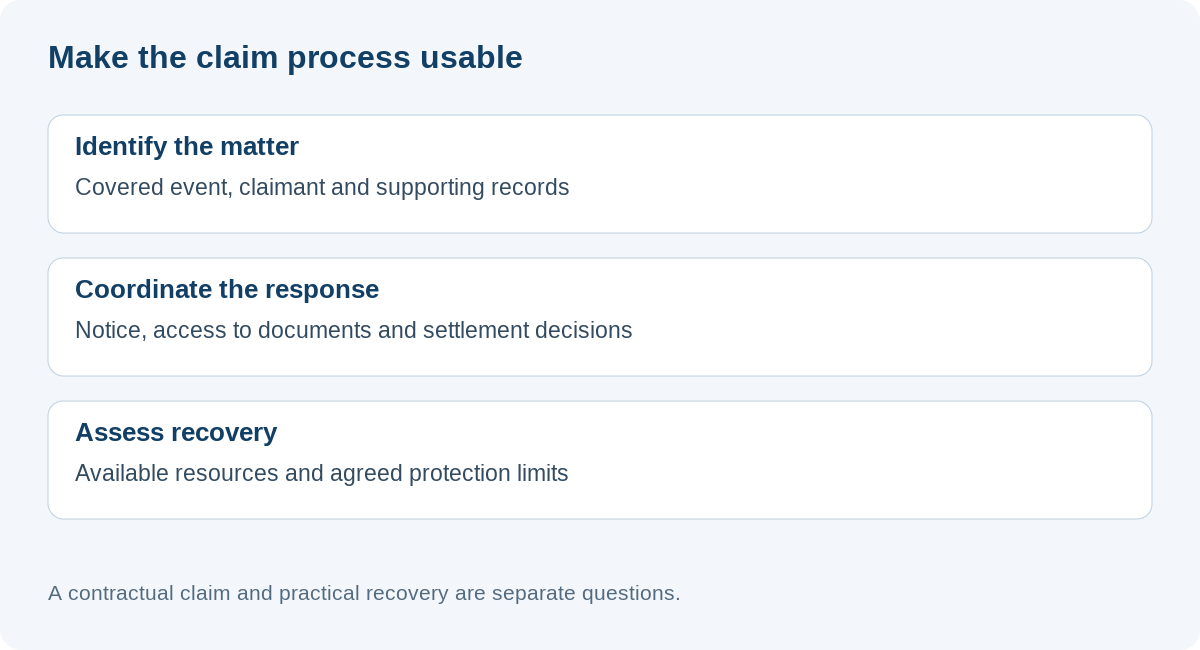
When a supplier, employee or authority raises an issue, the acquisition agreement may require prompt communication between the parties. Establish who receives the notice, what information must be shared and who can make admissions or settle. The appropriate arrangement depends on the matter and cannot override duties owed under applicable law. Avoid allowing a contractual coordination process to cause a missed external deadline.
Maintain the relevant contracts, correspondence, invoices and decision records. A concise claim chronology should distinguish the underlying allegation, the response taken and the reimbursement requested. If the amount is estimated, identify the basis and what remains uncertain. This is more useful than sending a large folder with a general demand that the other party pay all costs associated with the business.
The broader service for drafting and reviewing contracts supports a consistent transaction document. For liability provisions, the most useful instruction includes a schedule of known exposures, the proposed allocation and the unresolved choices. This allows the wording to be tested against actual events rather than an abstract demand for complete protection.
When preparing a review with Jurion & Partners, provide the proposed structure, relevant underlying documents and the draft claim provisions. Ask which party owes the underlying obligation, who bears the negotiated economic cost and how a claim would work. Those questions expose gaps that a general description of buyer and seller responsibilities can miss.
>>> See more: Signing M&A Contract, what are the noteworthy points?
>>>Read more: Legal due diligence in M&A transaction
Buyer and seller liabilities in M&A should be expressed through identifiable obligations and a workable recovery process. Before accepting the final allocation, reconcile it with the transaction structure, third-party rights and the resources available to meet a claim. Keeping those layers separate supports a realistic agreement and makes the remaining exposure visible to the people who will manage the business after completion.






Subscribe today to get more breaking news from Jurion Partners - Solicitors & Litigators

108 Tran Dinh Xu St., Cau Ong Lanh Ward, Ho Chi Minh City, Vietnam
(+8428) 66.701.709 - (+84) 903.419.479
contact@jurionpartners.com
Follow us
Accept payment





 English
 Tiếng Việt