Understand which companies continue, who owns the business and how obligations are treated when choosing between a merger, consolidation, share purchase or asset transfer.
The difference between mergers and acquisitions is best understood by asking what happens to the companies, their ownership and their obligations. Both terms describe ways of combining business interests, but they do not identify the same legal structure. In Vietnam, it is particularly important to distinguish a merger into an existing company from a consolidation into a new company, and both from a purchase of shares or selected assets.
A business announcement may use “merger” to describe a collaborative deal, even where the legal documents provide for a share purchase. That commercial description does not determine whether a company continues to exist, which entity holds a contract, or how obligations are transferred. Those questions must be answered from the structure and applicable law.
Start with three practical questions: which legal entities exist after completion, who owns the relevant interests or assets, and which entity is responsible for existing obligations? The answers help distinguish arrangements that may look similar in a press release but require different documentation, approvals and transition work.
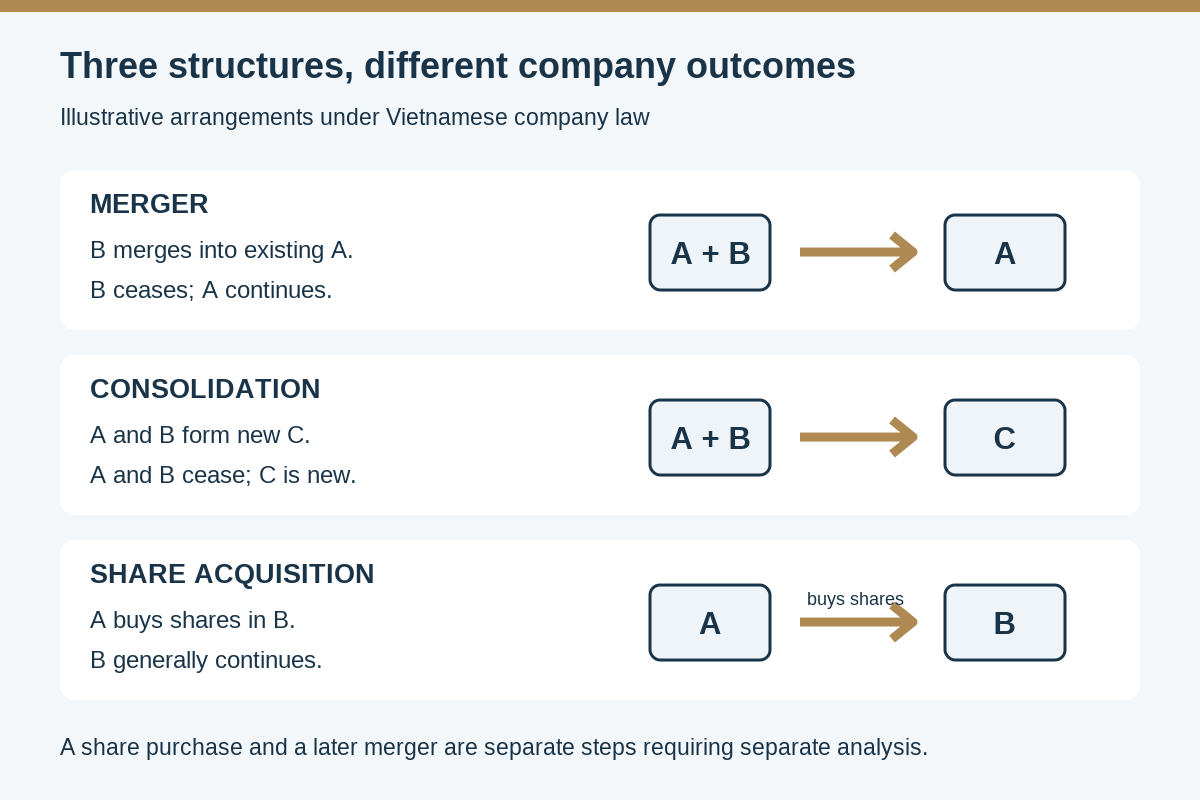
Article 201 of the Law on Enterprises addresses a merger, or sáp nhập. One or more companies transfer their assets, rights, obligations and lawful interests into another company, with the merged companies ceasing to exist. The receiving company continues as the entity into which the other companies are merged.
This is different from saying that every merger creates a new company. For example, Company B may merge into Company A. Following the relevant completion and registration steps, A is the receiving company, while B ceases to exist. The structure therefore requires attention to what A inherits, how its governance and ownership will operate, and how the agreed conversion arrangements are implemented.
The merger agreement and related corporate documentation must reflect the statutory requirements and actual arrangement. The parties also need to address the relevant creditor and employee notifications, registration and competition requirements. A merger is a legal reorganisation with consequences for obligations, rather than a way to combine useful assets while leaving every inconvenient liability behind.
Article 200 addresses consolidation, or hợp nhất. Two or more companies consolidate into a new company, and the consolidating companies cease to exist. In a simple illustration, Companies A and B consolidate to form Company C. C is a new legal entity rather than one of the original companies continuing as the receiving company.
The new company succeeds to the relevant rights, obligations and lawful interests under the statutory arrangement and consolidation agreement. The work includes the consolidation agreement, the new company's charter, required approvals and registration. Its owners and management must be identified through the agreed arrangements and applicable governance rules.
In general business English, people sometimes use “merger” broadly enough to include this type of combination. When discussing a Vietnamese transaction, specify whether the intended structure is a merger into an existing company or a consolidation into a new one. That simple clarification avoids a fundamental misunderstanding before drafting begins.
In ordinary transaction language, an acquisition can involve buying shares, capital interests or particular business assets. The consequences depend on what is bought and how the transaction is implemented. An acquisition need not involve purchasing the whole business, and it does not always cause the target company to disappear.
If Company A purchases shares in Company B, B generally remains the same legal entity. Its shareholders change, but its assets and contracts do not automatically become the direct property or contracts of A. Even a purchase of all the shares should be distinguished from a later merger or other reorganisation.
The rights obtained depend on the interest acquired, its legal characteristics, the company's governance arrangements and applicable law. A minority investment may provide limited voting or contractual protection rather than day-to-day control. A majority interest also does not give the buyer an unrestricted power to disregard other shareholders, directors' duties, creditors or mandatory requirements.
An asset purchase identifies particular assets and rights to be transferred. The seller may continue in existence after the transaction. The parties need to establish title, transfer formalities and the treatment of associated agreements, employees and obligations. A licence, customer relationship or lease may need separate analysis rather than automatically following the physical assets.
It is therefore unsafe to assume that an asset purchase always excludes liabilities. Some obligations may be assumed by agreement or arise under applicable law, and third party rights need consideration. The structure must be assessed against the assets and business the buyer actually intends to operate.
The Competition Law has its own definition relevant to economic concentration. Article 29 addresses an acquisition of all or part of another enterprise's capital or assets sufficient to control or dominate that enterprise or a business line. This specific test should be distinguished from the wider commercial use of “acquisition”, which may also describe a smaller investment without that level of control.
| Question | Merger | Consolidation | Share acquisition |
|---|---|---|---|
| Basic example | B merges into A. | A and B consolidate into new C. | A purchases shares in B. |
| Does the target remain? | The merged B ceases to exist. | The consolidating A and B cease to exist. | B generally continues. |
| Is a new company necessary? | A is an existing receiving company. | C is a new company. | A share purchase does not itself require one. |
| What needs particular attention? | Succession and the receiving company's arrangements. | The new company and succession arrangements. | Ownership rights and the target's continuing history. |
This comparison explains the basic company structures rather than every sector-specific variation. A transaction can also use more than one step: an investor might first acquire shares and later merge group entities. Each step needs its own analysis, and completing the first does not automatically complete the second.
The difference between mergers and acquisitions cannot be reduced to whether cash changes hands. A purchase may use cash, shares, deferred consideration or a combination, subject to the relevant rules. A merger or consolidation also requires the parties to agree how interests and assets are converted and how the resulting ownership arrangements work.
The payment method has its own consequences. Cash raises funding and payment questions; share consideration raises valuation, rights and dilution questions; an earn-out raises measurement and control questions. These matters help shape the documents, but none supports a universal claim that mergers require no money or that acquisitions always require a large cash payment.
Also identify who is selling and receiving the consideration. In a purchase of existing shares, the selling shareholder receives the agreed price for those shares. Where the target sells its own assets, the target is the seller and receives the asset price. Those are different transactions from an investor subscribing for newly issued interests, where the investment goes into the issuing company. Confusing these routes can produce a funding plan that pays the wrong party or fails to provide the business with the capital the parties intended.
Companies do not have to be equal in size for a legally structured merger or consolidation. Similarly, a buyer does not have to be larger than the business in which it invests. The commercial balance of power can affect negotiations without changing the legal identity of the structure chosen.
An acquisition may be negotiated cooperatively, and a transaction described as a merger may involve difficult negotiations. Friendly or hostile language concerns the circumstances of the deal; it is not a substitute for analysing ownership, approvals and the rights being transferred. Avoid choosing the structure merely because one label sounds more positive.
Each arrangement requires consideration of the corporate decisions, regulatory requirements and contractual consents relevant to the actual parties and business. Competition notification, where required, is a separate question from obtaining a shareholder resolution. A private agreement cannot remove a mandatory legal requirement.
Continuity also needs careful planning. In a share acquisition, a contract may remain with the same company but still contain a change of control restriction. In a merger or consolidation, statutory succession does not justify ignoring sector rules or the practical steps needed to update records and continue operations. Identify the critical permissions, agreements and counterparties early.
Employee arrangements and integration should follow the legal structure and applicable obligations. The commercial desire to combine teams does not itself authorise contract termination or unrestricted access to every record. The transaction team should identify the responsible employer, the intended changes and any required process rather than treating integration as a single automatic event.
See more: 07 things important issues necessary when M&A bussiness
See more: Key legal aspects of Mergers and Acquisitions
Prepare a diagram of the entities before and after the proposed transaction, together with the interests or assets involved and the business objectives. Jurion & Partners can assist with reviewing those arrangements and identifying the legal questions that must be resolved before the documents are finalised.
The legal due diligence guide explains how to investigate the rights and obligations underlying a proposed deal. Understanding the difference between mergers and acquisitions starts with legal identity, ownership and succession, then connects those consequences to the practical result the parties want to achieve.






Subscribe today to get more breaking news from Jurion Partners - Solicitors & Litigators

108 Tran Dinh Xu St., Cau Ong Lanh Ward, Ho Chi Minh City, Vietnam
(+8428) 66.701.709 - (+84) 903.419.479
contact@jurionpartners.com
Follow us
Accept payment





 English
 Tiếng Việt