A practical final review of an acquisition agreement, from the binding document and price calculation to factual assurances, completion steps and consequences of breach.
Signing an M&A contract should follow a review of what the parties are promising, what remains conditional and what must happen before ownership or control changes. A document can look complete while leaving the price calculation, disclosure record or completion obligations unclear. The final review should connect the commercial bargain with the operative clauses, supporting documents and execution arrangements, so that the parties understand both their commitments and the consequences of non-performance.
M&A is a commercial description covering different arrangements. A share purchase agreement, an asset sale agreement and a statutory merger agreement do not perform identical functions. Confirm the structure, the interests or assets involved and the legal entities participating before reviewing the wording. Avoid relying on a general definition that assumes every merger creates a new company or every acquisition absorbs a smaller business.
Also distinguish the definitive transaction agreement from a term sheet, memorandum or other preliminary document. The effect depends on its terms and applicable law, rather than its heading alone. Confidentiality, exclusivity or other provisions may be intended to bind even where the principal transaction remains subject to further negotiation. Identify that position before anyone signs an apparently informal document.
Match the names and identifying particulars against reliable records. Determine whether the seller owns the interest being transferred and whether the proposed buyer is the entity intended to acquire it. If a group company, nominee arrangement or guarantor appears in the documents, establish its role and the obligations it actually assumes.
Check the required corporate decisions and the authority of each signatory. A person who negotiated the deal may need a separate authorisation to sign. Where approval refers to an earlier draft or different commercial terms, confirm that it covers the document now being executed. Signature logistics cannot repair a missing substantive approval.
Establish the relevant execution and form requirements for the particular documents, including any legally required notarisation, certification, registration or other step. Do not assume that every M&A agreement follows the same formalities. The final version, signature method and supporting authorisations should be agreed before the signing meeting.
A headline price may be only the starting point. Identify whether the amount is fixed or subject to cash, debt, working capital or another adjustment. Define the items, valuation date, accounting policies and preparation process. The legal drafting and the financial model should use compatible assumptions.
Run the mechanism with actual or illustrative numbers. If an agreed base price is increased by qualifying cash and reduced by debt, ask where a particular unpaid liability belongs and whether another adjustment counts it again. The objective is not to choose an accounting answer without expertise, but to reveal inconsistent definitions before they become a dispute.
State when the relevant accounts or calculation must be delivered, what information accompanies them, how the other party can object and who resolves an unresolved question. Distinguish an expert accounting determination from a broader legal dispute so that the agreement does not send the same issue to incompatible procedures.
For an earn-out, specify the performance measure, period, calculation and information rights. Address changes in accounting policy, related party charges and the buyer's discretion to operate or integrate the business. A promise to pay an additional sum “if the company performs well” gives neither party a reliable standard.
For deferred consideration, establish the due date, payment conditions, any agreed security and the treatment of a contested claim. Confirm that the proposed payment route is lawful and practical. Neither delayed payment nor an escrow arrangement should be adopted without understanding how funds will be released and disputes handled.
Representations and warranties commonly address facts about ownership, accounts, contracts, compliance or disputes. Define who gives each assurance, the relevant date, any knowledge qualification and the agreed consequences of inaccuracy. The effect of these provisions under the chosen law depends on their wording and the legal framework; an English label alone does not establish a particular remedy.
Read the disclosure letter and schedules at the same time. Determine which statements are qualified, what counts as disclosure and whether the buyer can identify the matters being disclosed. A last-minute upload of documents can be significant if the agreement treats all data room material as qualifying the assurances.
Do not assume that a statement described as a declaration can never have legal consequences. Article 387 of the Civil Code addresses information affecting acceptance of a contract, confidentiality during formation and compensation where breach of those duties causes damage. The proper analysis depends on the facts, the agreed obligations and any other applicable grounds; clear drafting is valuable without making unsupported claims that statutory protection disappears.
A covenant requires a party to act or refrain from acting. A completion condition determines whether the agreed obligation to complete has become due under the contract. Where an approval or consent is essential, the documents may need both a promise to pursue it and a condition requiring the result before completion.
Specify the acceptance test, evidence, responsible person and deadline. Address what happens if a condition remains unsatisfied: extension, lawful waiver, termination or another agreed response. A private waiver cannot remove a mandatory legal requirement. Also distinguish signing the agreement from completing the transfer; not every deal completes immediately on signature.
If the business continues under the seller's control between signing and completion, define permitted conduct, information updates and the treatment of material changes. The buyer should not assume it can exercise unrestricted control during that interval. Any proposed consent rights or integration activity need assessment against the relevant legal requirements.
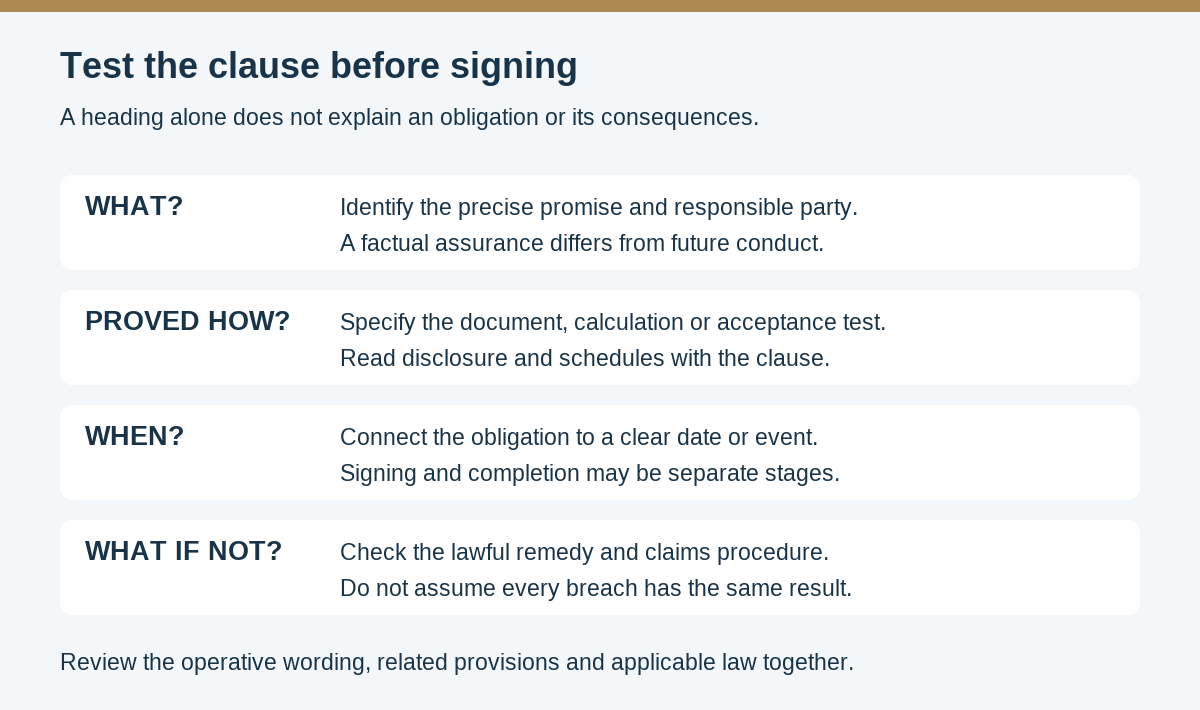
When signing an M&A contract, review the remedy provisions as carefully as the commercial promises. Distinguish compensation, an agreed contractual penalty, interest for late payment, a specific risk allocation and termination. These mechanisms have different requirements and should not be treated as automatic equivalents.
For a compensation claim, consider the obligation breached, the loss claimed, causation, evidence and applicable restrictions. The Civil Code addresses contractual loss and the duty to take reasonable measures to prevent or limit damage. A breach does not mean that every amount claimed by the other party is automatically recoverable.
A contractual penalty needs a lawful basis in the agreement and must comply with the applicable legal regime. Its relationship with compensation also requires attention. Avoid importing a single penalty cap or a foreign template into every acquisition without checking the law governing the relevant obligation.
For late payment, identify the sum due, the due date and the applicable contractual and statutory interest rules. An interest provision should not obscure a genuine dispute over whether the amount has become payable. Check that the payment and dispute clauses work together.
Review notice requirements, claim periods, liability limits, exclusions and the handling of third party claims. Distinguish a negotiated contractual notification period from an applicable statutory limitation period. Do not assume that a general clause preserves every claim or validly eliminates every mandatory protection.
Consider who can actually meet an obligation after the transaction. A seller's promise may be difficult to enforce economically if the seller has distributed its assets or is outside the jurisdiction where recovery is expected. Any guarantee, retention or security should be assessed for authority, enforceability and implementation rather than included merely as reassuring terminology.
List the signatures, approvals, payments, releases and delivery documents required at completion, with a person responsible for each. Check the sequence: the parties should understand when documents are released, when payment is made and which evidence confirms that the agreed transfer step has occurred.
Then examine what continues afterwards. Examples include delivery of outstanding records, cooperation on tax matters, agreed transition assistance, confidentiality and settlement of a price adjustment. If ongoing governance is intended, ensure that the relevant shareholder or constitutional arrangements support it. A purchase agreement alone should not be assumed to resolve every future management question.
Check defined terms, cross-references, schedules, dates and consistency across related agreements. If there are multiple languages, establish how interpretation is handled and whether the versions match. Remove unresolved placeholders and confirm that the schedules are the versions reviewed by the decision makers.
Review the governing law and dispute clause with the actual transaction in mind. Identify the intended forum, the scope of disputes covered and any procedural detail requiring agreement. A clause should be workable with the parties and documents involved, rather than copied solely because it appeared in another deal.
Read more: What is the difference between Mergers and Acquisitions?
Read more: 07 things important issues necessary when M&A business
Bring together the agreed commercial terms, due diligence findings, latest contract, disclosure material and completion list. Jurion & Partners can assist with reviewing the open drafting points and explaining their implications so that the people approving the transaction can make an informed decision.
The guide to drafting and reviewing contracts provides context for this process. Careful preparation for signing an M&A contract makes the agreed price, promises, conditions and remedies understandable and workable, reducing avoidable uncertainty when the parties must perform their obligations.






Subscribe today to get more breaking news from Jurion Partners - Solicitors & Litigators

108 Tran Dinh Xu St., Cau Ong Lanh Ward, Ho Chi Minh City, Vietnam
(+8428) 66.701.709 - (+84) 903.419.479
contact@jurionpartners.com
Follow us
Accept payment





 English
 Tiếng Việt