A practical overview of the legal decisions connecting an acquisition structure with authority, price mechanisms, contractual protections and implementation.
Legal aspects of mergers and acquisitions influence what a buyer receives, which obligations remain and how the transaction can be completed. A commercially attractive price is only one part of the analysis. The parties also need a lawful structure, appropriate authority, reliable information, clear payment arrangements and a plan for transferring control. Addressing these matters together helps prevent a negotiated deal from failing when the documents must be signed or implemented.
Identify precisely what is being acquired. A purchase of shares or capital interests, a transfer of selected assets and a corporate merger are different legal arrangements. They may require different approvals, documentation and implementation steps. The transaction description should name the parties, target entities, interests or assets, intended ownership and the business outcome the buyer expects.
In a share acquisition, the target generally remains the same legal entity, with its contractual history and obligations. An asset acquisition requires analysis of the assets being transferred, associated rights and any liabilities imposed by law or assumed by agreement. It is misleading to say that buying assets necessarily means taking on no liabilities.
A structure should also be workable in practice. If the value depends on a licence, site or customer relationship that cannot simply move with the assets, the buyer needs an appropriate solution before relying on the structure. Tax, financing and operational advice should be coordinated with the legal assessment rather than added after the parties have committed.
The seller's entitlement to transfer the proposed interest must be established from the relevant records and history. Review ownership documentation, capital contributions, prior transfers and any disclosed security or restriction. A seller's position as founder or manager is not a substitute for proving its ownership of the interest being sold.
Separately, identify the approvals and signing authority required for each party. Corporate constitutions, governance rules, existing agreements and applicable law may all be relevant. A person able to negotiate the commercial terms may still need an authorisation or corporate decision before signing a binding transaction document.
The approval record should correspond to the transaction actually being signed. A resolution approving an earlier price or different asset package may require reconsideration. Align names, amounts, conditions and execution arrangements across the documents, and identify who will confirm that any outstanding approval has been obtained.
Legal due diligence examines whether the proposed acquisition is supported by the target's actual legal position. Its scope commonly includes corporate history, licences, material contracts, financing, premises, intellectual property, employment and disputes. Priorities should follow the business and transaction, with exclusions and limitations stated clearly.
The legal team should exchange findings with financial, tax and technical reviewers. For example, a valuation may assume that a customer contract continues for several years, while the agreement permits early termination following a change of control. That finding can affect the acquisition rationale even if the target has complied with the contract to date.
Incomplete evidence also needs an explicit response. A missing approval is not automatically proof that approval was never obtained, but it is not safe to treat silence as confirmation either. State the information gap, request the document needed to resolve it and explain the consequence if satisfactory evidence is unavailable.
Map the requirements relevant to the particular transaction, including any investment, competition, securities or sector rules. These are separate from approvals under a loan, lease, distribution agreement or other private contract. Satisfying one category does not automatically satisfy the other.
Vietnam's economic concentration framework requires an assessment of the transaction and applicable notification criteria. Where notification is required, the parties must address the process before implementing the concentration and observe the applicable review requirements. An agreement between buyer and seller cannot waive a statutory notification or turn a prohibited transaction into a permitted one.
For contractual consents, read the operative wording and amendments. A clause concerning assignment may differ from one concerning a change in ownership. Identify the consenting party, required form, possible conditions and timing. The completion plan should show which consents are essential and what happens if they are refused or delayed.
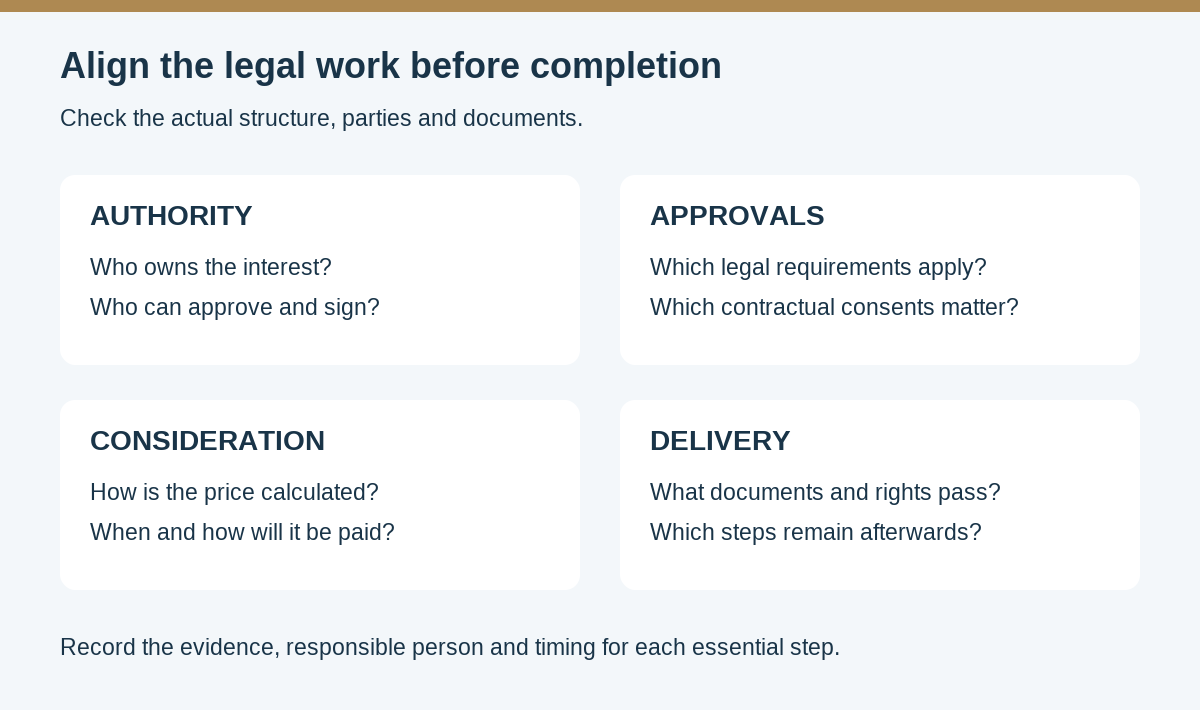
A working capital adjustment can align the price with an agreed level or measure of operating working capital at a specified date. It is a negotiated mechanism, not a universal legal requirement for every acquisition. The parties need definitions that match the business and the valuation approach.
Specify included and excluded items, accounting policies, the reference date, preparation of the relevant accounts and the process for objections. Consider seasonal patterns and unusual transactions. A business with substantial inventory movements may need a different analysis from a service company whose main current assets are receivables.
Check the interaction with cash, debt and other price adjustments. The same obligation should not unintentionally be counted in working capital and again as a separate debt deduction. A worked numerical example can reveal ambiguity before signing; the agreement should also explain how an unresolved accounting dispute will be determined.
Cash consideration requires a clear amount or calculation, payment dates, currency, account details and any conditions to release. The parties should confirm the funding route and applicable banking or foreign exchange requirements. Cash is not automatically the safest or most flexible arrangement for every buyer and seller.
Share consideration raises additional questions about the issuer, valuation, share class, rights, dilution and restrictions on transfer. The recipient needs to understand what it will own and whether it can readily realise that value. Any required corporate or regulatory steps for the issue or transfer must be included in the timetable.
Deferred payments and earn-outs can bridge a valuation difference but create further drafting needs. Define the measurement period, accounting treatment, operational discretion, access to information and dispute procedure. A seller may be concerned that the buyer controls the business producing the earn-out; a buyer may need flexibility to integrate it. The contract should address that tension expressly.
One of the practical legal aspects of mergers and acquisitions is identifying who answers for which obligation. Do not assume that every shareholder becomes responsible for every claim merely because it participates in the sale. Read the applicable law and the agreed obligation, including whether a seller gives only an individual assurance or a broader undertaking.
The Civil Code distinguishes separate obligations from joint obligations. Under a separate obligation, each obligor performs its own defined part. For a joint obligation, the creditor may require one joint obligor to perform the whole obligation, with contribution between obligors addressed separately. This is different from saying that each seller's responsibility is always measured by its contribution to the loss.
Transaction drafting should identify the relevant sellers, allocation, limits and any agreed security. For example, several sellers may agree different treatment for title assurances and a specific historical exposure. Consider whether the proposed recourse is commercially meaningful: a substantial promise from an entity with no recoverable assets may offer limited practical protection.
Statements about the business, promises to take action and specific financial protections serve different purposes. Their scope and consequences should be written clearly under the applicable law. A familiar clause heading does not supply a complete remedy without operative wording addressing the relevant facts.
Check the disclosure process, relevant dates, notification requirements, limits and claims procedure. Known issues may need a specific response rather than a general statement qualified by disclosure. A contractual allocation of cost does not itself remove a regulator's power or an outside creditor's rights.
Where corrective action must occur before completion, state the responsible party, the required result and evidence of satisfaction. If the outcome depends on a third party, distinguish an obligation to pursue it from a condition requiring it to occur. These distinctions help the commercial team understand what it can enforce and when it may decline to complete.
Signing and completion may occur together or at different times. When there is a gap, the agreement should address conduct of the business, information updates and the handling of material changes. Avoid assuming that the buyer can exercise unrestricted control before it is legally entitled to do so.
Prepare a completion agenda showing documents, payments, approvals, releases and deliveries, with a responsible person for each step. Afterwards, identify required registrations or notifications, access to records, management changes and remaining contractual actions. Employment, data access and integration measures should be checked against the relevant obligations rather than treated as automatic consequences of paying the price.
Read more: Legal due diligence in M&A transaction
Read more: The proposed direction of the problem handling of the lawyers after the LDD
A useful starting brief includes the intended structure, ownership records, principal agreements, price proposal and timetable. Jurion & Partners can assist with identifying the legal questions that need resolution and aligning the transaction documents with the commercial objectives and evidence available.
The legal due diligence guide explains how the investigation informs this work. Careful attention to the legal aspects of mergers and acquisitions connects structure, authority, approvals, pricing and implementation, helping the parties understand what they are committing to and what must happen for the deal to deliver its intended value.






Subscribe today to get more breaking news from Jurion Partners - Solicitors & Litigators

108 Tran Dinh Xu St., Cau Ong Lanh Ward, Ho Chi Minh City, Vietnam
(+8428) 66.701.709 - (+84) 903.419.479
contact@jurionpartners.com
Follow us
Accept payment





 English
 Tiếng Việt