Practical preparation for a child custody request: define the arrangement, explain the facts, organize evidence and keep the child’s needs central.
Parents asking how to get custody of children in case of divorce need to turn their preferred outcome into a clear, workable request. The starting point is the child’s life, not a promise that one document or one accusation will secure a favourable decision. This guide explains how to prepare a parenting proposal, organize supporting material and respond constructively when the other parent disagrees.
First identify the decision you need. Are you asking to provide direct care as part of a pending divorce, seeking recognition of an agreed arrangement, or considering a later change to an existing effective decision? These situations require different preparation. Bring any earlier orders or agreements to the review instead of starting with a new account that omits them.
Write the proposed outcome in ordinary language: where the child would live, who would provide everyday care and what support or contact arrangements are sought. If there is more than one child, identify each child and explain whether the proposed arrangement is the same. A request to “protect all my rights” does not tell the court which parenting decision you want it to make.
Separate the child-related request from property grievances and the reasons the marriage broke down. Some events may be relevant to both, especially violence or neglect, but not every marital disagreement establishes a parenting risk. Explain the link between the facts relied upon and the child’s care.
Article 81 of the Law on Marriage and Family and Article 6 of Resolution 01/2024/NQ-HĐTP guide the assessment of children’s interests. Care capacity, protection, stability, attachment, parental involvement, sibling relationships and the child’s wishes are relevant subjects. Higher earnings alone do not determine the result.
For children below thirty-six months, the mother’s general position is subject to the statutory exceptions and the detailed guidance on care conditions. For a child aged seven or above, the child’s wishes must be considered through an appropriate process. Neither rule should be reduced to a slogan that prevents consideration of the actual circumstances.
Use this framework to identify weaknesses in your own plan before criticizing the other parent’s. If your proposed home is far from the school, explain the transport or transition. If you work evenings, explain who will be available. A candid explanation of an achievable arrangement is stronger than an idealized description unsupported by daily reality.
A useful brief can be concise without leaving important questions unanswered. It should allow a reader unfamiliar with the family to understand the present arrangements and the proposed change. Keep descriptions factual, and identify estimates or arrangements that have not yet been confirmed.
| Subject | What to explain | What to verify |
|---|---|---|
| Residence | The proposed home and who shares it | Actual availability and suitability |
| Ordinary care | School days, weekends and backup care | Work schedules and helpers’ commitments |
| Health and education | Existing needs and continuity | Relevant records and practical access |
| Contact | Communication, collection and holidays | Travel time, safety and school commitments |
| Support | Needs, payment proposals and expenses | Reliable figures and financial capacity |
Avoid using the brief as a diary of every argument between the adults. Focus on facts that explain the requested arrangement. Where a serious incident matters, state it precisely and identify the available evidence. Where a point is uncertain, record the question that needs further checking.
Consider a fictional parent who works rotating shifts and asks to become the direct caregiver. Simply attaching a high salary statement leaves a practical gap: who will collect the child during late shifts? A better proposal explains the roster, a reliable helper’s availability, the journey from school and the backup if the helper is unavailable. The purpose is to demonstrate continuity of care, not to pretend the parent will never need assistance.
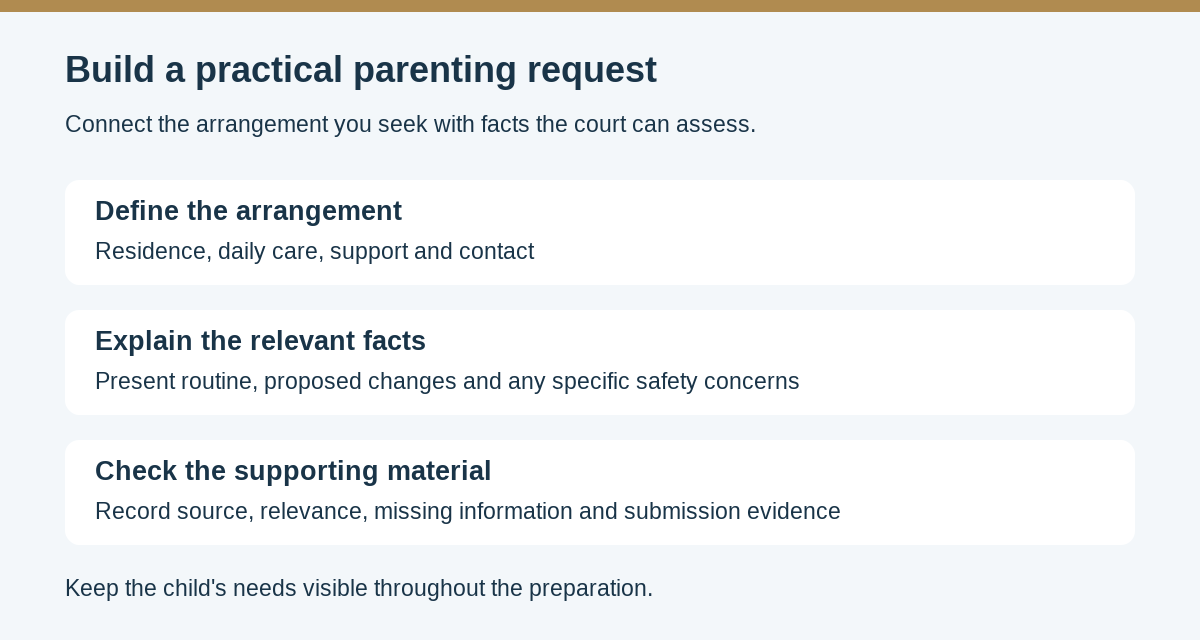
Create an index with three columns: the fact, the material supporting it and anything still missing. For example, a claim about regular medical care might be supported by relevant appointment records; a claim about a proposed home needs evidence of actual access to that home. Different records answer different questions.
Keep financial material proportionate to the issues. Explain earnings, dependable resources and the child’s needs rather than presenting an unexplained pile of statements. If income varies, describe the period covered and the basis of any average. Do not characterize an occasional payment as guaranteed monthly income.
For communications or photographs, retain the original context, date and source where available. An isolated message may be misunderstood without the surrounding exchange. Do not edit evidence to make it appear more favourable or ask a child to collect material from the other parent’s private devices.
Record what the document is, who holds it and the steps taken to obtain it lawfully. The Civil Procedure Code contains procedures concerning evidence submission and collection; the appropriate request depends on the circumstances. A court is not automatically responsible for finding every record a party has not attempted to obtain.
When submitting evidence, keep an inventory and proof of receipt, follow the court’s directions and address applicable requirements for sharing material with other participants. Explain genuinely unavailable records rather than substituting assumptions. Foreign-language documents also require assessment of the applicable translation and recognition formalities.
Read the competing proposal before preparing a response. Identify which facts are accepted, which are disputed and which practical details are missing. If the other parent suggests a school transfer, ask what the actual arrangements are and explain the effect on the child. Disagreement should be connected to a relevant issue rather than expressed as a general attack on character.
Offer a workable alternative where possible. If a collection time conflicts with classes, suggest a time that can be carried out. If long-distance travel is proposed, address frequency, duration and responsibility for arrangements. A response that only says “I disagree with everything” can obscure points that might otherwise be resolved.
Do not assume that conceding an accurate fact means surrendering the whole request. Acknowledging that the other parent has a meaningful relationship with the child can support a more realistic plan. The important question is how the overall arrangement serves the child, including any substantiated need for protection.
The child should not be asked to carry messages, sign an adult’s prepared account or repeatedly choose between parents. For children whose wishes must be obtained, the resolution calls for an age-appropriate and friendly process without parents present or psychological pressure. Explain practical concerns to your adviser or the court instead of rehearsing answers with the child.
Before a meeting, distinguish matters open to discussion from concerns needing a specific legal response. You may be able to agree on school updates while residence remains disputed. Record partial agreements accurately, including any conditions, and avoid presenting them as a full settlement if important issues are unresolved.
If a proposal is unclear, ask for time to understand its operation before signing. Review what happens during holidays, illness, travel and delayed collection. A short agreement that both parents can follow is more useful than extensive wording that leaves the ordinary week unexplained.
Where there is a credible concern about violence, neglect or another immediate risk, identify the conduct and the protection needed. Ordinary negotiation may not resolve an urgent danger. Seek advice about appropriate protective measures and lawful evidence rather than waiting for the final parenting decision.
Keep a careful record of relevant incidents, existing restrictions and communications with competent authorities. Avoid public accusations that expose the child’s private information or make later cooperation harder. Do not assume that a pending custody request itself authorizes unilateral conduct inconsistent with an existing order or applicable law.
Parents hoping to get custody of children in case of divorce should also plan for the period while the proceeding is pending. Identify the current care arrangement, school continuity and any immediate support problem. Temporary practical arrangements should be clearly distinguished from the final outcome sought.
After receiving the court’s judgment or decision, check the actual operative terms and their legal effect. Confirm who provides direct care, what support is required and what contact provisions apply. Ask about any available review route and deadline for that particular document; rules should not be assumed identical for every agreed decision and contested judgment.
Implementation may require practical coordination with the school, medical providers or other caregivers. Share only the information each person lawfully needs. Retain the effective outcome and evidence of payments or agreed handovers. If a term is unclear or compliance becomes difficult, seek the appropriate clarification or enforcement advice rather than rewriting the decision informally.
A later request to change the direct caregiver is assessed under Article 84 and the relevant procedure. Changed circumstances must be explained through current facts; dissatisfaction with the original result alone is not a complete basis. Do not treat a new partner, a larger home or a job change as an automatic transfer of direct care.
>>> Read more: Does resolving a consensual divorce take a long time?
>>> Read more: The fastest divorce procedure in Vietnam
Prepare the existing court papers, the parenting brief and the evidence index before a discussion with Jurion & Partners. Identify the questions you need answered: whether the request is sufficiently clear, which evidence matters, or how to respond to a competing care plan. This supports a specific assessment without promising a predetermined result.
The guide to drafting a lawsuit petition in Vietnam explains how to organize a written request. When preparing to get custody of children in case of divorce, use that structure to present a realistic arrangement supported by relevant facts, while keeping the child’s welfare central to every proposed step.






Subscribe today to get more breaking news from Jurion Partners - Solicitors & Litigators

108 Tran Dinh Xu St., Cau Ong Lanh Ward, Ho Chi Minh City, Vietnam
(+8428) 66.701.709 - (+84) 903.419.479
contact@jurionpartners.com
Follow us
Accept payment





 English
 Tiếng Việt