Separate acquisition consideration from financing, assess liquidity and dilution, and define payment timing, account routes, currency and supporting documents.
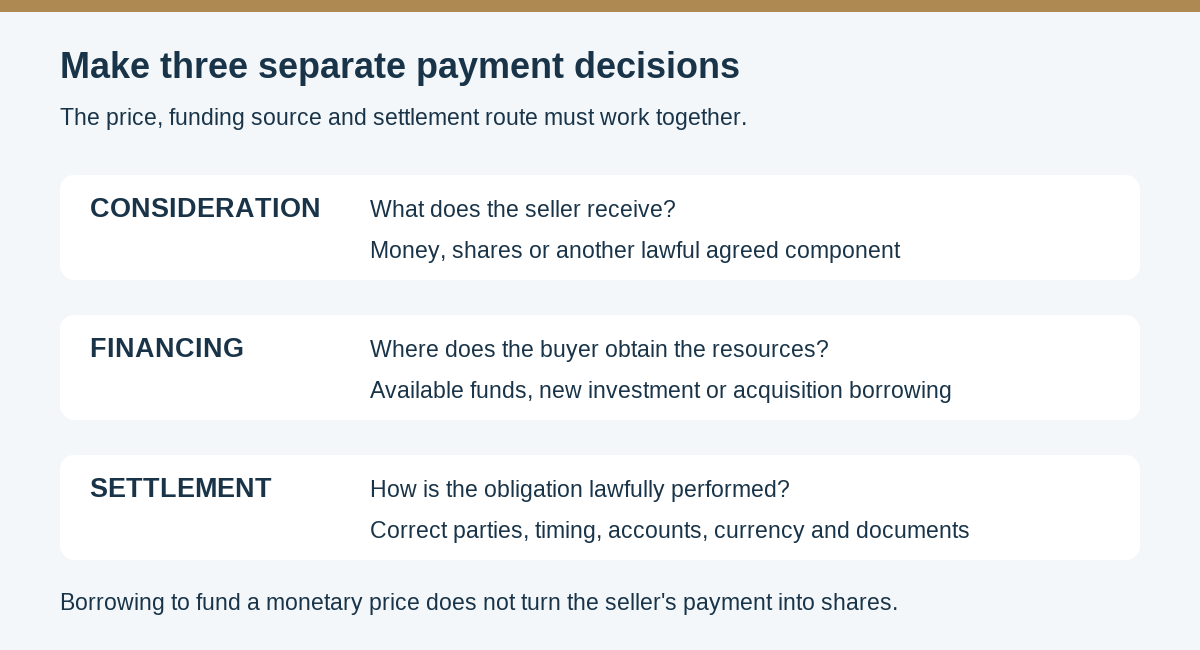
The payment method in M&A affects the buyer's funding needs, the seller's exposure and the ownership arrangements after completion. Choosing between money, shares or another agreed form of consideration requires more than comparing the headline purchase price. The parties should distinguish what the seller receives, how the buyer finances it and which legal and banking steps are required to make the agreed payment work.
Consideration describes what the buyer provides in exchange for the interest or assets acquired. Financing describes where the resources come from. A buyer may borrow money and pay the seller a monetary price; that remains monetary consideration even though debt finances the acquisition. Conversely, issuing shares directly to a seller raises different questions from issuing shares to investors and using the proceeds to pay the seller.
A leveraged buyout, usually abbreviated LBO, is therefore a financing structure rather than a separate currency of payment. Its feasibility depends on the debt terms, lawful security arrangements, approvals and the ability to service the borrowing. Expected cash flow is a financial assumption to test, not a guarantee that lenders can rely on every target asset or that the business can always meet the debt.
Start with a transaction diagram identifying the buyer, seller, target, funding providers and payment recipient. A purchase of existing shares pays the selling shareholder, while a subscription for newly issued interests generally provides capital to the issuer. Confusing those transactions can leave the business without the funding the parties intended.
A monetary price can provide a clear nominal amount, subject to agreed adjustments. In transaction discussions, “cash consideration” normally distinguishes money from shares or other assets; it should not be read as an instruction to settle with physical banknotes. The lawful payment route and documentary requirements still need to be checked.
For the buyer, examine the funds available at completion and the amount needed afterwards for working capital, integration and operating obligations. Using all available money for the purchase can create a liquidity problem even if the acquisition itself appears affordable. Financing advisers should test the forecast and relevant repayment commitments.
For the seller, ask when the payment becomes unconditional and what evidence confirms receipt. A signed sale agreement is not the same as cleared funds. Define the amount or calculation, due date, currency, recipient account, allocation of bank charges and the relationship between payment and delivery of the agreed transfer documents.
Where the seller receives shares, identify the issuer and the class and number of shares or the exchange formula. The seller needs to understand the rights received, existing and potential dilution, restrictions on transfer and the practical ability to realise value. Shares in an unlisted company may not offer the liquidity the seller expects.
An exchange ratio is only meaningful with a clear valuation basis and date. If the value can change between agreement and completion, address the mechanism for that change. Financial advice should examine the economic assumptions while legal review checks the issue or transfer, approvals and rights attached to the consideration.
For existing owners of the issuing company, consider the resulting ownership and governance. New shares may dilute their percentage interests, but the consequences depend on the numbers, share rights and agreed arrangements. Neither loss of control nor improved earnings per share should be presented as an automatic result of every share-funded transaction.
A seller may agree to receive a debt instrument or a combination of money, shares and a deferred obligation where the proposed arrangement is lawful. The parties need to identify the issuer, repayment terms, interest, ranking, security and enforcement position. An instrument is not automatically highly rated, readily tradable or equivalent to immediate money.
Distinguish an instrument delivered to the seller as consideration from bonds issued to third party investors to fund a monetary purchase. These arrangements create different relationships and risks. The applicable corporate, securities and other requirements must be assessed for the actual instrument and parties.
Mixed consideration can help accommodate different preferences, but each component needs clear treatment. State how the total price is allocated, when each part is delivered and what happens if one component cannot be issued or paid as planned. A flexible commercial description should not become an uncertain payment obligation.
Deferral changes when the seller is paid and exposes it to the buyer's future ability to perform. Review the due date, conditions, permitted deductions, any agreed security and the procedure for disputed amounts. A retention or escrow arrangement should specify who holds the funds, the release events and the handling of competing instructions.
An earn-out makes part of the price depend on an agreed outcome, often the business's performance over a stated period. Define the measure, accounting policies, information rights and dispute process. Consider how the buyer's management decisions, integration costs and related party transactions affect the calculation.
The seller may want protection against changes that reduce the earn-out, while the buyer needs workable operating discretion. Address that balance expressly. An expectation that the parties will agree a fair result later is much less useful than a calculation they can apply consistently.
For a transaction involving foreign investment, establish the parties' legal status, residence, target classification and transaction type before deciding the account route. These are legal classifications, not assumptions based only on nationality or the language of the contract. Consult the authorised bank early about the documents needed for the intended transfer.
Circular 38/2026/TT-NHNN took effect on 18 August 2026 and replaced Circular 06/2019/TT-NHNN. Its scope and exceptions matter: it does not govern every securities-market arrangement. The account and currency analysis should use the current rules applicable to the transaction rather than a general statement that all foreign-related payments follow one route.
For example, for a transfer of shares or capital interests in an enterprise within Article 6(1), Article 10 distinguishes transactions between non-residents and residents from those within the same residence category. The former must use the relevant investment capital account, while the latter do not use that account under Article 10(1)(a). This distinction does not eliminate other applicable compliance requirements.
Article 13 also distinguishes the permitted valuation and payment currencies according to the parties and transaction. For an ordinary covered capital transfer between a resident and a non-resident, the provision requires Vietnamese dong. Do not assume that agreeing a foreign-currency price in the contract is sufficient to make that settlement lawful.
The tax consequences depend on the structure, the parties and the applicable current legislation. A share-based arrangement does not automatically qualify for tax deferral, and acquisition borrowing does not mean that every interest expense is deductible. These questions require a transaction-specific assessment.
Ask the tax team to compare the net results of the proposed alternatives, including the timing of liabilities, any relevant conditions and the responsibility for filings or withholding. The agreement should explain the intended allocation and cooperation obligations, while recognising that a private allocation does not itself change the tax authority's statutory rights.
Tax should be considered alongside commercial and legal feasibility. An arrangement described as tax-efficient may still be unsuitable if the necessary shares cannot lawfully be issued, the seller cannot use the instrument received or the funding cannot be delivered within the timetable.
Choosing a payment method in M&A involves both sides' priorities. A seller seeking a clean exit may place a different value on immediate money from a seller who wants continued participation in the combined business. The buyer may value preserving liquidity, managing leverage or keeping the ownership structure stable.
Use comparable assumptions when assessing the options. Examine the amount and timing of consideration, funding costs, repayment capacity, dilution, rights received, tax treatment and implementation requirements. Avoid prescribing money for every financial restructuring or shares for every strategic acquisition; the purpose of the deal does not determine one universally correct method.
Funding certainty should be tested before the payment obligation becomes binding. If a lender's commitment depends on conditions, compare them with the acquisition conditions and completion date. A mismatch can leave the buyer obliged to pay while its expected financing remains unavailable.
Prepare a schedule identifying each payer and recipient, the consideration component, amount or formula, due event, account route and required evidence. Check how price adjustments, exchange calculations, deferred amounts and completion deliveries interact. Assign responsibility for confirming the final instructions and resolving discrepancies before funds are sent.
A coherent schedule also helps identify what happens if completion is delayed or fails. The parties should understand the treatment of advance amounts, release conditions and any agreed repayment obligation. Those provisions must be assessed under the law applicable to the arrangement rather than inferred from an informal description of the payment.
Read more: Intellectual property due diligence in M&A
Read more: Why is Legal Due Diligence important in M&A transaction?
Bring together the proposed consideration, funding commitments, financial model and intended settlement steps. Jurion & Partners can assist with reviewing the legal questions and aligning the payment provisions with the transaction structure and documents available.
The guide to drafting and reviewing contracts explains how to turn agreed terms into workable obligations. A suitable payment method in M&A connects the value exchanged, the resources needed and lawful implementation, allowing the parties to evaluate the proposal as a complete arrangement rather than a headline price alone.






Subscribe today to get more breaking news from Jurion Partners - Solicitors & Litigators

108 Tran Dinh Xu St., Cau Ong Lanh Ward, Ho Chi Minh City, Vietnam
(+8428) 66.701.709 - (+84) 903.419.479
contact@jurionpartners.com
Follow us
Accept payment





 English
 Tiếng Việt