In todays modern business world, competition is becoming increasingly fierce, and many enterprises cannot rely solely on organic growth to maintain their position.
The advantages and disadvantages of mergers and acquisitions become clearer when a business asks what kind of growth it actually needs. Buying a company can add customers, production capacity or specialist capabilities, but a larger group is not necessarily a more productive one. The acquisition price, continuing operating costs and work needed to combine the businesses must be assessed against the value the buyer could create through other routes.
For a business considering a transaction in Vietnam, the useful question is not simply whether M&A offers faster expansion. It is whether the particular acquisition provides a workable answer to a defined commercial constraint. This guide explains how to evaluate that answer, identify the legal assumptions behind it and decide whether the proposed growth justifies the commitment.
A company seeking access to a new customer segment has a different problem from a manufacturer whose existing orders exceed its production capacity. The first may value distribution relationships; the second may need reliable facilities and equipment. Both might consider acquisitions, but the evidence required to support their decisions will differ.
Write the growth objective in operational terms before searching for a target. Examples include supplying an additional product category to existing customers, reducing a persistent production bottleneck or obtaining a capability that would take too long to develop internally. Avoid an objective stated only as becoming bigger or more competitive: it is too broad to test.
Internal expansion may preserve control over systems and culture, although recruitment, development and customer acquisition take time. A commercial partnership may provide access to a channel or technology without an ownership transaction, but its duration and dependency risks need consideration. An acquisition can bring control over an operating platform, accompanied by the cost and obligations of the chosen structure.
Compare these options using the same assumptions about timing, management attention and funding. If the acquisition appears attractive only because the internal-growth estimate includes every implementation cost while the acquisition estimate includes only the purchase price, the comparison needs correction before a decision is made.
A target may bring technical staff, a service network or established production processes that complement the buyer's strengths. The benefit is strongest where the buyer can explain how those capabilities will be used and what is needed to retain them. A list of qualifications or machines is insufficient without an understanding of how the business delivers its products.
For example, buying a maintenance company might help an equipment supplier offer continuing support to its customers. The buyer should examine service quality, technician availability and the rights to use diagnostic tools. The opportunity lies in reliable service delivery, rather than merely adding the target's historic revenue to a consolidated forecast.
Combining compatible operations may make better use of facilities, procurement or administrative resources. However, expected savings should be attached to specific actions, dates and accountable managers. Separate recurring savings from temporary reductions, and include the cost of changing systems, contracts or premises.
A shared warehouse might reduce duplicate rent eventually, while requiring a period of parallel operation and new transport arrangements. Count the transition costs and examine whether customers can still receive the promised service. A saving that causes lost orders or persistent delivery problems may undermine the growth objective.
A target can introduce the buyer to customers it could not readily reach alone. Cross-selling is nevertheless a proposition to test, not revenue already earned. Buyers should investigate customer overlap, purchasing needs, contractual restrictions and the sales resources required to explain the expanded offering.
Diversification also needs a clear rationale. Acquiring an unrelated business can spread exposure across activities while making management and reporting more difficult. The buyer should identify which knowledge, systems or relationships it can contribute, and what expertise it would need to recruit or retain.
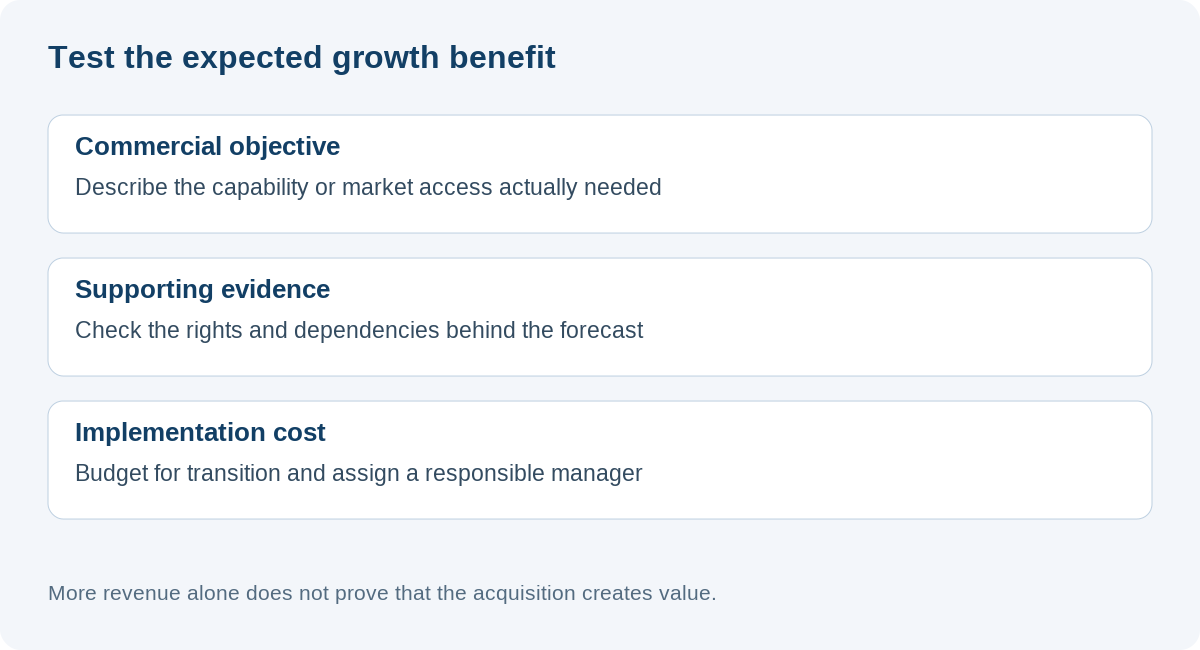
When comparing the advantages and disadvantages of mergers and acquisitions, distinguish the cost of obtaining ownership from the cost of making ownership useful. The purchase price is visible early. Integration expenses, management distraction and additional working capital can emerge later unless they are investigated during the transaction.
A seller may seek a price reflecting improvements that only the buyer can deliver. The buyer should distinguish the target's current performance from those future improvements, then consider who bears the execution risk. A promising opportunity can still be an unattractive investment at a price that leaves no margin for delay or disappointment.
Prepare more than one forecast. A base case can reflect the planned changes, while a downside case considers slower customer conversion, higher retention costs or delayed system migration. Identify which assumptions most affect the result and request evidence before treating them as reliable.
Senior managers who lead negotiations and integration may have less time for existing customers, product development and operational problems. This cost is easily missed because it may not appear as a separate invoice. A realistic staffing plan should explain who will run each business while the transaction team is occupied.
The buyer also needs escalation routes for decisions that cannot wait for a full integration meeting. Delayed approvals for pricing, procurement or customer complaints can damage both businesses even where the overall strategy is sound.
A target's success may depend heavily on a founder or a small group of employees. Before assigning value to their continued contribution, discuss roles, incentives, reporting relationships and knowledge transfer. A retention payment alone may not resolve uncertainty about responsibility or professional autonomy.
Customer relationships require similar care. Announcing new ownership without explaining changes to service contacts, invoicing or product availability can create confusion. A practical communication plan should identify who needs information, when it can be shared and who is authorised to respond.
Transaction labels can obscure the legal consequences relevant to growth. Under Article 201 of Vietnam's Enterprise Law, a statutory merger transfers the merged company's rights and obligations to the receiving company and ends the merged company's existence following the prescribed registration. It is not simply another name for buying shares.
In a share purchase, the target company generally remains the operating entity. An asset transaction requires the parties to define the assets and arrangements being transferred. These differences affect how the buyer plans continuity, permissions, records and the treatment of obligations. The commercial preference should be tested against the implementation requirements of the actual structure.
Do not assume that a restructuring removes historical problems. Identify the entity responsible for each material obligation and whether a counterparty's agreement is needed. Where the target relies on a founder-owned property or a related-party service, document the intended continuing arrangement rather than relying on the relationship to survive automatically.
The proposed structure and business activities should be reviewed for applicable competition, investment and sector requirements. The Enterprise Law expressly requires compliance with competition rules for statutory mergers. This does not mean that every transaction follows an identical notification procedure or that a commercial agreement alone is sufficient to implement the intended combination.
Expected market expansion should be assessed within the applicable legal constraints. Describing the objective as eliminating competitors overlooks whether the proposed transaction can lawfully proceed and how the combined business may operate. Include the relevant review in the timetable before treating the growth plan as executable.
The advantages and disadvantages of mergers and acquisitions should be evaluated using evidence from the target, rather than the transaction presentation alone. Legal, financial and operational reviewers need a shared understanding of the assumptions behind the price so that each team can examine the records that matter most.
The guide to legal due diligence in M&A provides a broader review framework. For a growth-led acquisition, prioritise the rights, dependencies and unresolved issues that could prevent the buyer from implementing its stated plan.
A finding should lead to a decision: obtain further evidence, change the forecast, negotiate protection, require a pre-completion action or reconsider the acquisition. Recording a risk without changing the relevant assumption leaves the investment decision largely untested.
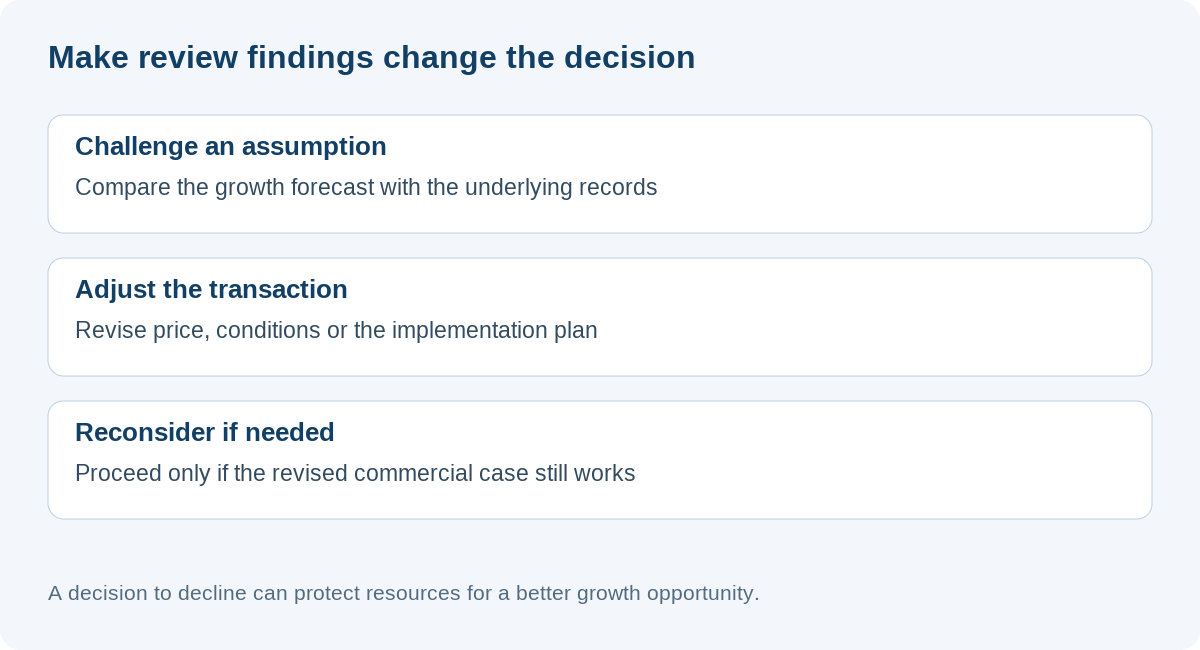
Suppose a manufacturer wants wider regional coverage and considers buying a distributor. The initial proposal assumes that the target's sales team can immediately offer the manufacturer's products to every existing customer. Due diligence instead reveals that a major distribution agreement restricts competing products and that several relationships are managed personally by the founder.
The buyer now has several questions to resolve. Can the restricted product lines coexist? Would the relevant supplier agree to revised terms? How will the founder introduce replacement account managers? What proportion of forecast sales depends on those answers? These questions connect the legal review directly to the growth model.
The appropriate response might involve revising the sales forecast, agreeing a transition arrangement or making a necessary consent a completion condition. If the commercial case no longer works on realistic assumptions, declining the transaction can be a disciplined growth decision. Completing the purchase is not itself evidence that the strategy has succeeded.
A plan built around the advantages and disadvantages of mergers and acquisitions should remain useful after ownership changes. Establish a baseline before completion and choose a small number of measures tied to the original objective. These might include retained customers, service response times, usable production capacity or the cost of delivering a defined product.
Track implementation costs separately from recurring performance. Assign responsibility for investigating variances and deciding whether to adjust the integration plan. Preserve the target's effective practices where they support the commercial goal; replacing every process merely to standardise the group can destroy capabilities that justified the acquisition.
Jurion & Partners can help examine the legal assumptions behind a proposed acquisition and connect identified issues to transaction documents. Prepare a concise brief setting out the growth objective, intended structure and principal assumptions behind the valuation so that the review can focus on decisions that matter.
>>>Read more: The proposed direction of the problem handling of the lawyers after the LDD
>>>Read more: Legal due diligence in M&A transaction
The advantages and disadvantages of mergers and acquisitions must ultimately be judged against the growth a particular buyer can deliver at an acceptable cost. Define the objective, test the rights and capabilities supporting it, and budget for the work after completion. An acquisition merits commitment when its expected benefits remain credible after that examination, with a clear plan for measuring whether they are achieved.






Subscribe today to get more breaking news from Jurion Partners - Solicitors & Litigators

108 Tran Dinh Xu St., Cau Ong Lanh Ward, Ho Chi Minh City, Vietnam
(+8428) 66.701.709 - (+84) 903.419.479
contact@jurionpartners.com
Follow us
Accept payment





 English
 Tiếng Việt