Distinguish a company repurchase from an ordinary transfer, and review the qualifying vote, written request, deadlines, valuation and remaining company obligations.
The repurchase of contributed capital concerns a company buying back an ownership interest from a member, rather than an outside investor purchasing that interest. Vietnam's Law on Enterprises provides different rules for a limited liability company with two or more members and a joint-stock company. The company type, qualifying decision, written request, price and ability to meet its remaining obligations all matter before money can lawfully be paid.
This guide addresses member capital repurchases and share repurchases under the Law on Enterprises 2020, as amended, including the consolidated text in Document 67/VBHN-VPQH of 2025. It should not be applied using the repealed Enterprise Law 2014 as the operative checklist. Public companies and other regulated entities may also be subject to relevant securities or sector rules.
First identify who buys the interest. If another member or an outside investor pays the owner, the transaction is a transfer to that buyer. If the company itself buys back the interest, the repurchase provisions apply. A return of capital, a dividend and a repurchase should not be treated as interchangeable ways to withdraw money from the company.
Article 51 provides a right to request repurchase where a member voted against a Members' Council resolution or decision concerning specified matters. These include amendments to charter provisions relating to the rights and obligations of members or the Members' Council, reorganisation of the company, and other cases provided in the charter.
The right is therefore connected to a qualifying decision and the member's opposing vote. Dissatisfaction with business performance or a wish to exit does not, by itself, establish every condition under Article 51. Examine the resolution, meeting and voting records, the applicable charter and the interest held by the requesting member.
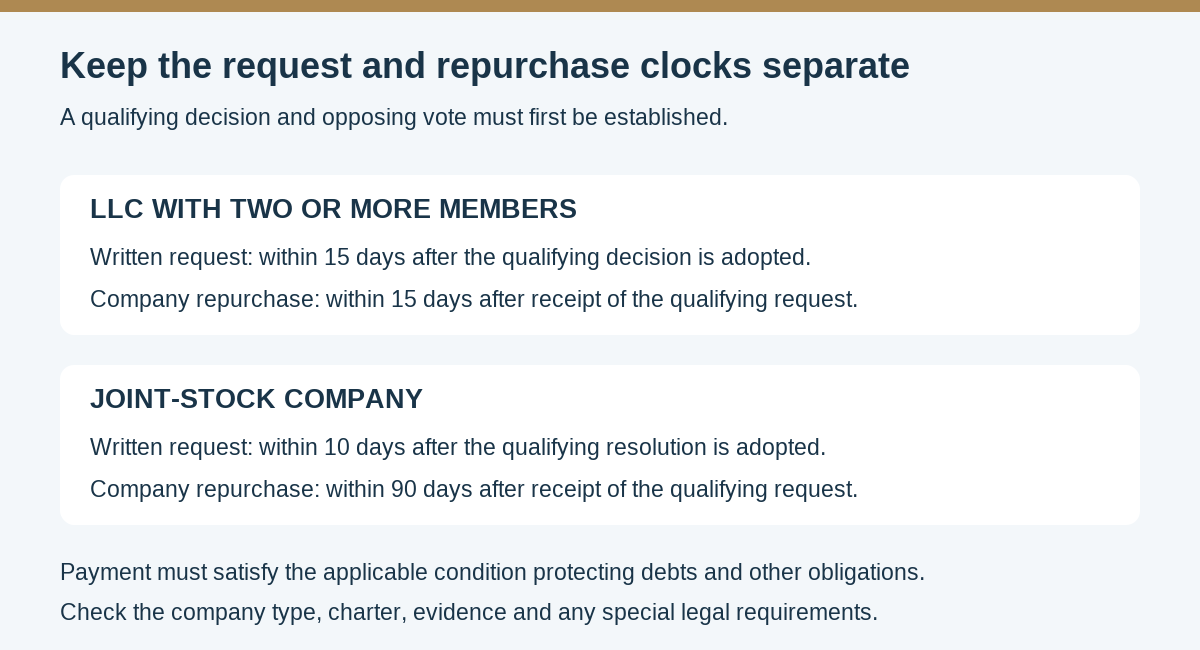
The member's request must be in writing and sent to the company within fifteen days after the relevant resolution or decision is adopted. Separately, Article 51 addresses the company's repurchase within fifteen days after receipt of the qualifying request. These periods begin with different events and should be recorded separately.
Keep evidence of the resolution date, the written request and its delivery. The request should identify the member, the interest concerned and the decision giving rise to it, with supporting material sufficient to explain the position. A later discussion about price should not obscure whether the request was sent within the statutory period.
The statutory pricing basis is market price or the price determined under the principles in the charter, unless the parties agree on the price. The process is not simply optional because the company says it does not accept a qualifying request. Equally, the existence of a repurchase right does not remove the legal condition governing payment.
Payment may be made only if, after paying the repurchased interest in full, the company can still pay its debts and other property obligations. Review the financial position and obligations with the relevant advisers. A bank balance sufficient to pay the member is not necessarily evidence that the company can satisfy all remaining liabilities.
Article 51(4) provides that, where the company cannot pay for the interest requested to be repurchased under the provision, the member may freely transfer it to another member or a non-member. This stated trigger should not be replaced by a broad assertion that any refusal automatically creates an unrestricted transfer route.
Article 52 otherwise contains the ordinary member-transfer procedure, subject to its exceptions, including Article 51(4). Establish which route applies and document the reason. Any resulting transfer still requires attention to the relevant ownership records and other applicable legal requirements.
A joint-stock company has shareholders and shares, so its procedure should be distinguished from the LLC member-capital procedure. Under Article 132, a shareholder who voted against a resolution concerning reorganisation or a change to shareholders' rights and obligations under the charter may request the company to repurchase its shares.
The written request must be sent within ten days after the General Meeting of Shareholders adopts the relevant resolution. It must state the shareholder's name and address, the number of shares of each class, the proposed selling price and the reason for the request. This is not a right arising from an opposing vote on every type of shareholder resolution.
The company must repurchase the qualifying shares at market price or the price calculated under the charter's principles within ninety days after receiving the request. Where the parties cannot agree on price, they may request valuation by an appraisal organisation. The company introduces at least three appraisal organisations for the shareholder to choose from, and that selection is final under Article 132.
The payment condition in Article 134 also applies: immediately after full payment, the company must remain able to pay its debts and other property obligations. A discussion of the ninety-day period without this condition gives an incomplete picture of implementation.
Article 133 addresses repurchases decided by the company. It permits repurchase of no more than thirty per cent of the total ordinary shares sold, and some or all of the dividend preference shares sold, under the specified procedure. These statutory provisions must be read with any applicable securities requirements for the particular company.
Within a twelve-month period, the Board of Directors may decide to repurchase no more than ten per cent of the total shares of each class already sold. Other cases are decided by the General Meeting of Shareholders. The calculation concerns shares sold, not every share authorised or offered for sale, and the applicable class and period matter.
The Board determines the repurchase price. For ordinary shares, Article 133 generally limits the price to market price at the time of repurchase, except for the proportionate repurchase procedure in paragraph 3. For other share classes, the statutory market-price floor applies unless the charter or an agreement with the relevant shareholder provides otherwise.
The company may offer to repurchase from shareholders in proportion to their holdings under the paragraph 3 procedure. Notice must reach all shareholders within thirty days after the decision is adopted and contain the required information about shares, price or pricing principles, payment and selling procedures. A shareholder accepting the offer must send written acceptance so that it reaches the company within thirty days after notification.
Use the correct approval and offer process rather than treating every company-initiated repurchase as a private purchase from any selected shareholder. The legal team should check the class, aggregate amount, prior repurchases and procedure before the proposed resolution is finalised.
For share repurchases under Articles 132 and 133, Article 134 treats the repurchased shares as unsold shares. The company must register a corresponding reduction in charter capital by the total par value within ten days after completing payment, unless securities law provides otherwise. The repurchase price and the par-value reduction are different figures.
Share certificates confirming ownership of the repurchased shares must be destroyed promptly after full payment in accordance with Article 134. The provision also addresses creditor notification where, after payment, total asset value recorded in the company's accounting books has decreased by more than ten per cent. In that case, all creditors must be notified within fifteen days after full payment.
LLC repurchases require their own follow-up assessment of capital, membership records and applicable registration requirements. Do not copy the joint-stock share-cancellation procedure into every LLC file. The records should accurately reflect the legal event and the company type.
A review of the repurchase of contributed capital should bring together the current charter, ownership records, relevant resolution, voting evidence, written request or offer, delivery evidence and pricing material. Include the financial information needed to assess the payment condition and the corporate approvals supporting implementation.
Separate disagreement about eligibility from disagreement about price or ability to pay. For example, a member might have evidence of a timely opposing vote and request, while the company disputes the valuation. That calls for examination of the statutory and charter pricing basis, rather than assuming that a pricing disagreement erases the request or permits payment despite outstanding obligations.
Where foreign investors or cross-border transfers are involved, check the applicable investment, account, currency and tax requirements for the actual transaction. A statutory repurchase right does not, by itself, answer how the payment must be transferred or which administrative updates may be required.
Read more: Choosing the payment method in M&A
Read more: Intellectual property due diligence in M&A
Identify the company type, the decision or offer relied on and the dates supported by the records. Jurion & Partners can assist with reviewing the procedure, pricing questions and implementation documents so that the parties distinguish a statutory repurchase from an ordinary transfer or another capital transaction.
The legal due diligence guide explains how to investigate the ownership and corporate records supporting that analysis. A properly assessed repurchase of contributed capital connects the member's or shareholder's rights with timely requests, lawful payment and accurate follow-up records, helping the parties plan an exit without overlooking the company's remaining obligations.






Subscribe today to get more breaking news from Jurion Partners - Solicitors & Litigators

108 Tran Dinh Xu St., Cau Ong Lanh Ward, Ho Chi Minh City, Vietnam
(+8428) 66.701.709 - (+84) 903.419.479
contact@jurionpartners.com
Follow us
Accept payment





 English
 Tiếng Việt