A seven-part review for an acquisition, connecting business value with reliable documents, lawful employee planning, competition screening and current tax responsibilities.
A business acquisition checklist should connect the opportunity being offered with the evidence needed to assess it. Buying an established business may provide access to people, customers, assets and a recognised brand, but those advantages need to survive the transaction. These seven areas help an investor examine the proposal in Vietnam, identify the specialists required and decide which questions must be answered before committing funds.
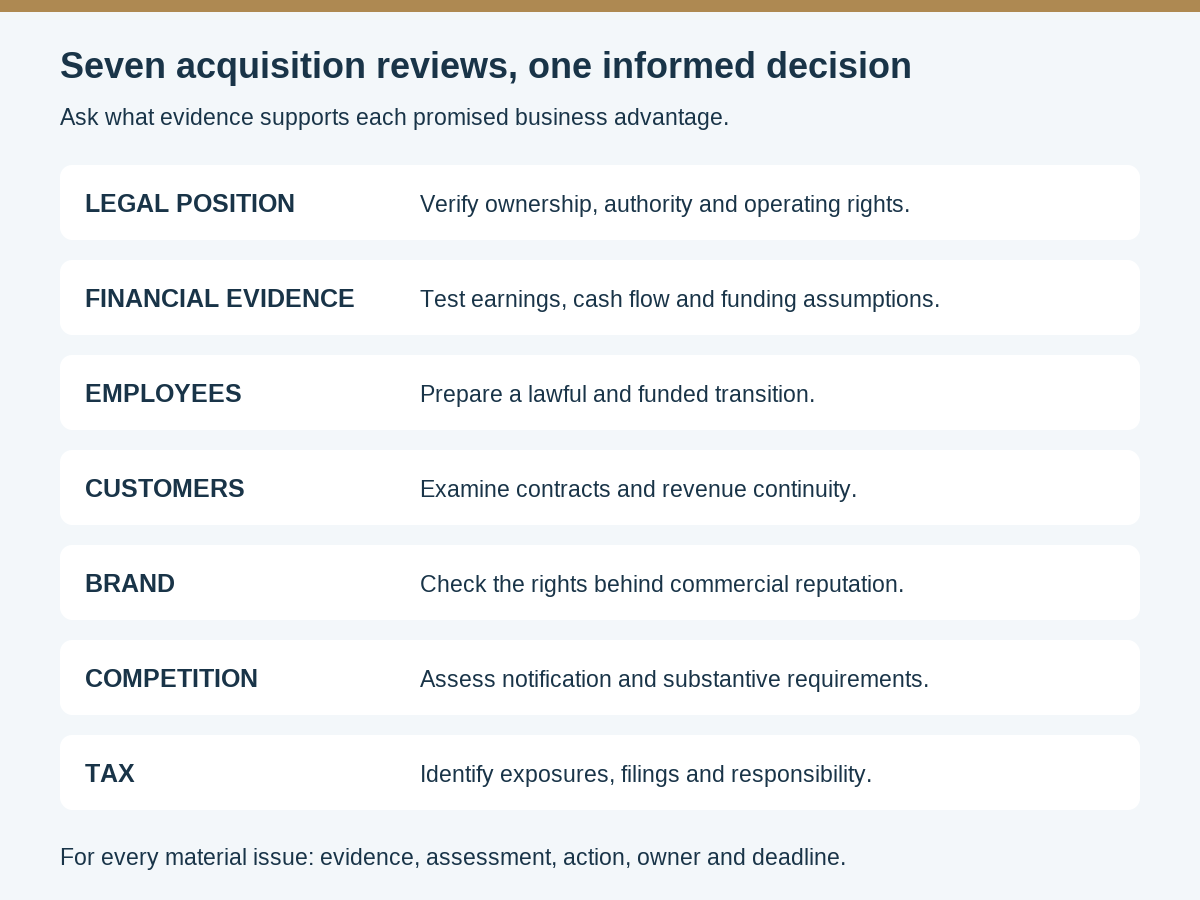
The seven areas below cover legal structure, financial evidence, employees, customers, the brand, competition requirements and tax. They are connected: a customer relationship can affect valuation, an employment issue can affect continuity, and an approval requirement can change the timetable. Assign a person to each area and make sure the findings are shared across the team.
Begin with a short transaction outline identifying the buyer, seller, target entities, proposed interest or assets and intended ownership. A purchase of shares, a selected asset transfer and a corporate merger do not produce identical legal consequences. Keep the review tied to the structure actually proposed, and reassess the relevant questions if that structure changes.
Verify what the seller owns and what it is entitled to transfer. Review the target's establishment records, ownership history, capital contributions, governance documents and relevant decisions. Identify restrictions, security arrangements and existing agreements that could affect the transaction. A manager's assurance that “everything belongs to the company” needs supporting documents where ownership matters.
Compare the target's actual activities with its registrations, permissions and continuing legal requirements. A certificate should be checked for its holder, scope, conditions and location. If the business relies on a licence or contract held by a founder or affiliate, determine how the intended buyer will obtain the necessary rights.
Map any applicable investment, securities, sector and other regulatory steps alongside private consents. These requirements depend on the parties, ownership, activities and structure. Do not assume that a company registration document alone authorises every activity, or that a contractual promise from the seller replaces an approval required by law.
Request financial statements, relevant management accounts and the records needed to understand revenue, costs, debt and cash flow. Agree a review period suitable for the business and transaction; three to five years may be useful in some assignments, but it is not a universal period sufficient for every acquisition. New businesses and businesses with major recent changes need a different perspective.
Financial specialists should assess how the reported results were produced. Distinguish recurring trading income from unusual receipts, sales from collections, and accounting profit from available cash. Examine material receivables, inventory and related party transactions. A growing sales figure can conceal a collection problem or dependence on a transaction unlikely to recur.
Reconcile the financial model with legal findings. If the model assumes continued access to a site, customer or technology, confirm that the relevant right supports that assumption. Ask how identified liabilities, corrective expenditure and working capital needs will affect the price and funding requirement. The purchase price is not necessarily the full cost of acquiring and operating the business.
Understand who employs the workforce, which roles are essential and what obligations exist under employment contracts, collective arrangements and applicable law. Review relevant pay, social insurance, benefits, training arrangements and disputes. A retention plan for key personnel should be considered separately from any proposal to change the wider workforce.
Article 43 of the Labour Code addresses specified reorganisations and transfers, including mergers, consolidations and certain business or asset transfers, where the employment of many employees is affected. In that situation, the employer must develop a labour utilisation plan under Article 44. The current and succeeding employers are responsible for implementing the adopted plan.
The plan addresses employees continuing in employment, retraining or moving to part-time work, retirement and proposed contract terminations, as well as rights, responsibilities, implementation measures and funding. Where a grassroots employee representative organisation exists, the employer must consult it when developing the plan. Employees must be informed publicly within 15 days after adoption.
An acquisition does not itself give the buyer an unrestricted right to dismiss employees. Identify the actual employer, the proposed change and the lawful basis and procedure for any termination. Redundancy-related payments, where applicable, are distinct from unemployment insurance benefits; calculate the relevant entitlement under the rules governing that payment rather than assigning one generic cost to every employee.
The employee section of a business acquisition checklist should therefore produce a funded transition proposal, not simply a headcount reduction target. Address communications, continuity of payroll and records, responsibility for outstanding obligations and the practical retention of people on whom the business depends.
A customer list shows names, but does not establish that the associated revenue will continue. Examine customer concentration, contract duration, renewal, termination rights and any change of control or assignment restrictions. Understand whether the relationship belongs contractually to the target or relies mainly on a founder's personal involvement.
Compare the contracts with actual trading patterns. A customer may have a long framework agreement but no minimum purchasing commitment. Another may account for substantial reported revenue while paying slowly or disputing invoices. These differences affect the quality of the business and the assumptions used in valuation.
Plan any customer enquiries carefully with the seller and advisers so that confidentiality and commercial relationships are respected. Consider who will communicate after completion and what transition support is genuinely available. Avoid treating customers as assets whose loyalty can be guaranteed merely by transferring shares or paying a price.
Separate reputation and commercial goodwill from the legal rights used to protect the brand. Identify relevant trademarks, registered owners, protected goods or services, territories and status. Examine licences, assignments, disputes and any relationship between the brand owner and the target company. The entity using a mark may not be its owner.
The wider review may include domain names, designs, copyright material and social media accounts where they matter to the business. Determine who controls these accounts and whether contractual arrangements permit the intended use or transfer. A business can have a recognisable trading name while lacking important supporting rights.
Brand value should be assessed against evidence of commercial performance and the rights available to the buyer. Fame does not mechanically produce a proportionate acquisition price. Financial and marketing specialists can examine the value assumptions while legal advisers identify restrictions, remaining protection and the steps needed to preserve lawful use.
The Competition Law 2018 addresses economic concentrations including relevant mergers, consolidations, acquisitions and joint ventures. Whether the proposed arrangement falls within the framework must be assessed from its substance. Article 30 prohibits concentrations that cause or are capable of causing significant restrictive effects on competition in Vietnam.
Article 33 provides for notification based on applicable thresholds, using criteria concerning assets, revenue, transaction value or combined market share. The implementing rules and the circumstances of the participating businesses must be checked. A simple statement that a transaction is permitted whenever combined market share is no more than 50% is not an adequate statement of the current framework.
Where notification is required, it must be addressed before implementation and the applicable review requirements must be observed. Separate the notification assessment from the substantive competition assessment: meeting a filing threshold does not itself mean that the transaction is prohibited, and falling outside a particular filing test is not a general exemption from competition law.
Collect the relevant group, financial and market information early enough to support the assessment. Build the necessary process into the timetable and transaction conditions. The competition section of the business acquisition checklist should identify a reasoned conclusion, its factual assumptions and any information still required.
Review tax filings, payments, relevant correspondence, audits or checks, disputes and identified historical exposures with the tax team. Compare the tax records with the accounts and underlying transactions. An assertion that all taxes have been paid needs to be tested against the scope and period of the review.
Consider separately the target's historical position and the taxes or administrative steps arising from the acquisition itself. The consequences depend on the structure, parties and applicable current legislation. Vietnam's Tax Administration Law 108/2025/QH15 took effect generally on 1 July 2026, so an assessment should not rely uncritically on an older transaction summary or outdated procedure.
Identify who must file, pay, provide information and retain access to records. If the agreement allocates a particular tax cost to the seller, clarify the claim mechanism and cooperation obligations. A private allocation does not itself change the authority's statutory rights or establish that the buyer or target has no legal responsibility. Obtain a transaction-specific conclusion rather than applying one succession rule to every form of M&A.
Read more: Key legal aspects of Mergers and Acquisitions
Read more: Legal due diligence in M&A transaction
For each material finding, record the evidence, commercial effect, proposed response, responsible person and deadline. Distinguish matters needing clarification from confirmed defects, and identify what must be resolved before signing or completion. Jurion & Partners can assist with organising the legal questions and reviewing how the proposed documents address them.
The broader legal due diligence guide explains how to plan the investigation supporting these reviews. A carefully applied business acquisition checklist brings the seven areas together, helping the investor test whether the promised business advantages are supported by reliable information and a workable, lawful transition.






Subscribe today to get more breaking news from Jurion Partners - Solicitors & Litigators

108 Tran Dinh Xu St., Cau Ong Lanh Ward, Ho Chi Minh City, Vietnam
(+8428) 66.701.709 - (+84) 903.419.479
contact@jurionpartners.com
Follow us
Accept payment





 English
 Tiếng Việt