Businesses in Vietnam often consider mergers or acquisitions as strategies for growth, market expansion, or restructuring.
Mergers and acquisitions can achieve similar commercial goals through very different legal routes. A business may acquire shares in another company, purchase selected assets or combine entities through a statutory reorganisation. The choice affects what survives, who bears existing obligations and which permissions or third-party arrangements need attention. In Vietnam, evaluating the legal pros and cons begins by describing the proposed structure precisely, rather than assuming that every transaction called M&A has the same consequences.
A statutory merger should not be confused with a consolidation into a newly formed entity. In a merger into an existing company, the receiving company remains and the merged company ceases to exist under the applicable process. Articles 200 and 201 of Vietnam's Enterprise Law distinguish these outcomes: consolidation creates a new company, while merger into another company preserves the receiving company. The companies involved must follow the applicable corporate process; the transaction should not be described as ordinary dissolution followed by re-registration. A share acquisition, meanwhile, changes ownership interests without necessarily ending the target company's existence. These distinctions matter when identifying the future holder of rights and the party responsible for obligations.
An asset purchase concerns the agreed assets and connected arrangements. It requires attention to what can be transferred and how the buyer will operate them. A new owner of equipment may still need access to premises, software, employees, customer relationships or permits. The structure should therefore be assessed against the whole operating model. A simple diagram of the entities before and after the deal often reveals a misunderstanding that an attractive headline description conceals.
Consider whether the objective is ownership of an operating company, access to a particular product line, removal of duplicate entities or control over future decisions. A minority investment intended to secure information rights has different needs from a full acquisition followed by integration. Identify what the buyer must be able to do on the first operating day after completion and what can be implemented later. Those requirements provide a practical basis for comparing structures.
The seller's position also matters. It may wish to retain another business line, protect a continuing brand or leave the group entirely. These objectives can affect the perimeter and transition arrangements. A structure that looks convenient for the purchaser may require difficult separation work for the seller. Understanding both sides' needs makes the comparison more realistic than describing one route as universally faster or safer.
In a share acquisition, continuity of the target's legal identity may help preserve an established operating platform. The company remains the contracting party to its existing agreements, subject to their terms and applicable law. This can be useful where value depends on relationships and systems that would be difficult to recreate individually. It does not mean that every contract or permission is unaffected by a change in ownership or control.
For mergers and acquisitions involving a functioning business, continuity can reduce some separation work. The buyer may gain an existing organisational structure rather than assemble assets and services from scratch. However, assess the quality of that structure. An operating platform with unreliable records, undocumented related-party support or unresolved disputes may require considerable remediation even though the company itself remains in existence.
The target's past does not disappear because its shares change hands. Historical contractual commitments, employment matters, tax exposure and disputes require investigation. A seller's promise to compensate the buyer can allocate some economic risk between the parties, but it should not be confused with extinguishing the underlying obligation to another person. The buyer needs to understand both the target's position and the practical value of the contractual remedy.
Governance is another issue. Acquiring an interest does not necessarily provide every decision-making power the buyer expects. Review the ownership level, company documents, existing agreements and applicable rules. Minority holders and reserved decisions may remain relevant. If the investment depends on directing a particular strategy, establish how the required decisions can lawfully be made instead of assuming that a share certificate provides unrestricted control.
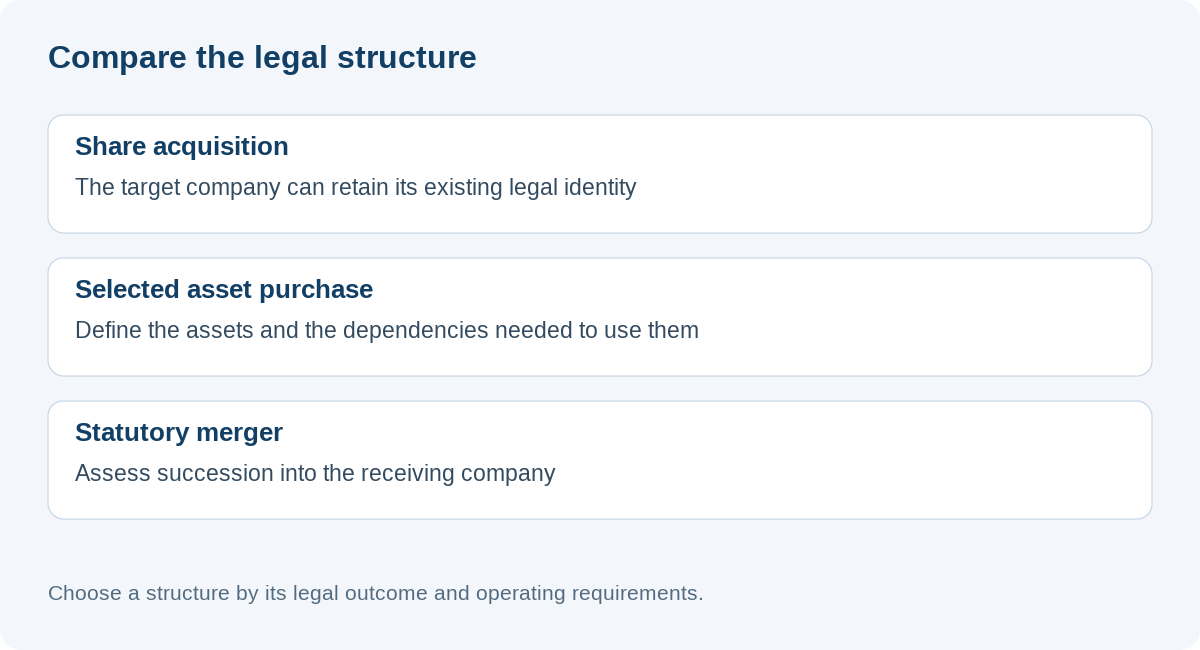
An asset transaction allows the parties to define the assets and business elements included in the sale. This can suit a buyer interested in a specific operation while the seller retains other activities. The advantage is a more deliberate perimeter. To make that perimeter workable, identify the associated rights, services and obligations needed for continued use. Selecting the visible equipment without its essential dependencies can leave the buyer with assets that cannot support the intended business.
Transferability requires its own review. A customer contract may need consent, intellectual property may be held outside the seller entity, and an operating permission may not simply follow the assets. The applicable legal and contractual requirements determine the next steps. An asset deal should not be advertised as a universal way to avoid every historical liability or regulatory question. Those consequences require assessment of the actual transaction and relevant law.
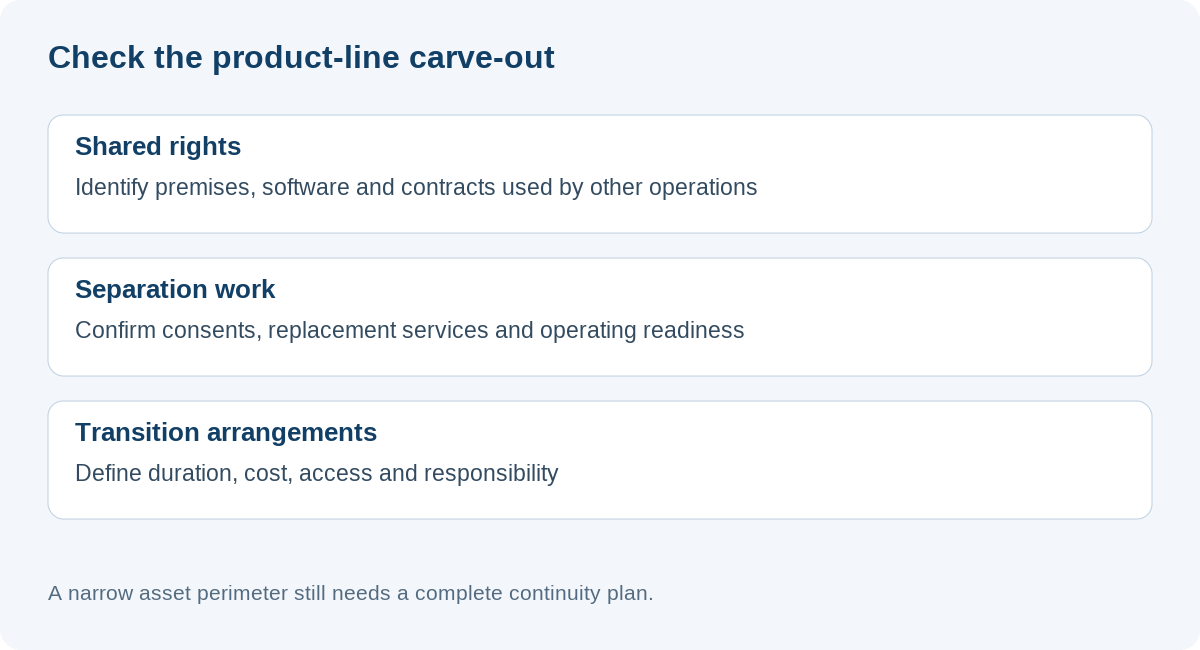
The seller may provide accounting, IT, purchasing or premises services through a wider group. After a carve-out, the buyer needs replacements or a clearly documented transition. Agree which services continue, for how long, at what cost and with what access to records. These arrangements can materially affect the economic comparison. A lower acquisition price may not be advantageous if essential support must be rebuilt urgently at substantial expense.
Employees should be considered within the proposed structure rather than treated as another item on an asset list. Identify who employs the people performing the work, what will change and which obligations arise. Legal and HR teams should coordinate the analysis with the operating plan. Do not assume that the same employment process applies to a share acquisition, an asset transfer and a statutory combination.
Mergers and acquisitions may be followed by a statutory merger intended to reduce duplicate entities or consolidate operations. The legal combination has consequences for rights and obligations that need to be understood before implementation. It is different from a commercial integration plan that merely aligns brands, reporting lines or procurement. The parties should distinguish the acquisition itself from any later reorganisation and assess each stage.
A simplified group structure may reduce some administrative duplication. Yet the transition requires reliable records and responsibility for transferred obligations, operating changes and communications. Customers, creditors, employees and authorities may need attention through the applicable procedures. Avoid describing the process as routine dissolution of every original entity. The survival and succession consequences depend on the particular form of reorganisation.
The legal classification and effects of a transaction must be examined separately from the commercial label. A share or asset acquisition may raise competition issues, just as a statutory merger may. The relevant analysis concerns the actual transaction and applicable notification or substantive rules. It is misleading to say that a merger necessarily faces more scrutiny, or that an acquisition avoids it simply because the target retains its identity.
Foreign investment and sector requirements also need transaction-specific attention. Investor status, activities, ownership changes and other facts can affect the route. One regulatory result does not settle all other permissions. Obtain a coordinated assessment early enough to influence the structure and timetable. Do not compare completion speed by counting only the registration step while excluding the time needed to prepare the information and resolve prerequisites.
| Structure | Potential legal benefit | Question to resolve |
|---|---|---|
| Share acquisition | The target can retain its legal identity and existing contractual position. | Which ownership changes require consent, and what historical obligations remain within the target? |
| Selected asset purchase | The parties can define a narrower acquisition perimeter. | Can essential rights, services and permissions support an independently operating business? |
| Statutory merger | Operations may be combined within the receiving company through the prescribed succession process. | How will transferred obligations, stakeholder procedures and operational integration be implemented? |
Use the comparison as a starting point for investigation, not a ranking of structures. The same customer relationship or technical capability may be easier to preserve through one route but require greater attention to historical exposure. Record that trade-off and the evidence behind it so that the commercial team can compare realistic options.
Suppose a buyer wants a manufacturer's specialist product line, while the seller wants to retain its other operations. Buying shares in the existing company would also expose the buyer to those retained activities unless the perimeter is reorganised. Buying the product-line assets may fit the commercial objective more closely, but the buyer discovers that the factory lease, software and key customer contract are shared across the seller's operations.
The comparison is no longer simply shares versus assets. The team must evaluate separation feasibility, third-party cooperation, transition services and the time needed to establish independent operations. A proposed asset purchase might still be appropriate, but only with a workable continuity plan. Alternatively, a different structure may be considered after assessing its own requirements. Neither route should be selected solely because a generic checklist calls it more flexible.
This is where mergers and acquisitions analysis becomes useful to decision-makers. Explain which business objective each structure meets, which dependencies remain and how those dependencies affect cost and timing. Present unresolved questions as questions, rather than burying them in a statement that the structure is legally possible. Commercial approval should follow an informed comparison of the implementable options.
The review should also explain its boundaries. Financial projections, technical capability and tax consequences may require separate specialist work. Legal analysis can reveal constraints or obligations affecting those assumptions, but it does not replace valuation or operational verification. Coordinate the findings so that the same unresolved issue is not treated as somebody else's responsibility by every adviser.
The wider legal due diligence process provides a way to test the records supporting the proposed acquisition. A focused review can investigate whether the preferred structure actually delivers the rights and continuity on which the investment depends. If a material finding changes the picture, return to the structure comparison before finalising the transaction documents.
For mergers and acquisitions under consideration, a practical instruction to Jurion & Partners can include the intended business outcome, a diagram of the proposed entities and the assets or activities the seller wishes to retain. Ask for the important legal differences between the realistic options and the evidence needed to choose between them. This supports a concrete discussion rather than a generic list of advantages.
Mergers and acquisitions offer legal routes to business change, but their advantages depend on how well the chosen structure fits the investment. Before approving a route, confirm what survives, what transfers, what obligations remain and how the business will operate afterwards. A documented comparison of those consequences makes the decision more useful than treating any structure as an automatic shortcut to growth or freedom from risk.






Subscribe today to get more breaking news from Jurion Partners - Solicitors & Litigators

108 Tran Dinh Xu St., Cau Ong Lanh Ward, Ho Chi Minh City, Vietnam
(+8428) 66.701.709 - (+84) 903.419.479
contact@jurionpartners.com
Follow us
Accept payment





 English
 Tiếng Việt