When businesses consolidate or one business acquires another, this process is referred to as mergers and acquisitions. In this article, Jurion & Partners (Tel: (+84) 903.419.479) will discuss how a merger and acquisition can be beneficial.
Pros and cons of mergers and acquisitions should be assessed against the purpose of the proposed deal, the evidence supporting its value and the work required after completion. Acquiring an existing business can provide customers, capability and an operating platform. It can also expose the buyer to obligations, integration costs and assumptions that do not survive closer examination. The transaction label alone does not establish whether the investment is attractive.
A useful assessment asks how the deal compares with realistic alternatives, which benefits depend on further action and what could prevent the plan from working. This article explains the main commercial advantages and risks, with practical questions for evaluating a transaction involving Vietnam. It distinguishes a business objective from a result that the parties can actually demonstrate.
An acquisition can take different forms. Buying shares may change the ownership of a company while that company continues as the same legal entity. An asset purchase instead concerns the agreed assets and associated arrangements. A merger or consolidation involves its own legal reorganisation. Do not describe all these structures as one company disappearing into another under a new name.
Nor does the buyer always have to be a larger business. The relevant questions are what is being acquired, how ownership or control changes and which entities continue. The answers affect the documents, approvals, obligations and implementation steps that need to be investigated. A commercial presentation may use “M&A” broadly, but the transaction plan must be more precise.
Whether the parties support a proposal is a separate question from its legal form. An agreed acquisition remains an acquisition; it does not become a merger merely because the participants regard it as mutually beneficial. Clarify whose agreement or approval is required and which decisions have actually been made before drawing conclusions from the way the deal is presented.
Buying an operating business may provide an existing team, customer relationships, systems and facilities. This can be valuable where building those elements independently would require substantial effort. The benefit should be tested against the actual condition of the platform, including whether key resources will remain available and whether the buyer can use them as intended.
For example, a business may have an attractive customer list but depend heavily on a few relationships held by its founder. A facility may be operating while important arrangements require further review. Ask what has been acquired in a durable form and what depends on future cooperation. Existing revenue is evidence to analyse, not a guarantee of continuing revenue.
One reason to examine the pros and cons of mergers and acquisitions is the possibility of entering a market through an established participant. The target may have distribution knowledge, local relationships or a product offering that complements the buyer. These advantages can make a transaction worth investigating, but they do not remove the need to examine investment conditions, licences and other requirements.
Consider whether the benefit comes from an asset, a contract, a regulated activity or the experience of particular people. Each may require a different continuity plan. A commercial relationship that cannot be maintained on the proposed terms has a different value from one supported by a stable agreement and a credible operational handover.
Capability can also be acquired through technology, processes or specialist teams. Check what rights and knowledge the business actually holds, what is licensed from others and what depends on individuals staying. A buyer should not assume that paying for a company gives it unrestricted use of every tool or piece of information used by the target.
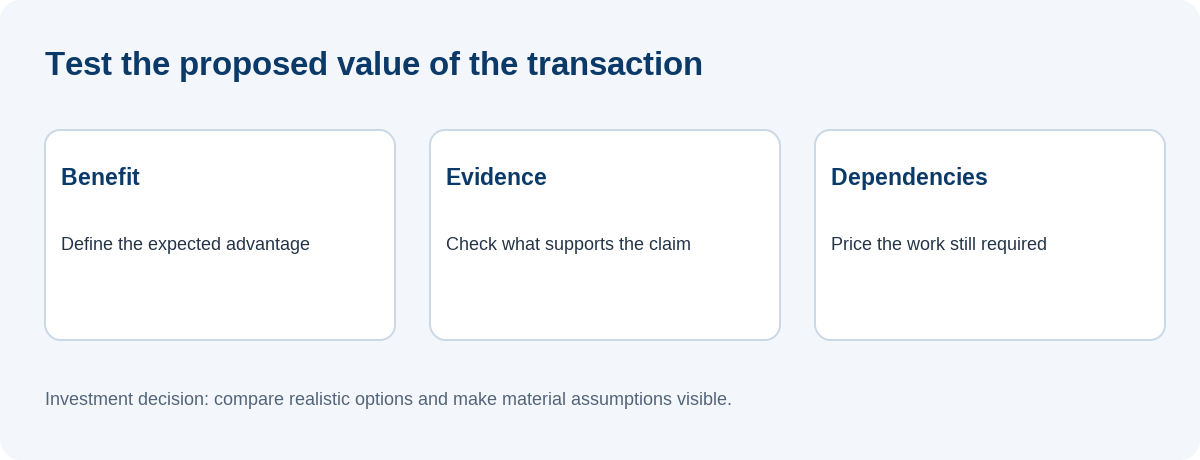
Complementary businesses may be able to coordinate distribution, improve purchasing or remove genuinely duplicated activities. These are possible sources of value, often described as synergies. The important task is to identify the mechanism: which activity changes, how the benefit is measured and what must be spent before any saving or growth is achieved.
Separate immediate effects from benefits that require systems integration, renegotiation or training. A saving that depends on terminating an agreement, changing employment arrangements or obtaining a third party's cooperation should not be treated as available on the completion date without examining those steps. Assign a responsible owner to each material assumption.
Compare the combined business with a realistic stand-alone scenario. If the financial case relies on benefits that both companies already expect to achieve separately, the acquisition may receive credit for value it does not create. A clear model helps the decision-makers challenge the assumptions instead of accepting a single optimistic total.
Overpayment is a central risk when assessing the pros and cons of mergers and acquisitions. A competitive process, ambitious growth forecast or fear of losing an opportunity can push the price beyond what the evidence supports. Examine how much of the proposed value depends on continued performance, successful integration or conditions outside the parties' control.
Use scenarios to show what happens if a major customer leaves, integration takes longer or expected savings do not arise. These are planning exercises, not predictions that the events will occur. Their purpose is to identify which assumptions drive the decision and whether the proposed price leaves sufficient capacity to deal with uncertainty.
Payment structures can allocate some risk, but they need careful design. A deferred payment or performance-related element may introduce questions about measurement, access to records and control of the business. Do not assume a more complex price mechanism solves a weak investment case or removes the need for reliable underlying information.
The target may have outstanding commitments, disputes or weaknesses in its records. The relevance of those issues depends partly on the transaction structure. A share acquisition and an asset purchase should not be assessed through an identical checklist of assumed consequences. Identify the exposure and the proposed contractual or operational response.
A focused legal due diligence review helps test ownership, authority, material contracts and other transaction assumptions. Its findings should lead to decisions: further investigation, a condition, a negotiated protection or a change in structure. Collecting documents without connecting the findings to the deal leaves the buyer with information but little direction.
Approvals and third-party arrangements can affect whether a proposed benefit is available. In Vietnam, competition notification requirements must be checked under the rules applicable to the deal, including the changes effective from July 2026. A transaction should not be presented as avoiding regulatory obstacles merely because the target already operates in the market.
Even a legally completed acquisition can struggle if the combined operation lacks a workable integration plan. Different systems, management practices and customer commitments may require coordinated decisions. A larger organisation is not automatically easier to manage, and removing one duplicated function can create additional work elsewhere.
People-related assumptions deserve particular attention. Retaining specialist employees requires more than listing them in a presentation. Review employment arrangements, proposed changes, communication and the responsibilities of the relevant employer. Cost reductions should be assessed with the applicable obligations and implementation effort, rather than treated as an immediate consequence of signing.
Protect the continuing business while integration takes place. Assign responsibilities for customer service, financial controls and operational reporting during the transition. If everyone is focused on reorganising the business, the very relationships that justified the acquisition may receive less attention. A phased plan can help identify dependencies without promising that every change must happen at once.
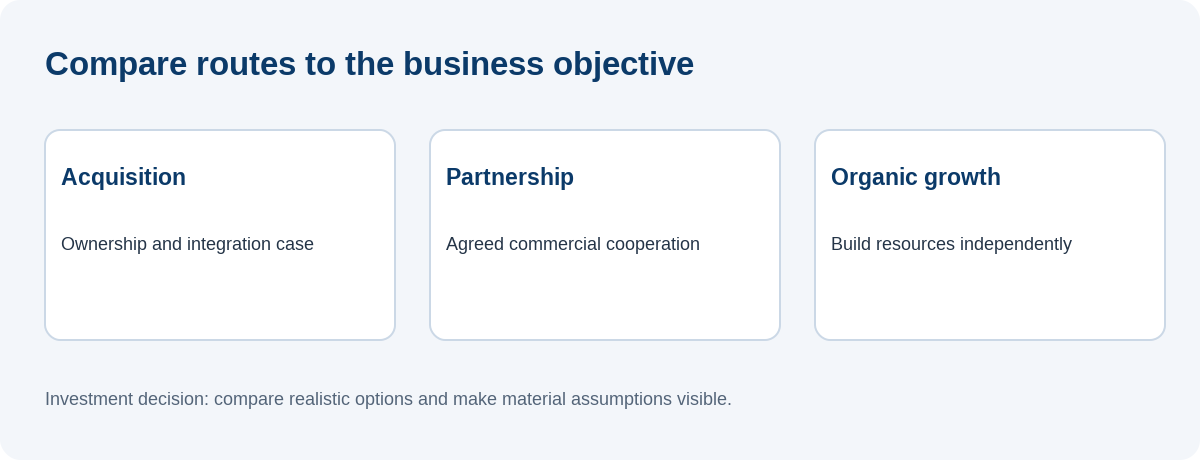
A balanced view of the pros and cons of mergers and acquisitions should include alternatives such as independent growth, a commercial partnership or a narrower asset arrangement where suitable. Compare the resources, control, timing and risks of each. An acquisition may be appropriate, but it should earn that conclusion through evidence rather than the assumption that M&A is always the fastest route.
Use a short decision paper to state the objective, the proposed structure, the benefits that have been verified and the uncertainties that remain. Explain which matters must be resolved before commitment and which can be managed through implementation. Decision-makers should be able to see what would cause them to change the price, structure or decision to proceed.
For a proposed transaction, Jurion & Partners can help connect the commercial assumptions with legal review and the actions required to implement the chosen structure. Begin with a clear explanation of the desired business outcome, the entities involved and the issues the parties have not yet resolved.
Read more: Legal Due Diligence (DD)
Read more: General process of an M&A - Due Diligence (DD) deal
The pros and cons of mergers and acquisitions depend on what the buyer is obtaining, what the evidence supports and what the parties can implement. Test the advantages, price the uncertainties and compare alternatives before making the commitment. A sound transaction case explains both why the deal could create value and what must happen for that value to be realised.






Subscribe today to get more breaking news from Jurion Partners - Solicitors & Litigators

108 Tran Dinh Xu St., Cau Ong Lanh Ward, Ho Chi Minh City, Vietnam
(+8428) 66.701.709 - (+84) 903.419.479
contact@jurionpartners.com
Follow us
Accept payment





 English
 Tiếng Việt