Distinguish a revised divorce proposal from an effective recognition decision and a later request to change child care or support.
Changing a consensual divorce agreement in Vietnam depends on when the change is proposed and what it concerns. Revising a draft before recognition is different from challenging an effective court decision or seeking a later adjustment to child care or maintenance. Identify the procedural stage first, then explain precisely which term is no longer accepted and whether the other spouse agrees to the replacement.
Collect the latest petition, signed agreement, court minutes and any decision already issued. A document described informally as “the divorce agreement” might be an early proposal, a signed private document, a reconciliation record or an agreement incorporated into a judicial decision. Those documents do not have identical effects.
Record the dates on which documents were signed, minutes were drawn up and a decision was issued. Confirm whether the court has actually recognized the divorce instead of relying on an expectation that recognition will happen soon. This establishes whether the immediate task is to notify the court of a changed position or assess a decision that already binds the parties.
Also separate the issues. A spouse may still want a divorce while disagreeing with the proposed transfer of an apartment. Another may accept the property terms but seek a different child-care arrangement. A third may withdraw consent to ending the marriage itself. A clear account of what remains agreed prevents an adviser or the court from misunderstanding the scope of the change.
Article 55 of the Law on Marriage and Family requires genuinely voluntary divorce and arrangements protecting the legitimate interests identified by the law. Under Article 397 of the Civil Procedure Code, recognition also depends on the specified conditions concerning divorce, property and children. An earlier signature should not be presented as permission for the court to ignore a later, properly communicated change of position.
Where both spouses agree to a revised term, prepare a complete and consistent replacement. Explain which previous clause is replaced and what the revised obligations mean in practice. The court still assesses whether the agreement meets the legal requirements; two signatures do not automatically make an unlawful or child-prejudicing arrangement suitable for recognition.
Where only one spouse wants the change, they should notify the court promptly and accurately. Continuing private discussions is not a reliable way of ensuring the court knows that the recorded agreement is disputed. Preserve a copy of the submission and evidence of its receipt through the appropriate channel.
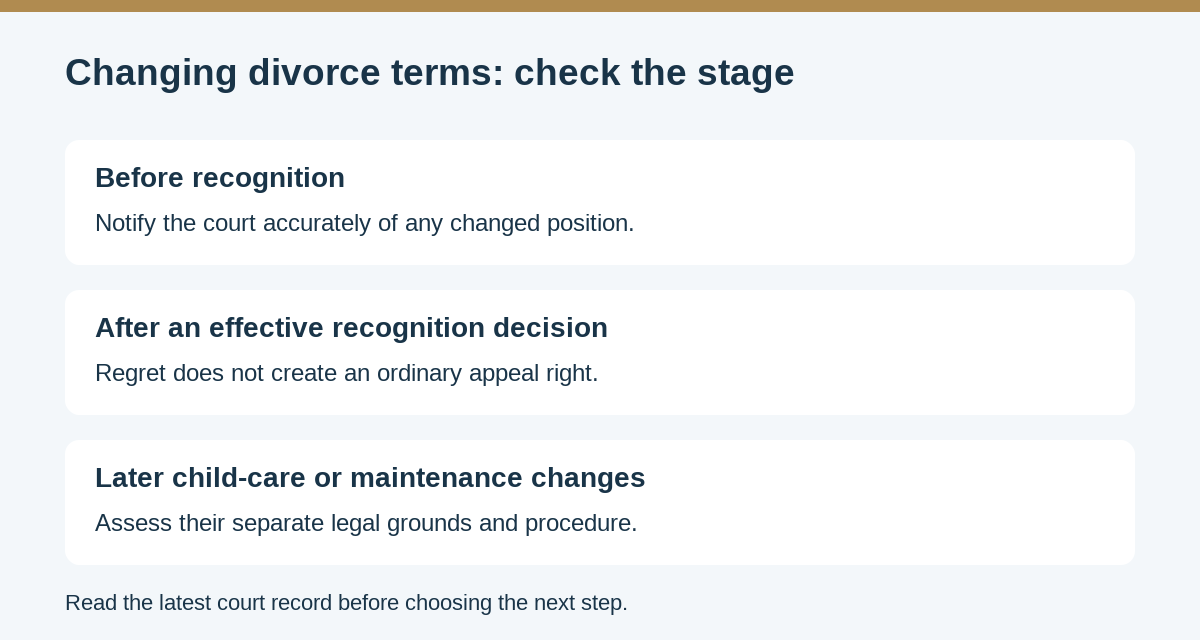
Article 397 refers to Article 212 for recognition in the relevant circumstances. Article 212 provides a seven-day period from the preparation of successful reconciliation minutes during which a party may change their position before the recognition decision is made under that provision. Identify the actual record and its date instead of assuming the period begins with an informal conversation or the initial petition.
That period should not be advertised as a general right to appeal for seven days after an effective recognition decision. The point in the procedure and the type of document matter. If there is uncertainty about the date or whether a decision has already been issued, obtain the court record immediately rather than wait for private negotiations to conclude.
A notification should say what has changed: consent to divorce, a particular property term, the proposed direct carer or another relevant issue. Avoid a vague statement that everything is cancelled if that is not the person's true position. Precise wording gives the court a usable account of the remaining agreement and disagreement.
Article 397(5) addresses unsuccessful reconciliation where the parties cannot agree on property division or the specified child matters: the court discontinues the civil matter for recognition and accepts a case for resolution under the ordinary procedure. The provision states that a new acceptance notice and reassignment of the judge are not required for that transition.
This should not be described as a temporary suspension of the recognition request. Nor does transition mean that one spouse automatically wins the disputed terms. The ordinary case requires the relevant claims, participation and evidence to be considered under the applicable rules.
Reconciliation in which the spouses actually reunite is a separate situation addressed by Article 397(3). Withdrawal of a request, loss of consent to divorce and disagreement over a financial clause should not all be given the same automatic procedural outcome. Explain the facts and ask which route applies, especially where one spouse wishes to continue seeking divorce and the other does not.
Changing a consensual divorce agreement may involve clarifying whether the court is being asked to divide assets at all. Article 397(4) recognizes agreement on dividing or not dividing common property. Resolution 01/2024/NQ-HDTP also explains that the relevant agreement includes not requesting the court to resolve property division.
There is an important difference between saying that no common property exists, saying that property has already been divided and saying that the parties are not requesting division in the present proceedings. Choose wording that matches the facts. A statement made for procedural convenience can create later uncertainty if it suggests a final settlement the parties never intended.
If a revised settlement transfers ownership or requires a balancing payment, identify the asset, payment date, handover obligations and relevant formalities. Consider mortgages, shared ownership and creditor rights. An agreement between spouses cannot simply erase a bank's or another person's rights without an appropriate legal basis.
In a fictional example, both spouses initially use an estimated apartment value, but obtain a substantially different valuation before recognition. If they agree to revise the balancing payment, they should submit clear replacement terms. If they cannot agree, they should disclose the disputed issue rather than ask the court to recognize an arrangement one spouse no longer accepts.
Article 213 provides that a decision recognizing the parties' agreement takes legal effect immediately upon issuance and is not subject to ordinary appellate appeal or protest. It is therefore misleading to promise that a spouse can simply lodge a normal appeal because they now prefer another allocation.
The article identifies particular grounds for supervisory protest, including mistake, deception, threats, coercion or an agreement violating a legal prohibition or social morality. This is a different review mechanism with its own requirements. A disappointed party cannot assume that merely requesting review automatically cancels the decision or suspends compliance.
If a person alleges coercion or deception, identify specific facts and preserve lawful evidence: relevant messages, document versions, dates and the circumstances of signing. Separate a genuine allegation affecting consent from ordinary dissatisfaction with the bargain. The available route requires individual assessment and should not be promised as a guaranteed reopening.
A final divorce decision does not mean that every future child-care or support arrangement must remain unchanged regardless of circumstances. Article 84 of the Law on Marriage and Family provides grounds for changing the direct carer, including a qualifying parental agreement consistent with the child's interests or inadequate conditions of the existing direct carer. The wishes of a child aged seven or older must be considered under the provision.
Maintenance has separate adjustment rules. Article 116 addresses changes where there is a legitimate reason, through agreement or a court request if agreement cannot be reached. Article 117 concerns payment methods and relevant changes. A request to adjust child support is not a general opportunity to reverse the divorce or reopen all property terms.
Describe the actual development and the decision sought. New care schedules, essential expenses or evidence about current ability to provide care should be organized around the relevant issue. Avoid presenting every change in income or every parental disagreement as automatically sufficient to change the court's arrangement.
Suppose the parents' working circumstances change after divorce and their existing care arrangement becomes difficult. They should assess a child-focused replacement and the correct legal steps. A private message proposing a different schedule should not automatically be treated as a judicial amendment, particularly if the other parent disputes what was agreed.
Keep the original signed documents intact. Prepare a separate dated proposal or submission that identifies the existing clause, the proposed replacement and the reason. Editing an old scan without clearly identifying the amendment can create uncertainty over whether the other spouse ever agreed to that version.
The guide to drafting a lawsuit petition in Vietnam helps organize parties, relief and evidence where a court claim is required. Confirm the correct procedure before using a generic form; a pending recognition matter and a later child-care request serve different purposes.
>>> Read more: How to divorce with the person who is missing in Vietnam?
>>> Read more: How to divorce in Vietnam
Jurion & Partners can review the latest court record and identify whether the issue concerns pending consent, the effect of a recognition decision or a separate later adjustment. Before changing a consensual divorce agreement, verify the stage, define the disputed term and gather the evidence supporting the specific outcome requested.






Subscribe today to get more breaking news from Jurion Partners - Solicitors & Litigators

108 Tran Dinh Xu St., Cau Ong Lanh Ward, Ho Chi Minh City, Vietnam
(+8428) 66.701.709 - (+84) 903.419.479
contact@jurionpartners.com
Follow us
Accept payment





 English
 Tiếng Việt