Prepare a child-focused care proposal with relevant evidence, realistic routines and a clear understanding of age, contact and support rules.
Custody of children in divorce disputes should be assessed through the child’s care, safety and development rather than a contest over which parent appears more successful. Vietnamese law allows parents to agree on direct care and their respective responsibilities, but a disagreement requires a careful assessment of the child’s interests. Preparing a credible proposal means explaining everyday arrangements, supporting relevant facts and preserving the child’s relationship with both parents where appropriate.
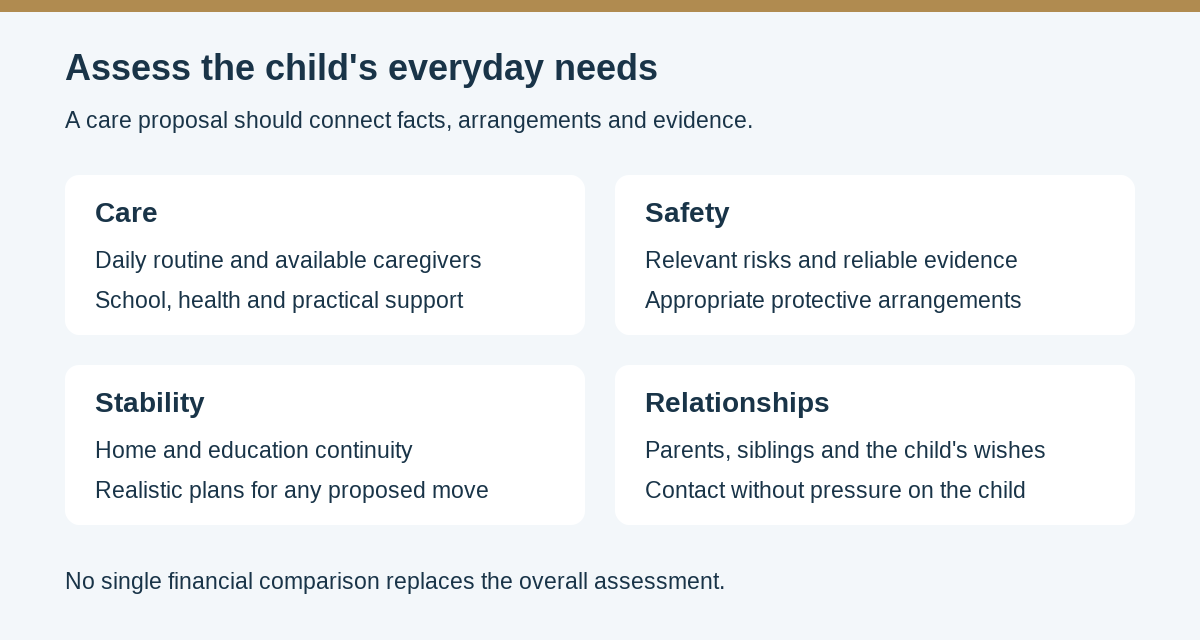
Article 81 of the Law on Marriage and Family provides the central framework, supplemented by Article 6 of Resolution 01/2024/NQ-HĐTP. The assessment is broader than salary, property ownership or an assertion that one parent loves the child more. It considers the ability to provide care and education, protect the child, maintain important relationships and offer stability.
The court also considers attachment, the parents’ involvement, the child’s wishes and the value of maintaining sibling relationships. These factors should be assessed together. They are not a points table in which ownership of a house cancels out a serious safety concern, or a demanding job automatically makes a parent unsuitable.
Begin by describing the child’s present circumstances: age, health, school, home, daily caregivers and significant relationships. Then explain what would change under each proposed arrangement. This gives the discussion a practical foundation and helps distinguish a genuine need from an adult preference.
The general rule places a child below thirty-six months with the mother for direct care, subject to the statutory exceptions concerning her ability to provide care or a different parental agreement consistent with the child’s interests. This is not an unconditional rule, and a parent should not assume that a single allegation establishes an exception.
Resolution 01/2024 provides specific guidance on inadequate care conditions, including serious illness affecting care, the specified combination of very low income and no other assets, or insufficient minimum time for direct care. Its comparative safeguard concerning the father’s conditions also matters. Assess the full circumstances rather than treating unemployment, a diagnosis or the absence of home ownership as automatic disqualification.
The wishes of a child aged seven or older must be considered. This does not mean the child alone decides the case or must defend a choice to either parent. The guidance requires a friendly, age-appropriate process without parental presence or pressure. A child should not be coached to repeat a preferred answer.
For younger children outside the infant rule, the assessment still concerns their overall interests. There is no automatic transfer to the higher-earning parent at a particular birthday. Changes in age may affect needs, schooling and the practical care plan, but they do not replace the broader assessment.
A proposed home should be described in terms of the child’s use of it: sleeping arrangements, access to school, health needs and the adults sharing the household. A large property is not necessarily a better environment if the plan leaves the child without dependable supervision. Renting suitable accommodation should not be treated as inherently inferior to ownership.
Explain a normal school day and a normal non-school day. Identify who prepares meals, accompanies the child, handles medical appointments and provides care when work runs late. Where grandparents or another trusted adult will help, describe the support accurately and establish that it is available. Do not present occasional help as a permanent commitment.
Parents with shifts, business travel or overseas work should address those circumstances directly. A workable backup arrangement is more persuasive than an unrealistic promise never to be away. Likewise, past involvement matters, but a historical division of responsibilities should be explained alongside any genuine changes in present capacity.
Where a child has a disability, chronic illness or additional educational needs, explain the existing support and how it would continue. Relevant information may include appointment schedules, school arrangements and the practical availability of treatment. Share sensitive records only as needed for the proceeding and through lawful means.
If siblings might live apart, address their relationship and how contact would be maintained. Avoid treating children as interchangeable parts of a financial settlement. The proposal should explain the effect on each child and the reasons for any different arrangements.
Organize evidence by the issue it supports. A salary record may show earnings but not who collects the child after school. A tenancy agreement may establish access to accommodation but not the safety of the household. Connect each record with the factual point you ask the court to consider.
A short evidence index can identify the document, the point it supports and any limitation. Distinguish your own observations from assumptions about the other household. Preserve original material and avoid selective extracts that create a misleading impression. An unsupported accusation can distract from a stronger, properly documented account of the child’s needs.
Do not access another person’s private accounts unlawfully or involve the child in gathering material against a parent. Where a relevant record is held by an institution and cannot lawfully be obtained directly, seek advice about the proper procedural method. Fabricated statements or altered screenshots undermine both the proceeding and the family’s future communication.
A concern about violence, neglect, substance misuse or another risk should be described through relevant conduct and its effect on the child. State when an event occurred, who witnessed it and what reliable records exist. A broad label such as “unfit” does not explain the current risk or the protection requested.
Urgent danger may require protective action under the applicable law rather than waiting for the final divorce outcome. Obtain advice about available measures and the evidence needed in the actual circumstances. Do not assume a general parenting agreement is enough to manage a credible safety risk.
Conversely, a past disagreement unrelated to caregiving should not automatically be presented as proof that a parent cannot raise a child. Health conditions, criminal history and personal circumstances require a relevant, factual assessment. Avoid categorical claims that every person in a particular group must lose direct care.
The parent who does not directly raise the child retains rights and responsibilities under Articles 82 and 83, including the relevant obligations concerning support and contact. The direct caregiver must respect lawful contact, while the other parent must respect the child’s living arrangements. These responsibilities should be reflected in a workable plan rather than left to repeated informal disputes.
Discuss ordinary contact, holidays, collection arrangements and communication appropriate to the child’s age. Account for distance, school hours and safety. A plan that says only “visits whenever convenient” may leave the parents with different expectations. Clear arrangements can reduce friction without placing the child in the role of messenger.
Contact must not be abused to obstruct or harm care and education. Where the statutory conditions apply, the direct caregiver may ask the court to restrict visitation rights. A parent should seek the appropriate lawful measure rather than assuming a disagreement permits an indefinite, self-imposed ban.
Support should be considered with reference to the child’s needs and the payer’s actual capacity under the applicable rules. Do not promise that failure to make a payment automatically removes contact rights, or that contact difficulties automatically extinguish support. Obtain advice on the appropriate enforcement or variation route for the particular obligation.
A negotiated arrangement can reduce uncertainty, but its quality depends on the details. Check whether it covers the child’s ordinary week, significant expenses, communication and foreseeable changes. Both parents should understand the proposal and its practical consequences. Agreement obtained through pressure is not a sound basis for a long-term care arrangement.
Consider a fictional example: one parent proposes moving several hours away while offering the other parent weekday evening contact. The written promise may look generous but be impossible to carry out. Revising the schedule around travel time and schooling is more useful than adding increasingly forceful wording to an impractical plan.
When assessing custody of children in divorce disputes, separate areas of genuine agreement from unresolved issues. Do not describe the whole divorce as settled if the child’s residence remains contested. Equally, preserve useful agreements about school information or medical communication even where the main care question still requires determination.
Article 84 provides for changing the person directly raising the child in the specified circumstances, including an appropriate parental agreement or the current caregiver no longer satisfying the care conditions. The wishes of a child aged seven or older must be considered. A change requires the relevant assessment; it does not follow automatically from remarriage, a salary increase or a new disagreement.
If both parents are unsuitable for direct care, the statutory arrangements concerning a guardian need to be considered. Standing to request a change also depends on the applicable provision. Keep the existing effective decision and evidence of the relevant changes rather than relying only on complaints about the original outcome.
A consultation with Jurion & Partners can begin with the child’s present routine, the competing proposals and the evidence supporting each important point. Identify the practical decision you need help making, such as improving a care plan, addressing a safety concern or preparing a request for the court.
The guide to drafting a lawsuit petition in Vietnam helps organize the requested relief and supporting material. Keep the child’s needs visible throughout that preparation. A credible approach to custody of children in divorce disputes explains how care will work, supports material facts and leaves room for the child’s interests to guide the outcome.






Subscribe today to get more breaking news from Jurion Partners - Solicitors & Litigators

108 Tran Dinh Xu St., Cau Ong Lanh Ward, Ho Chi Minh City, Vietnam
(+8428) 66.701.709 - (+84) 903.419.479
contact@jurionpartners.com
Follow us
Accept payment





 English
 Tiếng Việt