Understand the difference between stepparent care duties, adoptive parenthood and separate promises to support a child after divorce.
Stepparent child support after divorce requires a careful distinction between marrying a child's parent and legally becoming that child's adoptive parent. Under Vietnamese family law, living together creates important responsibilities toward a spouse's child, but it does not automatically establish every obligation associated with legal parenthood. Before demanding payments or deciding to stop them, check the child's legal relationships, any adoption registration and the terms of existing decisions or commitments.
A family may use the words father, mother or child affectionately for many years. Those descriptions matter emotionally, but a legal assessment also needs civil-status records. Start with the birth record, the parents' marriage history and any adoption certificate. A child's surname, household arrangements or school records alone should not be treated as conclusive proof that an adoption was registered.
Three situations should be kept separate: a person who is only a stepparent, a stepparent who has also become an adoptive parent, and a person who has made a particular financial commitment. They may look similar in daily life while requiring different legal analysis. The divorce document should describe the actual situation rather than use a convenient family label to settle the question.
Article 79 of the Law on Marriage and Family addresses the relationship between stepparents and stepchildren living together. It provides responsibilities for looking after, nurturing, caring for and educating the spouse's child by reference to the relevant family-law provisions. It would therefore be inaccurate to suggest that a stepparent has no responsibilities simply because the child is not biologically theirs.
However, duties connected with living together are not an automatic basis for treating the former stepparent as the child's legal parent after the marriage ends. The maintenance relationships addressed in Article 107 and the parental obligation in Article 110 need to be considered separately. Marriage to a parent, by itself, does not generally create an independent continuing child-maintenance obligation equivalent to that of a biological or adoptive parent.
Keep the dates clear. A disagreement about care while the household was still together, a claim for payments under an existing instrument and a proposal for future assistance are different questions. Combining them into a single demand for monthly support may obscure which facts and legal basis actually need examination.
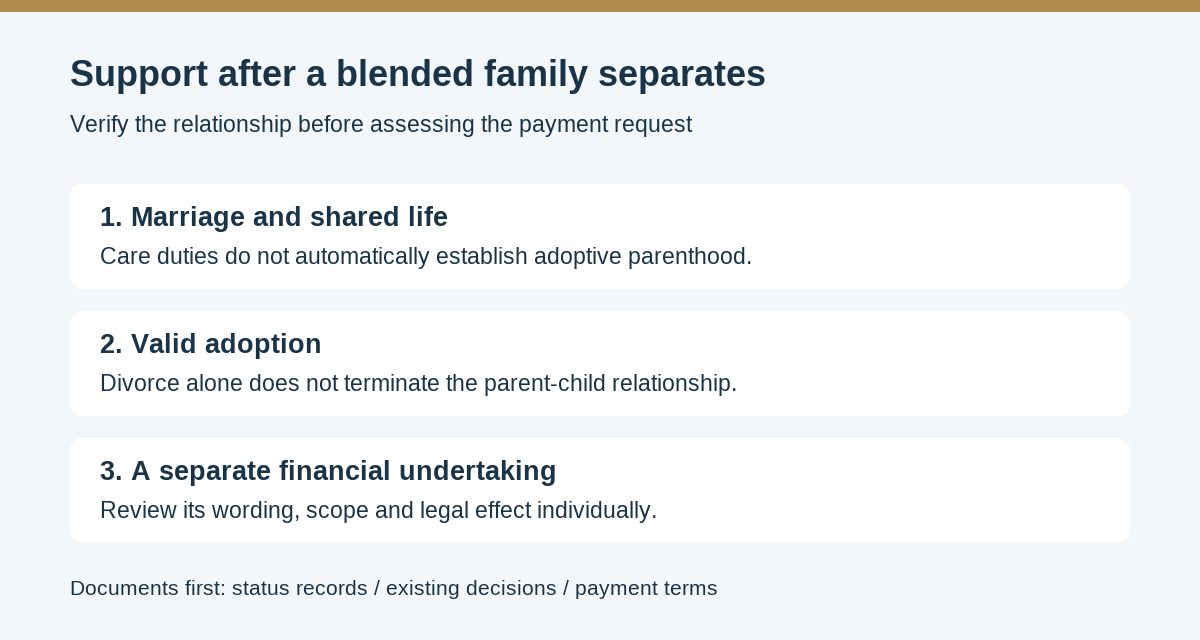
The answer to stepparent child support after divorce can change materially where a valid adoption has taken place. Article 24 of the Law on Adoption establishes parental rights and duties following the legally recognized adoption process. The analysis then concerns an adoptive parent, rather than a person whose only connection is marriage to the child's parent.
A divorce does not, by itself, terminate that adoption. Ending the marital relationship and ending an adoptive parent-child relationship are separate legal events. The adoption legislation contains grounds and procedures for termination and addresses the consequences of an effective court decision. A private statement that someone no longer wishes to act as a parent should not be assumed to remove an established legal status.
For an adoptive parent, assess child maintenance under the applicable parental rules, including the child's circumstances and the current care arrangement. Do not replace that assessment with an unconditional statement that all obligations disappeared on divorce. Conversely, a pending intention to adopt is not the same as a completed, valid adoption.
Obtain the certificate or competent authority's record and identify the people concerned, the relevant dates and any later court decision. If documents were issued abroad, their legal effect in Vietnam may require further examination. A translation or a family photograph cannot answer every recognition question. Flag any uncertainty early so that a divorce agreement is not drafted around an unverified assumption.
Where there has been no adoption, do not assume that a biological parent's responsibilities transferred to the new spouse when the family remarried. Review the child's legally established parentage and any earlier divorce judgment or support order. A new household may have been paying most expenses in practice while an earlier maintenance obligation remained relevant.
Adoption also requires care when assessing birth-parent rights and duties: Article 24 addresses their consequences and recognizes the relevance of qualifying agreements. It is unsafe either to assume that every birth-parent obligation always continues unchanged or to assume that remarriage alone extinguishes it. Read the adoption record, relevant agreements and applicable provisions together.
A practical case file should name each possible responsible person and state the basis being considered. This prevents requests being directed solely toward the adult who previously paid school fees because they were the easiest person to reach. It also helps distinguish a parentage question from a failure to comply with an already established obligation.
A former stepparent may want to help a child maintain schooling or complete a course of treatment. The legal effect of a written undertaking depends on its terms, the circumstances and the applicable law. The absence of automatic parental maintenance does not justify declaring every separate promise meaningless. Equally, a generous payment history does not automatically prove an unlimited promise to fund all future expenses.
Read the actual wording: who promised to pay, who benefits, which expenses are covered, for how long, and subject to what conditions? Identify whether the document was only a negotiating proposal, an executed agreement or part of a court decision. Preserve the complete text and surrounding communications rather than relying on one sentence copied from a longer exchange.
For future voluntary assistance, define practical boundaries clearly. Specify payment dates, whether payment goes directly to a school or another recipient, how receipts will be supplied and how exceptional expenses will be discussed. Do not use wording that suggests adoption or a transfer of parental status when the parties are only agreeing to provide financial help.
In a fictional example, a stepfather contributed to food, rent and school costs during marriage but never adopted the child. After divorce, the child's mother requests continuing monthly maintenance solely because he previously supported the household. The assessment should distinguish his former shared-life responsibilities from a legal parent's maintenance obligation and investigate any separate commitment. Prior generosity alone does not settle the entire claim.
In a second example, a stepmother validly adopted her spouse's child before the couple separated. The child then lives with the other parent. Describing her as merely an ex-stepmother misses the adoptive relationship. Her position requires assessment as a legal parent, and the divorce itself should not be treated as a termination of the adoption.
In a third example, a former stepparent signs a document concerning specified tuition for one academic year. The question is the effect and scope of that undertaking, rather than whether marriage automatically created lifelong maintenance. A request for unrelated expenses or an additional year needs its own basis. These illustrations identify issues to investigate; they do not predict the outcome of an individual dispute.
Preparation for a dispute about stepparent child support after divorce should prioritize documents that establish status and explain the requested payment. A large collection of unrelated marital accusations can distract from that task. Arrange the file chronologically and keep originals securely while using copies for preliminary review.
Label each item by what it proves. A bank transfer might establish that money was sent without proving why it was sent or whether further payments were promised. A school invoice shows a cost, but does not by itself identify the person legally required to meet it. That distinction makes both negotiations and legal review more precise.
If a judgment or enforceable instrument already addresses payments, obtain advice on its effect before stopping compliance. A general explanation of stepparent status is not permission to disregard a particular decision. Separate any amount already due from a request to change future arrangements, and preserve records of payments and service of relevant documents.
Where adults are planning a voluntary transition, focus on the child's immediate routine. Clarify upcoming school invoices, medication costs and who will communicate with the relevant institution. Avoid asking the child to negotiate between adults or treating financial help as a condition for affection. Practical cooperation can reduce disruption without requiring either adult to make inaccurate statements about legal parenthood.
For a potential court application, the guide to drafting a lawsuit petition in Vietnam explains how to organize parties, requested relief and supporting materials. Identify the legal relationship and the exact payment issue before choosing the claim; a divorce request does not automatically resolve every separate undertaking involving a child.
Read more: Foreigners Divorce in Vietnam
Read more: Custody of children in divorce disputes
Jurion & Partners can assess the adoption record, existing decisions and any particular financial undertaking before advising on the available route. A sound assessment of stepparent child support after divorce begins with verified legal relationships and a clearly defined claim, then turns to evidence and a workable arrangement that protects the child's interests.






Subscribe today to get more breaking news from Jurion Partners - Solicitors & Litigators

108 Tran Dinh Xu St., Cau Ong Lanh Ward, Ho Chi Minh City, Vietnam
(+8428) 66.701.709 - (+84) 903.419.479
contact@jurionpartners.com
Follow us
Accept payment





 English
 Tiếng Việt