Mergers and acquisitions (M&A) remain one of the most effective tools for business expansion in Vietnam.
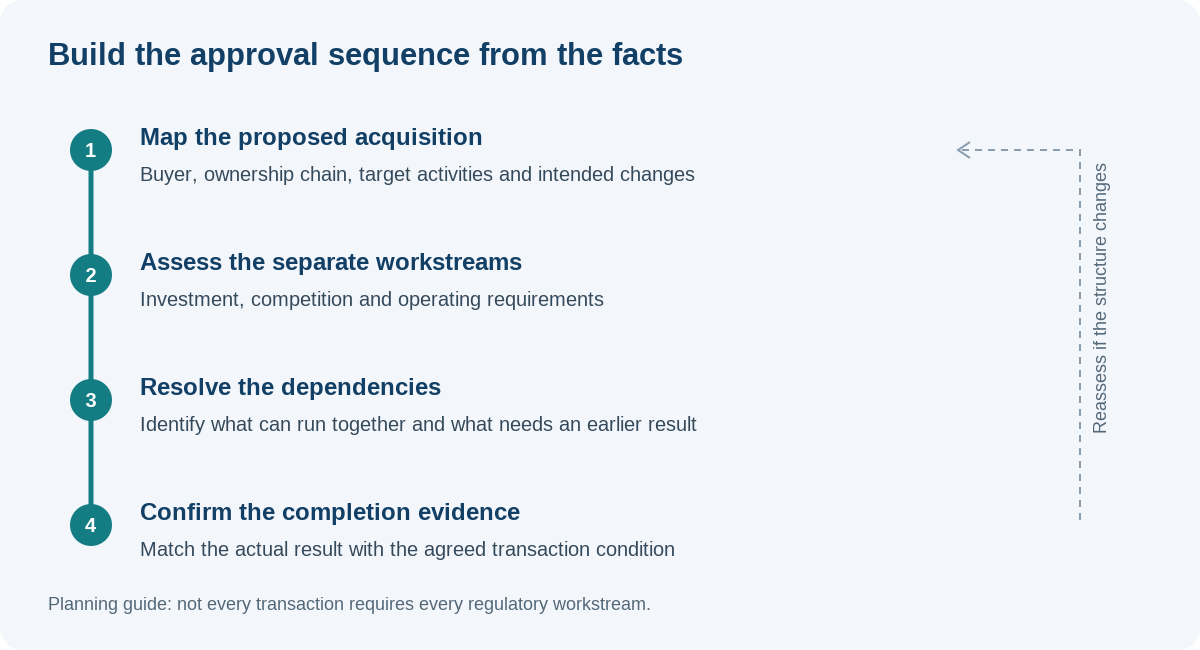
Regulatory approvals in M&A should be investigated before the parties commit to a completion date or assume that ownership can change immediately after signature. A transaction may involve investment screening, competition notification, sector requirements and changes to existing project or operating records. These are separate questions. The useful starting point is a map of the proposed acquisition, the businesses and assets involved, and the legal events that each authority is being asked to review.
Begin by describing the transaction accurately: who acquires what, through which entity, and with which resulting ownership and control arrangements. A purchase of existing shares differs from a subscription for new capital or a transfer of selected assets. Those differences can change the applicable procedures. Advisers need the intended structure and the relevant ownership chain, rather than only a headline price and the target's trading name.
Distinguish a substantive approval from a notification, a registration and an update to an existing record. An investment-related result does not automatically resolve competition requirements. An enterprise registration change does not necessarily replace an operating licence adjustment. The approvals map should state the purpose of each step, the responsible party and the event that it permits, so that the team can identify what must happen before completion and what follows afterwards.
Under Vietnam's Investment Law 143/2025/QH15, effective from March 2026, investment by capital contribution or purchase of shares or capital interests is distinguished from the procedure for obtaining an Investment Registration Certificate for a project. Certain foreign acquisitions require acquisition registration before changing members or shareholders. That is not a general rule that crossing an ownership threshold automatically requires a new IRC. Review the acquisition, the target's projects and any required record changes separately.
This distinction matters when instructions are prepared. A request to “obtain the investment certificate” may conceal several different tasks or identify the wrong task entirely. The team should explain which procedure applies to the actual proposal and why. Existing approvals and records should be collected early enough to check their content against the transaction, including whether a proposed change affects information already recorded for an investment project.
Regulatory approvals in M&A depend on the facts, including investor status, ownership changes and the activities being acquired. Review the business as operated, rather than assuming that the description in a brief company extract tells the whole story. Identify licensed activities, locations, relevant land interests and any unusual conditions in existing documents. These facts help determine which questions require investment or sector-specific analysis.
For a cross-border acquisition, obtain an ownership chart that shows the relevant investors and intermediate entities. Ask whether the target has activities or subsidiaries that require separate examination. A simple transaction at the top of a group may still have consequences lower down. Keep unresolved factual assumptions visible: a conclusion based on an incomplete business description should not be circulated as an unconditional confirmation that no filing is needed.
Competition notification has its own tests and information requirements. Vietnam changed several notification thresholds from July 2026 for transactions outside specified financial sectors. Reusing an older memorandum without checking the applicable date and category can therefore produce a wrong answer. The assessment should use the current rules, the relevant group information and the proposed transaction, rather than rely solely on the target's standalone turnover or the percentage of shares being purchased.
The commercial team should help identify products, services, customers and competing activities. Financial colleagues should explain the source and period of relevant figures. Legal advisers then assess the required notification analysis. Document the assumptions and retain supporting calculations even where the conclusion is that notification is not required. A clear record makes it easier to revisit the position if the structure, perimeter or available information changes.
A filing can require information held by the buyer, seller, target, subsidiaries or group finance teams. Different teams may use different entity names, accounting periods or activity descriptions. These inconsistencies create avoidable questions. Appoint a coordinator to maintain the factual record and confirm which version has been approved for use. Where translations are required, allow time to reconcile the translated wording with the source documents.
Missing information should have an owner and a consequence. “Awaiting documents” is too vague when the transaction timetable depends on them. Record the particular document or data set, the person obtaining it and whether its absence prevents a filing or affects an underlying conclusion. Escalate information that challenges the original structure rather than treating it as an administrative inconvenience to be resolved after signing.
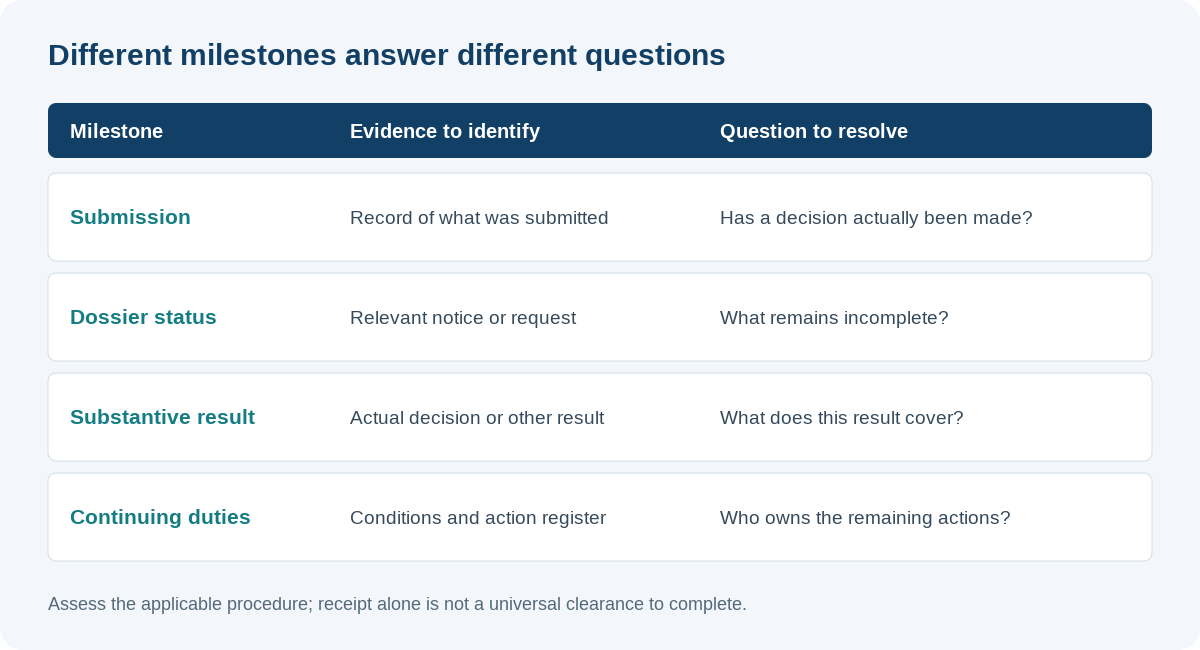
Transaction schedules often underestimate the work before a complete application can be submitted. They may also confuse acknowledgement of receipt with acceptance of a valid dossier or the substantive result. Track these milestones separately. Requests for clarification, supplementary information and related decisions can affect the practical schedule. Do not promise a completion date simply by adding a statutory review period to the day on which the first documents were sent.
Some workstreams can proceed together, while others depend on earlier results. The appropriate sequence must be established for the actual deal. A project-record adjustment may require information settled by the final transaction structure; a contractual completion condition may require a particular regulatory result. The coordinator should distinguish these dependencies from tasks that can begin immediately, so that the team does not postpone all preparation until the first approval arrives.
Suppose a buyer is considering an acquisition of a Vietnamese company operating a regulated service. Initial review identifies an investment-related procedure and a potential competition notification. The acquisition agreement treats those two results as the complete regulatory package. Later, the team discovers that an operating permission has conditions relevant to the proposed ownership or management arrangements. Neither of the earlier workstreams automatically answers that separate operating question.
The practical response is to assess the permission, confirm the proposed change and determine the required action. Depending on the facts, this may affect the structure, sequencing, cooperation duties or timetable. The parties should avoid describing the issue as solved merely because an application has been filed. Their completion checklist needs the particular evidence required by the agreed condition and the applicable legal process.
This example shows why regulatory approvals in M&A should be reviewed as connected workstreams with different legal purposes. A complete map helps the parties identify an overlooked dependency early enough to respond. It does not mean that every acquisition requires every type of approval, nor that every existing permission must be replaced. The assessment should remain proportionate to the actual business and change being proposed.
The contract should identify which results are conditions to completion and which party is responsible for pursuing them. It should address cooperation, access to information, communications with authorities and the handling of material requests. Where a proposed remedy or condition could affect the economics of the acquisition, decide who may accept it and what happens if the parties disagree. A general promise to “obtain all approvals” leaves too much unresolved.
Consider the relationship between the expected review process and the long-stop date. Extensions, termination rights and the allocation of relevant costs should reflect deliberate commercial choices. The agreement should also address permitted conduct while the parties await results. The parties should obtain advice before implementing changes that may constitute premature completion or otherwise breach applicable requirements. A contractual condition does not itself authorise the conduct that the law regulates.
Keep regulatory submissions consistent with the transaction documents and actual intentions. If negotiations change control rights, the asset perimeter or the buyer's structure, reassess the filing analysis and any submission already made. Establish a process for flagging such changes promptly. A version-controlled factual summary can prevent a revised agreement from silently diverging from the facts on which regulatory advice was based.
Regulatory approvals in M&A can improve decision-making when the work reveals restrictions or dependencies before the buyer commits significant resources. The parties can evaluate a different structure, gather evidence or reconsider timing with a clearer understanding of the available options. An organised process also helps financing and completion teams distinguish a genuine outstanding condition from a task that merely needs administrative follow-up.
Obtaining an applicable regulatory result addresses the matter within that result's scope. It should not be presented as proof that the target has no historical liabilities, that every contract is enforceable or that the business will perform as forecast. Those questions require their own investigation. The benefit is a more defensible and organised route to the transaction, with remaining risks identified rather than hidden behind a broad claim of legal certainty.
The wider guide to foreign investment procedures in Vietnam places an acquisition within the market-entry framework. A specific M&A assessment should then apply that context to the buyer, target, structure and intended completion sequence. General guidance is a starting point for organising the facts, rather than a substitute for that transaction-specific assessment.
When preparing an instruction for Jurion & Partners, include the ownership chart, business activities, existing permissions, proposed changes and intended timetable. Ask for a filing map that identifies the legal basis, required facts, responsible party and evidence of completion for each applicable step. This gives the team a practical document to maintain throughout negotiations.
>>> Read more: Foreigners Divorce in Vietnam
>>> Read more: Custody of children in divorce disputes
Regulatory approvals in M&A are best managed by identifying each applicable requirement, testing the facts behind it and connecting the result with the transaction sequence. Before authorising completion, confirm which decisions have actually been obtained, whether the implemented deal matches them and who owns the remaining actions. That discipline makes the benefits of compliance practical while keeping uncertainty and outstanding obligations visible.






Subscribe today to get more breaking news from Jurion Partners - Solicitors & Litigators

108 Tran Dinh Xu St., Cau Ong Lanh Ward, Ho Chi Minh City, Vietnam
(+8428) 66.701.709 - (+84) 903.419.479
contact@jurionpartners.com
Follow us
Accept payment





 English
 Tiếng Việt