Vietnam has recently become a potential market for foreign investors. Apart from preparing a good business strategy, to be able to carry on occupations in Vietnam, foreign investors also need to know how to carry out the procedures to make investment in V
Foreign investment in Vietnam requires a procedure map that reflects the investor, proposed activities and project. A new company, a share acquisition and a project carried out by an existing entity can raise different questions. The practical task is to identify the intended structure, assess the relevant conditions and prepare a consistent set of records. Starting with that analysis is more reliable than assuming that every investor follows the same sequence of applications.
The Law on Investment No. 143/2025/QH15 took effect on 1 March 2026, with its provisions concerning conditional business lines and the accompanying list taking effect on 1 July 2026. A project assessment must also consider applicable implementing provisions, sector rules and transitional issues. An older checklist based solely on the previous law may therefore describe a sequence that needs to be reassessed.
In particular, Article 19 allows foreign investors to establish an economic entity to implement a project before carrying out procedures for issuance or amendment of the investment certificate, subject to market access conditions at establishment. This does not remove the need to assess project procedures and operating requirements. The company and project workstreams should be mapped deliberately rather than treated as one interchangeable registration.
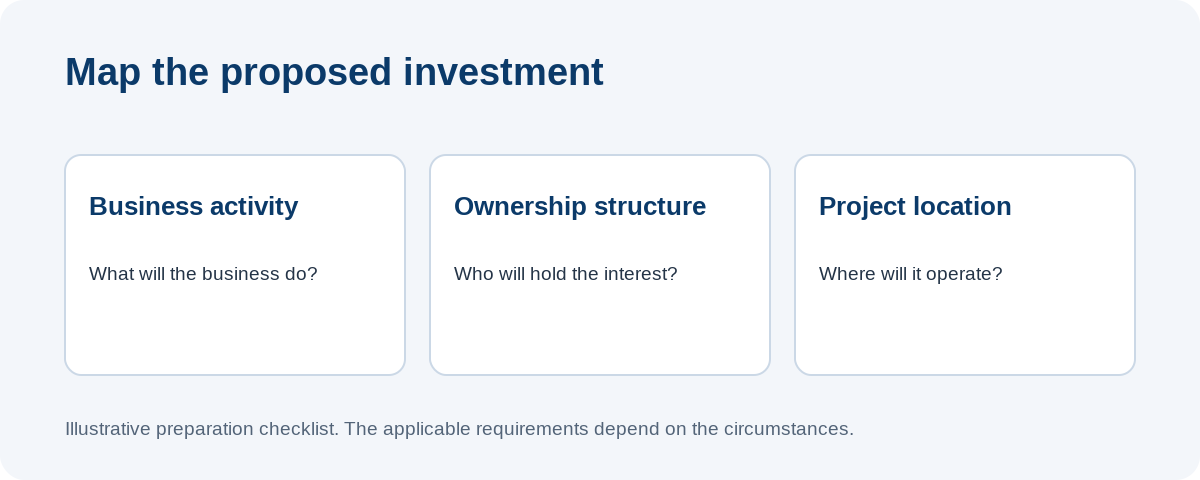
Describe the goods or services, customers, operating process and location in ordinary language. A broad business label may not show what the company will actually do. For example, a business involving software could provide development services, operate a platform or distribute products. Those activities may require different questions to be investigated, even if the commercial team groups them under one description.
For foreign investment in Vietnam, prepare a short activity matrix identifying each proposed activity, the entity that will perform it and the relevant customer or market. Include activities planned for a later phase where they affect the structure. This helps distinguish the immediate project from aspirations that have not yet become an implementation plan.
Determine who will make the investment and how ownership will be held. Collect reliable records of the investor's identity, existence and authority, together with an explanation of the ownership chain where relevant. Distinguish a direct investor from a parent group or a person acting under authorisation. The filing documents and commercial agreements should use a consistent account of the proposed participants.
The analysis should identify restrictions or conditions relevant to the proposed activities and investor. It should also distinguish entry questions from requirements for actually conducting the business. An ownership structure that is acceptable for establishment does not answer every question about licences or operating conditions. Record the source of each conclusion and the facts on which it depends.
A new entity can provide a structure built around the intended operation, but it also requires the investor to arrange the necessary resources and records. An acquisition or capital contribution involves an existing business with its own history and obligations. The choice should reflect the commercial objective, the target's position and the applicable legal requirements rather than the assumption that one route is always faster.
Foreign investment in Vietnam through an existing entity calls for due diligence on the subject of the transaction. Review ownership, authority, material agreements and relevant compliance questions. Identify whether the proposed transaction triggers a registration or approval requirement and how that affects the completion sequence. A contractual completion date should not ignore a regulatory dependency that has yet to be assessed.
Where the structure involves a project, prepare a coherent description of its objectives, scale, funding, location and implementation plan. The details should support one another. A proposed timetable may be unrealistic if the premises are not available or key equipment has not been sourced. A capital plan should identify the resources required rather than repeat an amount chosen without reference to the operation.
Collect the records needed to explain the investor's capacity and the project's practical assumptions. Identify documents that are available, those that need to be prepared and those that require further verification. A well-organised record allows advisers to assess the actual proposal and makes it easier to respond consistently when additional questions arise.
Consider whether the premises are suitable for the intended activities and which documents support their proposed use. The fact that a space is commercially available does not resolve every question about its legal suitability. Land, construction, environmental or other requirements may need assessment depending on the project. These issues should be investigated before the investor relies on an unconditional operating timetable.
Distinguish the proposed equity contribution from other funding and identify the assumptions behind each source. The legal and banking treatment needs its own assessment under the relevant framework. A promise that funds will be available is not the same as an agreed and documented financing arrangement. Keep the investment plan, corporate approvals and transaction documents consistent.
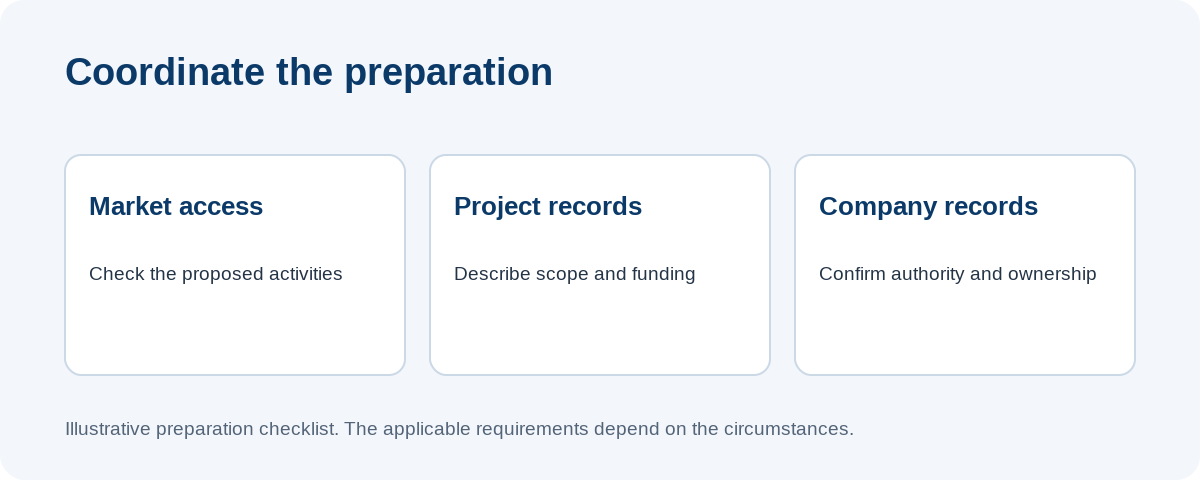
Foreign investment in Vietnam should be planned as a sequence of related decisions and filings. Identify which procedures apply, the relevant authority and the documents needed for each. Explain where one stage depends on another and whether any work can proceed in parallel. The map should be specific to the project and reviewed when its structure, location or activities change.
A useful project table records the procedure, supporting documents, responsible person, current status and next action. It should distinguish internal preparation time from any period associated with official processing. Missing records, translations or unresolved commercial decisions can affect the overall timetable. Avoid presenting a statutory period as a promise of the date on which the entire investment will be operational.
Investor records, authorisations, project descriptions and corporate documents should tell the same story. Check names, identification details, amounts and the capacity of the people signing. Identify which documents require translation or authentication under the applicable requirements. Do not assume that a document prepared for a different country or transaction can be reused without examination.
Control versions throughout the project. A change to the ownership structure may affect several records, while a change to the location can alter more than the address field. Assign responsibility for identifying those consequences. Keeping a change log helps prevent an earlier assumption from remaining in one document after the rest of the project has been updated.
The need for an investment registration certificate and the relevant process should be assessed against the project and investor structure. The certificate records the project information within its legal framework; it should not be treated as a general substitute for every permission needed to operate. A focused guide to the Vietnam Investment Registration Certificate explains the document preparation questions that arise within this wider investment plan.
Where a project already has investment records, review their current status and the proposed changes before deciding what procedure is required. An expansion, ownership change or revised activity may need a different analysis from an entirely new project. The starting point should be the operative documents and the actual change, not only the commercial name given to it.
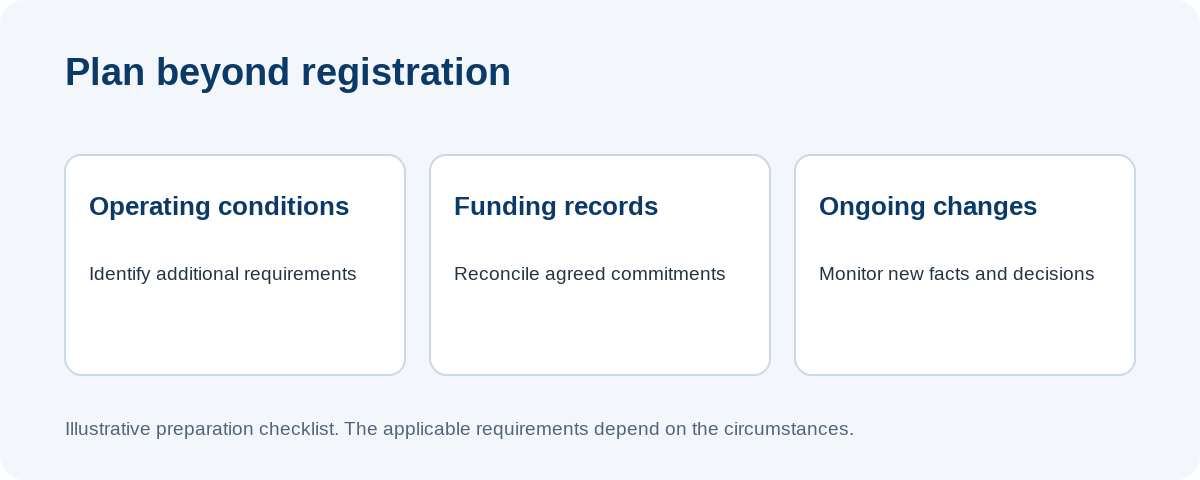
Foreign investment in Vietnam continues beyond initial registration. The team should identify the requirements relevant to starting operations, maintaining records and reporting changes. Tax, employment, banking and sector matters may require separate workstreams according to the activities. The purpose of the handover is to make those responsibilities visible and allocate them to people who will remain involved after the transaction team steps back.
Maintain a register of commitments, conditions and material project assumptions. If the operating plan changes, assess whether the records or procedures need updating before treating the change as routine. A business can avoid confusion by giving the operational team a clear summary of what has been approved, what remains outstanding and where specialist input is needed.
An investor discussing support with Jurion & Partners can begin with a description of the activities, proposed ownership, location and funding. The assignment can then identify the legal questions to assess and the records needed. Distinguish an initial feasibility review from document preparation, filings or continuing operational support so that the proposed scope is understandable.
Ask for the preparation output to identify material assumptions and unresolved dependencies. A practical procedure map should help management make decisions, allocate work and update the plan when facts change. It should not conceal uncertainty behind a fixed timetable or an assurance that all approvals will be obtained.
Define the operation, verify the structure and assemble the records before committing to a sequence copied from an older transaction. Review the applicable framework and connect each procedure to the facts it depends on. Well-planned foreign investment in Vietnam begins with a clear understanding of the business and continues through the responsibilities needed to operate it.





Subscribe today to get more breaking news from Jurion Partners - Solicitors & Litigators

108 Tran Dinh Xu St., Cau Ong Lanh Ward, Ho Chi Minh City, Vietnam
(+8428) 66.701.709 - (+84) 903.419.479
contact@jurionpartners.com
Follow us
Accept payment





 English
 Tiếng Việt