A practical filing guide covering the current IRC procedure, paper and electronic records, clarification notices, consideration periods and the handover after issuance.
The IRC registration procedure in Vietnam should begin with a defined project and a confirmed filing route. An Investment Registration Certificate, commonly called an IRC, is not required for every investment transaction, and receiving an application is not the same as approving it. Once the relevant procedure has been identified, the practical work is to assemble a consistent dossier, submit it to the competent authority, respond accurately to any notice and check the result before the project moves forward.
Start by identifying the investor, proposed activity, project location and investment structure. The Law on Investment 143/2025/QH15 distinguishes projects requiring an IRC from other projects and investment forms. A capital contribution or share acquisition should not automatically be placed in the same application category as a new investment project. If an existing company will implement the project, its legal status and existing project records also need examination.
Next determine whether investment policy approval or an investor-selection step is required. A procedure for a project outside policy approval differs from the IRC stage for a project already approved through the applicable process. This classification affects the dossier, the issuing authority's task and the consideration period. An application cannot be made accurate simply by adding more documents to the wrong procedural category.
Record the conclusion in a short filing brief. It should identify the procedure, the applicant, the project, the competent authority and the basis for the chosen route. List any decision that must occur first. This gives the people preparing the documents a common instruction and helps prevent the proposal from drifting into a different project during drafting.
For the ordinary route outside investment policy approval, Article 39 of Decree 96/2026/ND-CP refers to the document content in Article 32(1). Relevant categories include the request to implement the project, investor legal-status records, financial-capacity evidence, the project proposal and the applicable location and other supporting documents. Some requirements depend on the project rather than applying identically to every investor.
Use a checklist that explains the purpose of each item and identifies who will supply it. Separate documents already available from records that need certification, translation or a commercial decision. If a technology explanation, business cooperation contract or other conditional item is relevant, identify why it is included. If it is not relevant, do not manufacture one merely because a generic checklist mentions it.
Use the legal identity of the investor making the application. An overseas group name in a presentation may be different from the entity contributing capital. Check the registration record, legal representative and authority of anyone signing or acting for the applicant. Reconcile names and addresses across the request, proposal, funding evidence and supporting documents before arranging final signatures.
The proposal should explain the project objectives, scale, location, capital, funding approach and implementation plan, together with other required matters. If the project relies on leased premises, check the records supporting the right to use them and the suitability of the proposed use. A lease describing an office should not be treated as evidence for an unrelated manufacturing operation without further assessment.
Financial capacity can be supported through the alternatives in the decree, including relevant financial statements, funding commitments, guarantees or other evidence. Article 6 also addresses the treatment of financial statements and commitments, subject to other applicable law. Do not impose a blanket audit requirement based on an old checklist. Explain how the evidence relates to the applicant and the proposed project budget.
Use the current form applicable to the selected procedure and verify the receiving authority's published instructions. A request for an IRC for a defined approved-project category is not necessarily the same document package as a request to implement a new project outside policy approval. The published procedure should be read together with the underlying law and decree.
Before submission, freeze a reviewed version of the dossier. Check names, amounts, currencies, dates, activities and signing capacities. Keep a document index and identify any item supplied through legally available database information instead of a separate copy. A spreadsheet may help manage preparation, but it does not replace the required application documents or the evidence they must contain.
The current Investment Law identifies relevant zone management boards and Departments of Finance, with particular rules for projects involving different locations or zone arrangements. Confirm the authority for the actual project. Copying the former Department of Planning and Investment designation into a current application can create confusion about where the filing belongs.
Decree 96 permits direct or public postal submission and provides for online submission where the relevant information system meets the operating requirements. Check the available channel and the rules for the specific procedure before sending the file. Keep the submission receipt, case reference and a copy of the package actually submitted; a draft retained internally may differ from the final filing.
Article 6 addresses electronic copies accompanying investment administrative procedures and the relevant digital-signature requirements, including a specified exception for certain pre-establishment foreign-investor project situations. Assess the applicable case rather than assuming that a scanned signature or an ordinary email always completes the required electronic filing.
The investor is responsible for the consistency and completeness of paper and electronic records. The decree provides that the paper content has final legal value where the two differ. This is a reason to reconcile both versions carefully, not a reason to disregard the electronic record. Check signed pages, attachments and revised figures after conversion or upload.
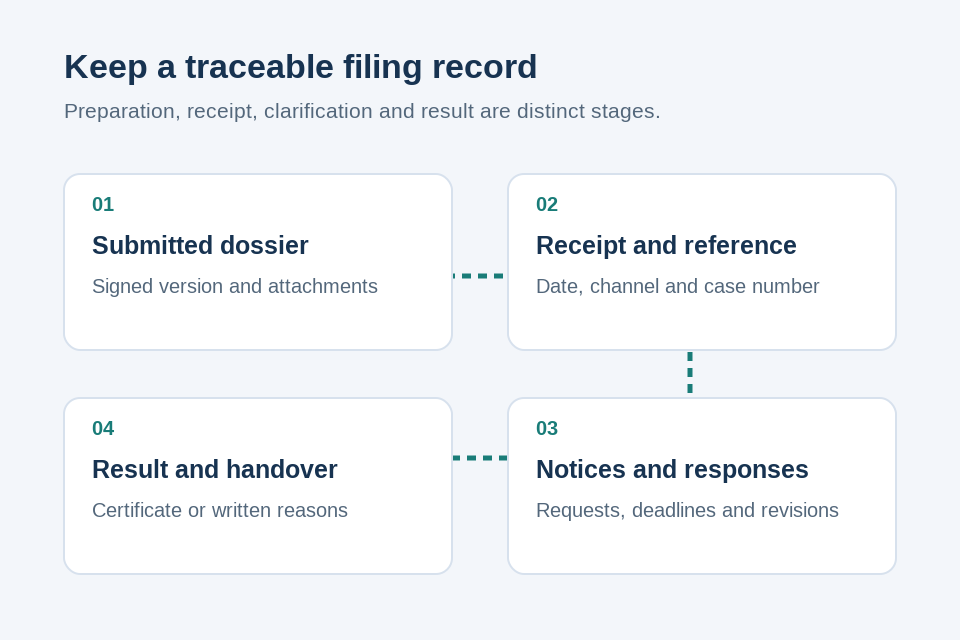
The receiving authority checks the dossier's validity and may address the relevant substantive conditions. Article 6 states that it must not require documents outside the dossier prescribed by the law and decree. Where a request appears unclear, identify the stated legal basis and respond through the appropriate channel. Avoid treating an informal conversation as a substitute for the official written record.
For the ordinary Article 39 route, the decree provides a 10-working-day consideration period from receipt of a valid dossier, subject to the relevant conditions. Article 38 provides different periods for specified situations, including five-working-day branches. The correct timetable depends on the route and trigger; it is not measured automatically from the first email sent to an adviser.
Document preparation, completion of earlier approvals and the applicant's response time should be tracked separately. Under Article 6, the applicant's time for amendments, supplementation or explanations, and specified administrative-violation handling time, is excluded from the procedural consideration period. A realistic timetable explains these distinctions rather than offering an unconditional completion date.
Decree 96 requires a written supplementation notice identifying the basis, content and deadline for the required changes. Its provisions address a notice covering the matters to be amended or supplemented for each dossier, while requests for explanation are also regulated. Read the actual notice before deciding what to change. Missing a response deadline can lead to written notification that processing has stopped.
Prepare a response table connecting each request with the answer and supporting document. If a response changes the location, capital or activity, review the rest of the file for consequences. Obtain the investor's approval for material changes. An adviser should not reduce project scale or alter a business objective merely because it is convenient for the next submission.
For example, a request to clarify the premises may reveal that the landlord's records cover a different unit from the proposed lease. Resolve that factual inconsistency and update the affected documents. Repeating the same address in another letter without addressing the underlying record does not make the dossier coherent.
These are different outcomes of the IRC registration procedure. If the authority refuses issuance or stops processing in the circumstances provided by the decree, it must give written notification and reasons. Review the stated basis, the application's history and the available response or review options. Do not assume that silence grants approval or that every refusal can be cured by resubmitting the same documents unchanged.
When an IRC is issued, compare it with the accepted project record. Check the investor, project details, location, capital and timetable, and retain its project code with the file. Article 40 provides for a unique project code generated through the national investment information system. Keep that identifier distinct from the company's enterprise registration information.
The conclusion of the IRC registration procedure does not mean that every business requirement is complete. Identify any remaining company registration, sector licensing, land, construction, employment or other obligation. If the company-first route was used, check the applicable investment-registration obligations and restrictions rather than assuming that the ERC alone permitted project implementation while the IRC was pending.
The wider guide to procedures for foreign investment in Vietnam explains the relationship between the different workstreams. Use that framework to allocate the remaining tasks and to assess later changes before the business departs from the project recorded in its documents.
>>> Read more: Foreigners Divorce in Vietnam
>>> Read more: Custody of children in divorce disputes
When discussing a filing with Jurion & Partners, provide the project brief, current documents and any notice already received. State whether the immediate need is classification, preparation, supplementation or review of a result. This helps define the work and prevents an existing procedural issue from being mistaken for a completely new application.
A controlled IRC registration procedure connects the legal route with an accurate dossier and a traceable submission record. Confirm the project and authority, reconcile the documents, respond to written requests and check the issued result. Those practical steps give the investor a clearer record of what was requested, what was accepted and what remains to be completed before implementation.





Subscribe today to get more breaking news from Jurion Partners - Solicitors & Litigators

108 Tran Dinh Xu St., Cau Ong Lanh Ward, Ho Chi Minh City, Vietnam
(+8428) 66.701.709 - (+84) 903.419.479
contact@jurionpartners.com
Follow us
Accept payment





 English
 Tiếng Việt